• Research
  • Emissary
  • About
  • Experts
Carnegie Global logoCarnegie lettermark logo
DemocracyIran
  • Donate
{
  "authors": [],
  "type": "other",
  "centerAffiliationAll": "",
  "centers": [
    "Carnegie Endowment for International Peace"
  ],
  "collections": [],
  "englishNewsletterAll": "",
  "nonEnglishNewsletterAll": "",
  "primaryCenter": "Carnegie Endowment for International Peace",
  "programAffiliation": "",
  "programs": [],
  "projects": [],
  "regions": [
    "North Africa",
    "Egypt"
  ],
  "topics": []
}
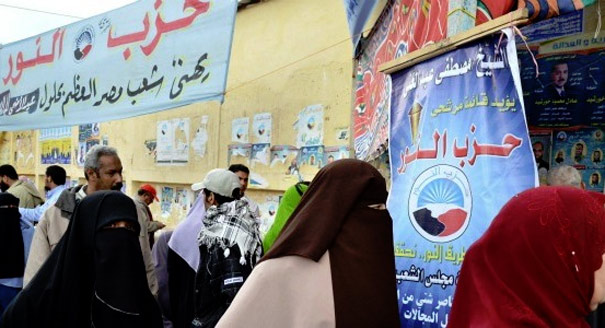
Source: Getty

Other

Nour Party

A backgrounder on the Nour Party.

Link Copied
Published on Sep 21, 2011

This resource was published on 09/21/2011 and is not updated to reflect changing circumstances.

Al-Nour is a Salafi political party founded after the January 2011 uprising. It was originally a member of the Democratic Alliance, but left the alliance in September 2011, becoming the founding member and largest party in the Islamist Alliance.

Major Party Figures

Younes Makhioun: President

Background

Al-Nour was founded in 2011 following the January 2011 uprising. It was the first Salafi political organization to submit a request to be recognized as an official political party. The party’s former president, Emad ad-Din Abd al-Ghofour, made the request in May 2011 as the representative of the party’s founders, and al-Nour was granted official status on June 12, 2011. The party advocates gradual reform under the slogan: “The only reform we desire is the reform we can achieve.”  This slogan is based on a view of the principles of Islam as a comprehensive framework for religion and state.

Platform

Political Issues

  • Supporting Article 2 of the Egyptian Constitution which states that Islam is the religion of the state and the Islamic law is the main source of legislation
  • Preserving fundamental rights and public freedoms in the framework of Islamic law
  • Calling for Islamic law to serve as the guiding  principles for all political, social and economic issues
  • Supporting separation between the legislative, judicial and executive powers and independence of the judiciary

Socioeconomic Issues

  • Preserving the right to private property and free economic competition as long as it does not harm the interests of society
  • Reducing  unemployment through state provision of jobs
  • Recognizing health care as a basic human right
  • Calling for the complete independence of al-Azhar from the government and restoration of its prominent role throughout the Islamic world
  • Improving education and establishing training programs throughout Egypt
  • Advocating for a greater state role in the institutions of Zakat and Waqf
  • Supporting religious freedom for the Copts and separate personal status laws for non-Muslims

Foreign Policy Issues

  • Founding foreign relations on a basis of mutual respect and equality
  • Supporting a greater role for Egypt in the Arab and Islamic worlds as well as among the Nile Basin countries, particularly Sudan
North AfricaEgypt

Carnegie does not take institutional positions on public policy issues; the views represented herein are those of the author(s) and do not necessarily reflect the views of Carnegie, its staff, or its trustees.
More Work from Carnegie Endowment for International Peace

  • A Black man pulls a trolley. He is small in the bottom center of the frame; in the background are stacks of large, colorful shipping containers and the parts of a large crane or similar piece of equipment.
    Article
    Africa’s Global Economic Edge: Advancing Strategic Sectors

    In key sectors such as critical minerals, specialty agriculture, and fintech, Africa can become a global powerhouse by investing more in manufacturing, value-add, and scaling.

      • Kholofelo Kugler

      Kholofelo Kugler, Georgia Schaefer-Brown

  • Article
    Kenya’s Health Deal Is a Stress Test for the America First Global Health Strategy

    U.S. agreements must contend with national data protection laws to make durable foreign policy instruments.

      • A Black woman with long hair wears a black blazer

      Jane Munga, Rose Mosero

  • Teenagers hold a large banner reading "stop pollution in Gabes, stop pollution everywhere, save Gabes'' in English and Arabic
    Article
    Civil Society Restrictions in North Africa: The Impact on Climate-Focused Civil Society Organizations

    For climate-focused civil society in countries like Morocco, Algeria, and Tunisia to be most effective, organizations should work together to develop networks that extend their reach beyond their local area and connect across borders to share best practices and amplify each other’s work.

      • Sarah Yerkes

      Sarah Yerkes

  • Commentary
    Diwan
    When Football Is More Than Football

    The recent African Cup of Nations tournament in Morocco touched on issues that largely transcended the sport.

      Issam Kayssi, Yasmine Zarhloule

  • Research
    Russia in Africa: Examining Moscow’s Influence and Its Limits

    As Moscow looks for opportunities to build inroads on the continent, governments in West and Southern Africa are identifying new ways to promote their goals—and facing new risks.

      • Nate Reynolds
      • +1

      Nate Reynolds, ed., Frances Z. Brown, ed., Frederic Wehrey, ed., …

Get more news and analysis from
Carnegie Endowment for International Peace
Carnegie global logo, stacked
1779 Massachusetts Avenue NWWashington, DC, 20036-2103Phone: 202 483 7600Fax: 202 483 1840
  • Research
  • Emissary
  • About
  • Experts
  • Donate
  • Programs
  • Events
  • Blogs
  • Podcasts
  • Contact
  • Annual Reports
  • Careers
  • Privacy
  • For Media
  • Government Resources
Get more news and analysis from
Carnegie Endowment for International Peace
© 2026 Carnegie Endowment for International Peace. All rights reserved.