

In The Media
Lahcen Achy
{
  "authors": [
    "Lahcen Achy"
  ],
  "type": "legacyinthemedia",
  "centerAffiliationAll": "",
  "centers": [
    "Carnegie Endowment for International Peace",
    "Malcolm H. Kerr Carnegie Middle East Center"
  ],
  "collections": [],
  "englishNewsletterAll": "",
  "nonEnglishNewsletterAll": "",
  "primaryCenter": "Malcolm H. Kerr Carnegie Middle East Center",
  "programAffiliation": "",
  "programs": [],
  "projects": [],
  "regions": [
    "Maghreb"
  ],
  "topics": [
    "Economy"
  ]
}
Source: Getty
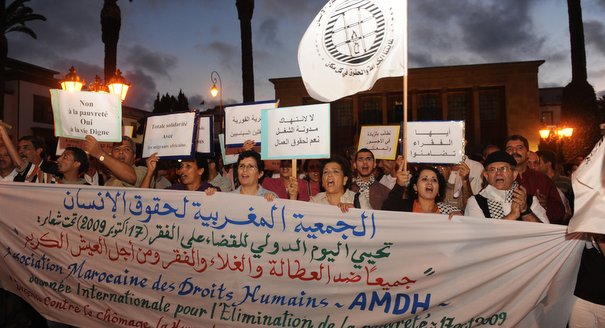
The worsening budget deficit in Morocco comes at a time of scarce liquidity in local banks and public dissatisfaction with the process of privatisation.
Source: National

The Moroccan government - in an attempt to preserve social peace and avoid any escalation in the protest movement sparked by the Arab Spring - increased civil servants' wages by about $70 (Dh260) a month, announced plans to hire more than 4,000 unemployed college graduates and doubled subsidies to preserve the price stability of fuel and basic consumer goods whose prices have risen considerably on the world market.
The worsening of the budget deficit in Morocco comes at a time of scarce liquidity in local banks and public dissatisfaction with the privatisation process, which has played a key role in the country's economy over the last few years by allowing the sale of public assets to keep pace with high public spending. The high interest rates on loans in international financial markets, due to the sovereign debt crisis and the repercussions of the Arab Spring, have seriously reduced the government's margin for manoeuvre.
The postponement of the budget law's approval ahead of critical legislative elections scheduled for the end of November reveals Morocco's vulnerability to structural imbalances. The country needs frank and transparent dialogue among the various stakeholders to come up with a social contract that ensures stability and balances current social demands and future economic growth goals. This requires an ambitious, yet realistic development strategy whose implementation may take years.
Policymakers need to focus on three structural distortions. First, Morocco suffers from a large trade deficit: it imports almost twice as much as it exports. This situation reflects the inability of Moroccan producers to compete globally and the inefficiency of economic policies that have failed to develop the local industrial sector and bolster its potential to compete in foreign markets. Morocco has grown accustomed to covering its increasing trade deficit with income from the tourism industry and remittances from emigrants, but these will both pose a challenge for the Moroccan economy over the coming years.
Despite their high resilience during the past decade, the long-term sustainability of remittances should not be taken for granted. New waves of emigrants are critical to support the continued growth of remittances. But policy barriers to Moroccans' traditional destinations have been increasing. The inability, so far, of the European Union's member states to develop a common migration policy has seriously impeded legal migration flows to Europe.
The ageing of former emigrants and the migration of entire families tend to cause a decline in remittances. New generations, born abroad, continue to remit, but less so than their parents' generation. Most of them have acquired the citizenship of their host countries and have different consumption and remitting habits.
More educated emigrants also tend to remit less and instead use their savings to invest in real estate in their country of residence.
And in the current climate, Europe's slow economic growth, high unemployment and austerity measures to reduce public deficits are likely to affect remittances negatively.
Morocco faces a second structural distortion because it will not be able to build a strong and competitive economy without a skilled and well-trained labour force. The government needs to allocate more human and financial resources to its adult literacy strategy to increase its efficiency and extend its coverage. Policymakers need to remove barriers to participation in literacy programmes and adapt their content and time schedules to fit the needs and desires of recipients.
The third structural weakness is that despite Morocco's efforts over the past decade, poverty rates have remained persistently high, particularly in rural zones, and inequality has been on an upwards trend. The poorest 10 per cent of the population accounts for 2.7 per cent of total consumption. At the other extreme, the richest 10 per cent makes up one-third of total consumption.
Consumption and income inequality are only part of the story, as inequality of ownership is even worse. Data on the distribution of agricultural land indicate that 5 per cent of farmers own one-third of all land.
Policymakers need to reinforce public redistribution policies to reduce inequality among individuals and territories. They should fight tax evasion, implement a more progressive taxation system and increase taxes on property and wealth. They also need to cancel full tax exemptions that benefit the entire agricultural sector, regardless of the size of a particular business and the income it generates. This exemption, which has been in force since the mid-1980s, is socially unfair and economically inefficient.
The next government, which will enjoy greater powers under the new constitution, should establish its priorities to ensure a balance between immediate popular demands and the requirements for economic growth based on human capital and the stimulation of investment, and to establish an equitable tax system to ensure a sustainable social peace.
Former Nonresident Senior Associate, Middle East Center
Achy is an economist with expertise in development, institutional economics, trade, and labor and a focus on the Middle East and North Africa.
Recent Work
Lahcen Achy
Lahcen Achy

Rubio’s recent visit brought welcome attention, but more capital requires governance changes that may be a hard sell for regional governments.

Jennifer B. Murtazashvili

China has showcased its engineering prowess with small modular reactor demonstration projects. But turning these technological achievements into commercial success will be a greater challenge.

Tong Zhao

Despite public disputes over trade and immigration, the strategic partnership’s foundations remain sturdy.

Sameer Lalwani

With its public finances in shambles, the far right polling at 35 percent ahead of the 2027 presidential election, and a growing protest movement, is France’s crisis a threat to the EU’s geopolitical awakening?

Rym Momtaz, ed.

Russian strikes are weakening the economy sustaining Ukraine’s war effort. Closing the growing funding gap will require more European support and politically contentious reforms in Kyiv.

Balázs Jarábik