

Paper
James M. Acton, Ankit Panda
{
  "authors": [
    "James M. Acton"
  ],
  "type": "legacyinthemedia",
  "centerAffiliationAll": "dc",
  "centers": [
    "Carnegie Endowment for International Peace"
  ],
  "collections": [
    "U.S. Nuclear Policy",
    "Korean Peninsula"
  ],
  "englishNewsletterAll": "ctw",
  "nonEnglishNewsletterAll": "",
  "primaryCenter": "Carnegie Endowment for International Peace",
  "programAffiliation": "NPP",
  "programs": [
    "Nuclear Policy"
  ],
  "projects": [],
  "regions": [
    "North America",
    "United States",
    "East Asia",
    "South Korea",
    "North Korea"
  ],
  "topics": [
    "Security",
    "Nuclear Policy"
  ]
}
Source: Getty
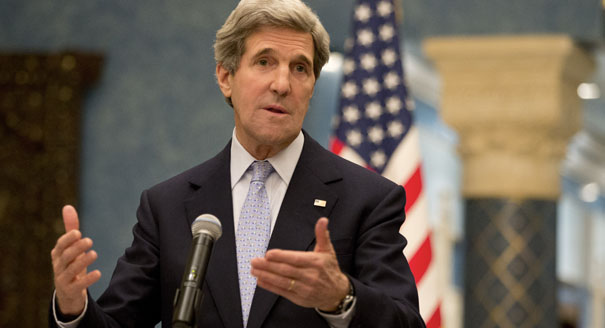
U.S. Secretary of State John Kerry has used strong words against North Korea after the country threatened to attack the United States.
Source: Al Jazeera
U.S. Secretary of State John Kerry has used strong words against North Korea after the country threatened to attack the United States. Carnegie's James Acton talks to Al Jazeera about the latest tensions between North Korea and the United States.
"We've heard yet another provocative announcement from North Korea. The irony is that this is not even the most provocative announcement to have come out of North Korea in the past few days," said Acton, adding, "threatening to build more nuclear weapons is actually not as provocative as threatening to use them against the United States, South Korea, or anyone else."
"But make no mistake," said Acton, "this is a dangerous and volatile situation on the Korean Peninsula; the South Korean government is worried, the United States government is worried, and they have good reasons to be." Acton said that he does not think that North Korea will use a nuclear weapon out of the blue, but rather that Pyongyang will commit another provocation.
"I don't think that North Korea wants a war," said Acton, "the question is whether it miscalculates, the question is whether it thinks it can get away with provoking South Korea via military force and assume that it will not be hit back.

Jessica T. Mathews Chair, Co-director, Nuclear Policy Program
Acton holds the Jessica T. Mathews Chair and is co-director of the Nuclear Policy Program at the Carnegie Endowment for International Peace.
Recent Work

James M. Acton, Ankit Panda
James M. Acton
Carnegie does not take institutional positions on public policy issues; the views represented herein are those of the author(s) and do not necessarily reflect the views of Carnegie, its staff, or its trustees.
The real test may come after the leaders leave the room.



Sheena Chestnut Greitens, Oriana Skylar Mastro, Yukon Huang, …

The Horn of Africa countries are among those facing a new security calculus.


Andrew Leber, Lesley Anne Warner

The European far right might fail to steer EU policy in the direction Russia wants, but they will create enough chaos inside Europe to benefit the Kremlin.

Dimitar Bechev

The new U.S.–Denmark–Greenland agreement will help Washington exert political, economic, and financial dominance under the guise of security. Yet, it acknowledged Copenhagen’s and Nuuk’s sovereignty on the island.

Marc Pierini

The nuclear relationship between China and the United States is increasingly shaped by widening perception gaps rather than deliberate strategic design.

Tong Zhao