

Research
- +10
Rosa Balfour, Frances Z. Brown, Yasmine Farouk, …
{
  "authors": [
    "Moisés Naím"
  ],
  "type": "legacyinthemedia",
  "centerAffiliationAll": "",
  "centers": [
    "Carnegie Endowment for International Peace"
  ],
  "collections": [],
  "englishNewsletterAll": "",
  "nonEnglishNewsletterAll": "",
  "primaryCenter": "Carnegie Endowment for International Peace",
  "programAffiliation": "",
  "programs": [],
  "projects": [],
  "regions": [
    "North America",
    "South America"
  ],
  "topics": [
    "Political Reform",
    "Democracy"
  ]
}
Source: Getty
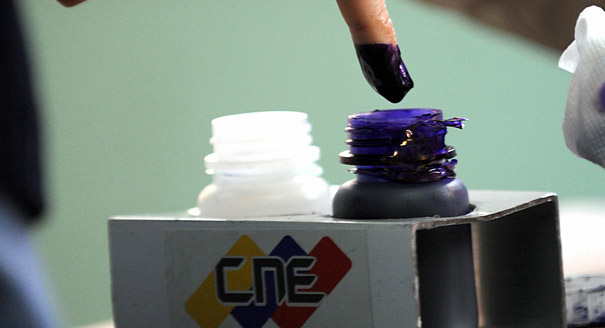
The Venezuelan presidential election produced a posthumous win for Chavez, but although his successor Nicolas Maduro was deemed the winner of the election, the results have not gone uncontested.
Source: Financial Times
Scene 1. Carmen felt both exhausted and thrilled. Exhausted because her 78 years made the 15-hour bus ride too long. And thrilled because she had voted in Venezuela’s presidential election. To do so, she had to travel from Miami to New Orleans, the nearest place where Venezuelans living in South Florida could vote. The long journey was caused by President Hugo Chávez’ decision to close his country’s consulate in Miami. So the 20,000 Venezuelans who live there (most of whom are not Chávez supporters) had to choose between not voting or going to New Orleans. Thousands travelled on buses, cars or aircraft. They voted in the October presidential elections and – after Chávez’ death in March – again in the snap election on April 14 to elect his successor. Television channels in New Orleans broadcast surprising, and very moving, images of young people, couples with babies and elderly voters barely able to walk doing what was necessary just to be able to cast their ballot.
Scene 2. William Dávila is a deputy to the National Assembly of Venezuela and belongs to the minority that is not controlled by the government. In the 2010 elections, the opposition won a majority (52 per cent) of the votes but the government changed the rules and, despite receiving fewer votes, won the largest number of members, ensuring the continuity of its control of the legislative body. During the 14 years of Chávez’ presidency the assembly never voted against his initiatives and often authorised absolute powers that allowed him to rule by decree, without consultation or scrutiny. On April 16, Mr Dávila was speaking in the assembly when he was approached by several members of the assembly suspected to be from the ruling party, who beat him up and cut his face, leaving a gash that required stitches.Scene 3. During the recent presidential election campaign, Nicolás Maduro, the acting president and the person anointed by Chávez as his heir benefited from a constant presence in the media, while the visibility and messages of opposition candidate Henrique Capriles were severely limited by the government. One of the most emphatic television messages of support for Mr Maduro was that of Luiz Inácio Lula da Silva, the former president of Brazil. After stating that it was wrong to interfere in the internal affairs of another country, Mr Lula da Silva went on to explain why Mr Maduro should be the next president. Dilma Rousseff, Brazil’s current leader, immediately recognised Mr Maduro’s victory, despite the fact that both the opposition and several countries, including the US, demanded a recount, citing evidence of irregularities.
Scene 4. In April, 600,000 people who in last October’s election had voted for Chávez changed their minds and voted against the dead president’s candidate. But not everywhere. In Rio Chiquito, a town in the western state of Yaracuy, Mr Maduro obtained 943 per cent more votes than Chávez did in October. In La Azulita, in the state of Mérida – also in the west of the country – Mr Maduro’s margin over Chávez was 530 per cent. In Punta Piedras in the island state of Nueva Esparta, it was 493 per cent. In other places, such as Machiques in state of Zulia (again in the west), 100 per cent of the votes were for the government candidate.
Scene 5. Leonel Cabeza is the director of the regional sports institute in Zulia. After the elections, he summoned all the workers of this public institution to an urgent meeting. He was outraged. The director explained that he knew exactly which of them had voted for the opposition candidate and who had not complied with the requirement to marshal votes for Mr Maduro by taking family, friends and neighbours to the polls. They were fired, he said. “You can go to court to complain; sue me. I do not care. I am throwing you out!”
Scene 6. Lieutenant Diosdado Cabello participated in the military coup of 1992 led by Chávez. Later, thanks to Chávez’ political success, Lt Cabello held many top positions in the government. He now serves as the president of the National Assembly. The day after the election, when an opposition deputy raised his hand wanting to speak, Lt Cabello asked: “Do you agree that Nicolas Maduro is the legitimately-elected president?” The deputy tried to answer, but Cabello interrupted him: “Tell me, yes or no? I’m not going to give the floor to any deputy that does not accept that Maduro is the legitimate president of this country.”
Scene 7. International pressure has forced the government to accept an audit of the recent vote. But Tibisay Lucena, head of the National Electoral Council, has been quick to urge Venezuelans “not to hold false expectations, as the audit’s only purpose is to demonstrate that the technology platform works perfectly and the results are a true reflection of the will of the voters”.
This article was originally published in the Financial Times

Distinguished Fellow
Moisés Naím is a distinguished fellow at the Carnegie Endowment for International Peace, a best-selling author, and an internationally syndicated columnist.
Recent Work



Rosa Balfour, Frances Z. Brown, Yasmine Farouk, …
Moisés Naím
Carnegie does not take institutional positions on public policy issues; the views represented herein are those of the author(s) and do not necessarily reflect the views of Carnegie, its staff, or its trustees.

If the Russian-speaking community in Latvia cannot articulate their interests without being seen as disloyal, they could end up embracing a pro-Kremlin agenda.

Sergejs Potapkins

Russia’s ruling party would have benefited from Putin appearing as its distant patron, but as an active frontman imposing his views on the public, he has done nothing but harm both the party’s election campaign and the ruling system overall.

Andrey Pertsev
Despite myriad challenges and occasional stumbles, the new Hungarian government is moving ahead with energy and conviction to uproot years of illiberalism and corruption and rebuild Hungarian democracy.

Thomas Carothers

Radical-right parties are expected to do well in upcoming elections in four of the EU's biggest member states. If successful, they could prevent the union from addressing key challenges ahead.

Stefan Lehne
By abandoning past U.S. pro-democracy policies and adopting several lines of pro-autocratic action, the Trump administration has fundamentally repositioned the United States vis-à-vis democracy in the world.
Thomas Carothers