

Article
Wang Tao
{
  "authors": [
    "Wang Tao"
  ],
  "type": "legacyinthemedia",
  "centerAffiliationAll": "",
  "centers": [
    "Carnegie Endowment for International Peace",
    "Carnegie China"
  ],
  "collections": [],
  "englishNewsletterAll": "",
  "nonEnglishNewsletterAll": "",
  "primaryCenter": "Carnegie China",
  "programAffiliation": "",
  "programs": [],
  "projects": [],
  "regions": [
    "East Asia",
    "China"
  ],
  "topics": [
    "Climate Change"
  ]
}
Source: Getty
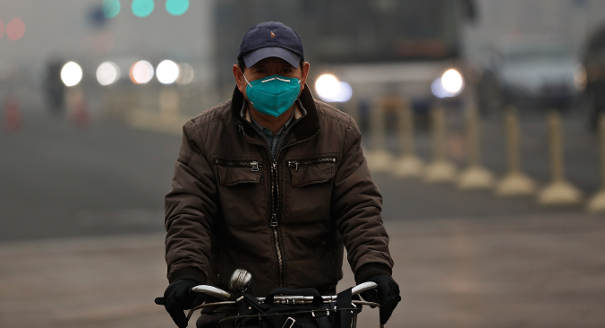
Stricter enforcement of higher emissions standards and investment in renewable energy sources are necessary to solve the long-term problem of air pollution in China’s capital.
Source: CCTV News
Acting quickly against the high levels of smog, the Beijing government called on a number of industrial plants to close or reduce their production. Carnegie-Tsinghua’s Wang Tao appeared on CCTV News to discuss these regulations and their effectiveness in combating air pollution. Wang suggested that authorities need to establish stricter standards and more diligently enforce these regulations by shutting down factories that fall short of the standards, adding that poorly implemented regulations decreased the efficacy of such policy measures.
Wang also discussed the importance of improving China’s coal power infrastructure in order to reduce pollutants. Citing Germany as an example of a coal-dependent nation with good air quality, Wang explained that improved technology and equipment could lead to cleaner coal energy and fewer emissions. In the long term, China will need to shift toward natural gas, which is more efficient and much cleaner than coal. However, he cautioned against the use of synthetic coal-to-gas, which actually emits more pollutants than coal alone.
Former Nonresident Scholar, Carnegie-Tsinghua Center for Global Policy
Wang Tao was a nonresident scholar in the Energy and Climate Program based at the Carnegie–Tsinghua Center for Global Policy.
Recent Work
Wang Tao
Wang Tao, Yang Yifang
Carnegie does not take institutional positions on public policy issues; the views represented herein are those of the author(s) and do not necessarily reflect the views of Carnegie, its staff, or its trustees.

The Plaza Accord was not an externally imposed punishment of Japan but part of a broader restructuring that Japanese economists and policymakers themselves recognized was necessary. Its effects were undermined, however, when Tokyo responded to the resulting slowdown with policies that exacerbated investment, credit expansion, and the very imbalances the adjustment was intended to resolve.

Michael Pettis

The real test may come after the leaders leave the room.



Sheena Chestnut Greitens, Oriana Skylar Mastro, Yukon Huang, …

The nuclear relationship between China and the United States is increasingly shaped by widening perception gaps rather than deliberate strategic design.

Tong Zhao
Why governance of rapidly evolving technology will be distributed and complex.


Stewart Patrick, Scott Singer

It should address the shortcomings of previous crisis communication efforts and adapt to the demands of frontier AI.

Lucy Luo