

Commentary
Judy Dempsey
{
  "authors": [
    "Judy Dempsey"
  ],
  "type": "legacyinthemedia",
  "centerAffiliationAll": "dc",
  "centers": [
    "Carnegie Endowment for International Peace",
    "Carnegie Europe"
  ],
  "collections": [
    "Europe’s Eastern Neighborhood"
  ],
  "englishNewsletterAll": "ctw",
  "nonEnglishNewsletterAll": "",
  "primaryCenter": "Carnegie Europe",
  "programAffiliation": "EP",
  "programs": [
    "Europe"
  ],
  "projects": [],
  "regions": [
    "Europe",
    "Eastern Europe",
    "Russia",
    "Ukraine",
    "Western Europe",
    "Germany",
    "Iran"
  ],
  "topics": [
    "Foreign Policy"
  ]
}
Source: Getty
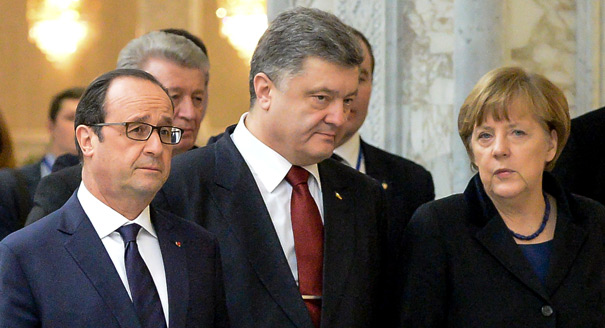
In accepting the task of dealing with Ukraine, the German chancellor took on two challenges: recalibrating the German-Russian relationship and keeping the EU together.
Source: The Moscow Times
Ever since the signing of the Minsk II agreement on Feb. 13, German Chancellor Angela Merkel has had no respite.
As one of the four negotiators in Minsk, the so-called "Normandy Four," Merkel has been on the phone constantly to President Vladimir Putin. She knows the details of the new Minsk agreement inside out. She knows the details of eastern Ukraine's terrain like the back of her hand.
She knows all too well what is at stake if Minsk II ends up like its failed predecessor, Minsk I. It will have immense consequences for Ukraine, for Eastern Europe and for European security.As for the United States, the administration is already preparing more sanctions on Russia if the cease-fire does not hold.
And although U.S. President Barack Obama has no appetite for such a move, leading Republican senators are leading a call for the United States to deliver weapons to Ukraine, to be used to fight the Russian-backed separatists in the east.
Their view is that a show of force might make Putin back down in eastern Ukraine, or at least show that the West is not prepared to abandon Ukraine and let it end up as a failed state or a dismembered country.
The Republican contingent at the recent Munich Security Conference gave Merkel a very hard time. They could not understand her opposition to sending arms to the Ukrainian military.
But where were the Republicans, or the Obama administration for that matter, when the Ukraine crisis broke out a year ago? Largely absent. Since then, it had been up to Merkel to negotiate with Putin. Indeed, Obama, preoccupied with enough domestic issues and the rise of the Islamic State in the Middle East, gladly delegated the Ukraine crisis to Merkel.
Merkel took on this unenviable role. Who else was prepared to? The EU leadership was in transition. But even its incumbents showed little interest in events in Ukraine and largely failed to grasp the significance of the Maidan movement and Russia's subsequent annexation of Crimea.
The fact that Merkel decided to take on such a role has shown two things. First is that she has tried to change the nature of Germany's relationship with Russia. Second is that she has managed, so far, to keep the European Union together and to present a united front on the highly controversial issue of sanctions against Russia. In both cases, it has been a very tough struggle and it is far from over.
Germany's relationship with Russia is fraught with difficulties. For the past 45 years, it has been based on Ostpolitik, or "Eastern policy," that was promoted by former Social Democrat Chancellor Willy Brandt.
In essence, Ostpolitik was about Germany forging a special, cooperative understanding with the Soviet Union and later Russia. In practice, it meant seeing Eastern Europe through the prism of that special relationship with Russia.
To this day, many German Social Democrats see Ukraine, but also other countries in the region, through that prism.
They are reluctant to abandon Ostpolitik despite the immense changes that have taken place among Germany's eastern neighbors since the fall of the Berlin Wall in 1989. Some are even prepared to justify Putin's annexation of Crimea.
Merkel has been chiseling away at those perceptions. Since becoming chancellor in 2005, she has increasingly focused on Germany's eastern neighbors like Poland and Hungary and even further afield to the Balkans and Moldova.
But with Ukraine, Merkel has taken on the biggest foreign policy challenge, if not the biggest gamble, in her political career.
She has to convince Putin to implement the Minsk II agreement. If the agreement collapses, the situation will escalate — American Republicans could use this as a pretext to send arms to Ukraine and the European Union could slap on more sanctions.
Above all, she has to convince her EU partners that Europe must support Kiev to build a modern and democratic state, no matter what happens in eastern Ukraine.
Unity inside the EU is holding, for now. But several member states, including the Czech Republic, Hungary, Bulgaria, Cyprus and Greece oppose more sanctions on Russia.
What would be left of Europe's soft power or commitment to Ukraine if another round of tougher sanctions were blocked?
Putin will have to make his own calculations as well. The Kremlin's propaganda machine can easily turn the tables on Merkel by tapping into the pro-Russian sympathizers in Germany and elsewhere in Europe. And there are many.
They can easily accuse Merkel of trying to isolate Russia and pushing it into a corner from which it could only escape by using force to defend its national interests.
And Putin too can exploit the divisions inside the EU, whose unity is fragile.
Above all, if the new Minsk agreement fails, the transatlantic relationship will be strained to the breaking point, making Merkel's role in this crisis an unenviable one, and an unenviable burden.

Nonresident Senior Fellow, Carnegie Europe
Judy Dempsey is a nonresident senior fellow at Carnegie Europe
Recent Work
Judy Dempsey
Judy Dempsey
Carnegie does not take institutional positions on public policy issues; the views represented herein are those of the author(s) and do not necessarily reflect the views of Carnegie, its staff, or its trustees.

The domestic impacts of how long it is taking to end the war in Ukraine have pushed the French electorate to the political extremes and compromised the country’s diplomatic capacity.

Rym Momtaz
Soft power on its own is insufficient to meet U.S. national security needs, but hard power also has its limits. Soft power allows for more effective and efficient use of hard power than hard power alone, as it encourages cooperation and compliance which deters the need for hard power.

Sarah Yerkes

A deep dive into the policy ecosystems behind battery development in China, South Korea, Japan, the European Union (including some of its member states), the United States, Canada, and India.



Milo McBride, Herbert Crowther, Darcie Draudt-Véjares, …

In an interview, Ian Lustick and Eli Clifton discuss their new book on why a prominent ally has so much influence in America.

Michael Young
Germany, India, and other middle powers can’t build frontier AI alone, and they risk being cut off if they depend on the United States or China. The way through is to build the capacity for a frontier sprint while hoping never to use it.


Anton Leicht, Sam Winter-Levy