

Commentary
Jamie Kwong, Toby Dalton
{
  "authors": [
    "Toby Dalton"
  ],
  "type": "legacyinthemedia",
  "centerAffiliationAll": "dc",
  "centers": [
    "Carnegie Endowment for International Peace"
  ],
  "collections": [
    "Korean Peninsula"
  ],
  "englishNewsletterAll": "ctw",
  "nonEnglishNewsletterAll": "",
  "primaryCenter": "Carnegie Endowment for International Peace",
  "programAffiliation": "NPP",
  "programs": [
    "Nuclear Policy"
  ],
  "projects": [],
  "regions": [
    "East Asia",
    "South Korea"
  ],
  "topics": [
    "Nuclear Policy",
    "Arms Control"
  ]
}
Source: Getty
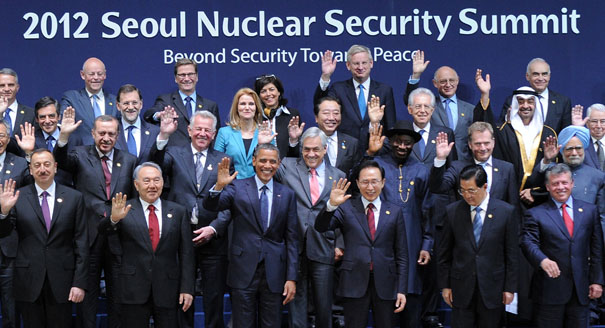
South Korea will chair several major meetings of the international nonproliferation regime in the coming years. Will this drive the country to develop its nuclear expertise?
Source: Council on Foreign Relations
The International Atomic Energy Agency (IAEA) announced this week that the Republic of Korea will chair the December 2016 ministerial meeting on nuclear security in Vienna, Austria. South Korea will also chair the forty-eight-member Nuclear Suppliers Group (NSG) next year and is slated to host the group’s annual plenary meeting in Seoul. 2016 is shaping up to be a critical year for South Korea’s nuclear diplomacy.
Seoul will again bring its substantial organizational and diplomatic capabilities to bear in managing the agendas for both events, as it did previously when it hosted the Nuclear Security Summit (NSS) in 2012. In 2016, however, the demands on South Korea will be greater, particularly since both the NSG and the IAEA ministerial confront thorny political issues. In order to lead both events successfully, Seoul will need to leverage its nuclear expertise in creative ways.South Korea’s experience with the 2012 NSS demonstrated the country’s considerable talents with “host diplomacy,” but the 2016 IAEA ministerial is a different kettle of fish. The meeting will confront squarely political differences among IAEA member states over the proper nuclear security roles and functions for the Agency. South Korean diplomats will find themselves managing high expectations from the United States and other countries that helped build the Nuclear Security Summit process, while addressing the “non-aligned” politics that are a feature of multilateral diplomacy at the IAEA.
The NSG plenary will be a more congenial and private affair, yet the major debate on the horizon within the group—whether to invite India to become a member—is no less challenging politically. The United States and several other countries would like to see India become a member in 2016. Other NSG members have lingering concerns that inviting India, which is not a member of the Nuclear Non-Proliferation Treaty, will weaken both the group and the broader nonproliferation regime. South Korea will again have to utilize deft diplomacy to avoid a meeting that ends in acrimony.
Most of the burden for these two events will fall on South Korea’s Ministry of Foreign Affairs, which will need to draw on an interagency team of technical, legal and policy experts to manage both events successfully. To date, South Korea’s international nuclear diplomatic profile seems to have outpaced the country’s domestic capability, as discussed in a recent Council on Foreign Relations book, Middle-Power Korea: Contributions to the Global Agenda. South Korea has built an impressive reputation as host and organizer of major events, but this international profile has not yet translated into a national infrastructure that allows Seoul to exert leadership beyond “host diplomacy.”
Perhaps the weight of managing two such major events in the same year will drive South Korea toward building its technical, policy and legal expertise and bureaucratic infrastructure. Some evidence suggests Seoul is moving in this direction. Recently, for instance, the Ministry of Foreign Affairs created a new bureau for managing nuclear policy issues. The bureau may permit the development of a permanent cadre of nuclear policy experts within the ministry and could have salutary effects on other government agencies dealing with nuclear matters. With better-organized and trained nuclear experts, South Korea can begin to play a more assertive role in technical cooperation, regional training, and other modes of activity that will expand the gains of the country’s nuclear diplomacy.
This op-ed was originally published by the Council on Foreign Relations.

Senior Fellow and Co-director, Nuclear Policy Program
Toby Dalton is a senior fellow and co-director of the Nuclear Policy Program at the Carnegie Endowment. An expert on nonproliferation and nuclear energy, his work addresses regional security challenges and the evolution of the global nuclear order.
Recent Work
Jamie Kwong, Toby Dalton
Ariel (Eli) Levite, Toby Dalton
Carnegie does not take institutional positions on public policy issues; the views represented herein are those of the author(s) and do not necessarily reflect the views of Carnegie, its staff, or its trustees.

The nuclear relationship between China and the United States is increasingly shaped by widening perception gaps rather than deliberate strategic design.

Tong Zhao

A look at why states without nuclear weapons are seeking naval nuclear propulsion, whether they can legally and technically deliver it, what it will cost them, and what responsible stewardship of the capability would look like.
Jamie Kwong

U.S. trading partners in Asia are closely watching the dispute for signs of how it may affect their own interests.

Barbara Weisel
Congress should ask tough questions about the agreement’s more unique features and whether they advance U.S. interests or compromise them.

Jane Darby Menton
Nuclear and maritime communities face a long and challenging journey to deploy commercial nuclear applications at sea.
Jamie Kwong, Toby Dalton