

Article
C. Raja Mohan, Darshana M. Baruah
{
  "authors": [
    "C. Raja Mohan"
  ],
  "type": "legacyinthemedia",
  "centerAffiliationAll": "dc",
  "centers": [
    "Carnegie Endowment for International Peace",
    "Carnegie India"
  ],
  "collections": [],
  "englishNewsletterAll": "ctw",
  "nonEnglishNewsletterAll": "",
  "primaryCenter": "Carnegie India",
  "programAffiliation": "SAP",
  "programs": [
    "South Asia"
  ],
  "projects": [],
  "regions": [
    "South Asia",
    "India"
  ],
  "topics": [
    "Domestic Politics",
    "Foreign Policy"
  ]
}
Source: Getty
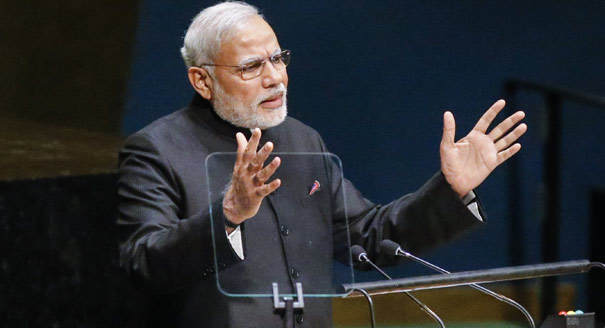
If Modi plucks the low-hanging diplomatic fruit with India's partners, his efforts to detox the domestic environment will get a big boost.
Source: Indian Express
You never let a serious crisis to go to waste,” said Rahm Emanuel, the then White House chief of staff, as a financial disaster threatened America at the dawn of Barack Obama’s presidency. We don’t know whether Prime Minister Narendra Modi is aware of the “Rahm Theorem”. But he appears conscious of the need to alter the political narrative after the electoral debacle in Bihar.
A week, it is said, is a long time in politics. If the Bihar results seemed to diminish Modi’s standing, the PM has reasons to bet that he can engineer an early turnaround. Might foreign policy be of some help to the prime minister?
There is no dearth of advice on a possible new course. The political part of it suggests that the PM must crack down on the extremists of the Sangh Parivar, who have eroded Modi’s support in the mainstream. The economic part suggests an acceleration of reforms and concentration on a few major deliverables that can credibly improve the PM’s chances for re-election. While Modi’s ability to push through big legislative change has been undermined by the Bihar results, there is much the government could do through executive action. We have seen some initial moves on reform already on liberalising the rules for foreign direct investment. More is expected to follow.But what about diplomacy? Foreign policy rarely figures in domestic political strategies. Whether it is the advanced nations or developing ones, the wallet always matters more than the grand themes of world politics. But diplomacy does offer some political opportunities for leaders who find the going tough at home.
Walking the global stage may not get you many votes, but it certainly helps boost the PM’s political image. Diplomacy also helps leverage external opportunities for more rapid internal economic development. While the gestation time can be long, the sense of concrete movement on major transformative projects can boost national economic sentiment.
In some contexts, critical external partnerships help improve domestic political standing. Recall Prime Minister Indira Gandhi’s embrace of the Soviet Union as the Congress party split in 1969. Moscow helped her win the support of the Left in the country to fend off her Congress rivals on the right.
The international setting also helps the PM to send important political messages home. If the protests in London underlined the gathering external storm, Modi has hinted at the prospects for political course correction. Facing tough questions on growing intolerance in India in his joint press conference with British PM David Cameron in London, Modi promised to protect the constitutional rights of every citizen. The PM knows that these can’t be empty assurances. As he travels around the world, the questions of domestic disharmony are going to shadow him unless there is a visible improvement at home.
Modi has before him a season of expansive diplomacy — having just returned from the UK and Turkey, he now leaves for Kuala Lumpur and Singapore. In December, Modi heads to Paris for the climate summit, receives Japanese Premier Shinzo Abe in New Delhi, and meets Russian President Vladimir Putin in Moscow. All these encounters will allow Modi to showcase his diplomatic standing and get a major external boost for his economic plans at home.
Dealing with great powers and global issues might generate some political excitement, but it does not have a great impact on domestic politics. Recall the great controversies during 2005-08 over then PM Manmohan Singh’s historic civil nuclear initiative with the US. The CPM, which pulled the plug on the coalition, came a cropper in the 2009 parliamentary elections, while the Congress returned with a larger majority.
Issues relating to the neighbourhood, however, have much greater political resonance at home. Developments within Nepal have been of some importance in the recent Bihar elections. Sri Lanka’s civil war has long cast a shadow over Tamil Nadu. Bangladesh has always loomed large over eastern India. The recent beef controversy drew Bangladesh into it as senior NDA leaders threatened to eliminate the cattle trade across the long frontier with Bangladesh. The question of illegal migration is bound to figure prominently in the Assam elections next year.
The BJP’s attempt to make Pakistan a factor in the Bihar campaign underlines the important and enduring connection between the internal and external in the subcontinent. The bitter legacies of Partition and the many accumulated grievances since weigh heavily on the political evolution of the subcontinent within and across borders. Modi is in a good position to ease the growing communal polarisation at home by taking sensible steps towards Bangladesh and Pakistan.
Modi can take political credit for getting the contentious land boundary agreement with Bangladesh approved in Parliament. New Delhi’s ties with Dhaka have now entered a very productive phase. The PM can do more by negotiating effective mechanisms for border management with Bangladesh. Progress in that direction could quickly transform the political dynamic in the eastern subcontinent.
Resuming the peace process with Pakistan might seem a lot more difficult. It is worth recalling though that PM Atal Bihari Vajpayee, whom Modi cites quite often in relation to Jammu and Kashmir, made consistent efforts under lot more difficult circumstances to improve ties with Pakistan at the turn of the millennium. Vajpayee’s quest for peace with Pakistan played no small role in limiting the communal conflict under the first BJP-led government in India.
It is no secret that productive engagement between India and Pakistan will have significant positive effects on the internal politics of both countries. If the PM plucks the low-hanging diplomatic fruit with Pakistan, his efforts to detox the domestic environment will get a big boost.
This article was originally published in the Indian Express.
Former Nonresident Senior Fellow, Carnegie India
A leading analyst of India’s foreign policy, Mohan is also an expert on South Asian security, great-power relations in Asia, and arms control.
Recent Work

C. Raja Mohan, Darshana M. Baruah


Alexander Gabuev, Paul Haenle, C. Raja Mohan, …
Carnegie does not take institutional positions on public policy issues; the views represented herein are those of the author(s) and do not necessarily reflect the views of Carnegie, its staff, or its trustees.

The real test may come after the leaders leave the room.



Sheena Chestnut Greitens, Oriana Skylar Mastro, Yukon Huang, …

The Horn of Africa countries are among those facing a new security calculus.


Andrew Leber, Lesley Anne Warner

The European far right might fail to steer EU policy in the direction Russia wants, but they will create enough chaos inside Europe to benefit the Kremlin.

Dimitar Bechev

The new U.S.–Denmark–Greenland agreement will help Washington exert political, economic, and financial dominance under the guise of security. Yet, it acknowledged Copenhagen’s and Nuuk’s sovereignty on the island.

Marc Pierini
Washington needs to recognize that influence in the Western Hemisphere comes from presence, delivery, and reliability. It also must recognize that while the United States remains the key external actor, it no longer operates in a permissive environment and cannot presume deference from regional players who have other options, namely China.
Juan S. Gonzalez