

Article
C. Raja Mohan, Darshana M. Baruah
{
  "authors": [
    "C. Raja Mohan"
  ],
  "type": "legacyinthemedia",
  "centerAffiliationAll": "dc",
  "centers": [
    "Carnegie Endowment for International Peace",
    "Carnegie India"
  ],
  "collections": [],
  "englishNewsletterAll": "ctw",
  "nonEnglishNewsletterAll": "",
  "primaryCenter": "Carnegie India",
  "programAffiliation": "SAP",
  "programs": [
    "South Asia"
  ],
  "projects": [],
  "regions": [
    "United States",
    "South Asia",
    "India",
    "North America"
  ],
  "topics": [
    "Foreign Policy"
  ]
}
Source: Getty
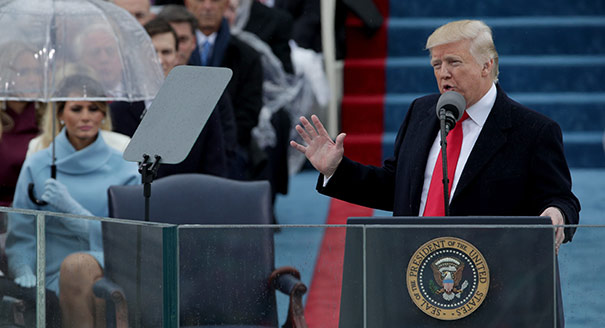
In his inauguration speech, Donald Trump described a new, protectionist America. India must prepare for a United States that does not plan to mess around with other people’s affairs.
Source: Indian Express
In a powerful appeal to American nationalism and a clarion call to put “America First,” the new President of the United States Donald J Trump has promised to upend America’s long standing commitments to economic globalisation, open borders and expansive internationalism.
As Trump’s America turns inward and redefines its role in the world, India must limit the many negative consequences to its current economic engagement with the United States. At the same time, it must seize the new opportunities for strategic cooperation with Washington by shedding past inhibitions.
Affirming America’s protectionist turn, Trump said: “We will bring back our jobs. We will bring back our borders.”
In a dramatic twist to the prolonged war on terror, Trump has reaffirmed the commitment to work with Russia and other civilised nations to wipe “radical Islamic terror” from the face of earth.”
None of these themes was a surprise from Trump. Through his presidential campaign during 2016, Trump had pounded away on these issues. Given the profound and entrenched opposition in Washington to Trump’s unorthodox views, many had hoped that Trump will moderate and finesse his positions. In choosing not to walk back, Trump has set himself on the ambitious course to change America’s economic and political trajectory after the Second World War.
Trump’s new vision for America would demand some serious rethinking of the approach to the US in India at the political as well as policy level. For long, the Indian elites have either criticised the US for forcing globalisation down the throat of other peoples and of intervening in the name of promoting political values like democracy. They will now have to deal with Trump who will have none of this.
Trump has delivered a stinging criticism of globalisation and the much cherished American leadership of the global order. Trump declared, “we’ve enriched foreign industry, subsidised the armies of other countries, while allowing for the sad depletion of our military. We’ve defended other nation’s borders while refusing to defend our own.”
Unveiling a new vision that is bound to send a chill down the spine of many chancelleries around the world, Trump said from now on, “every decision on trade, taxes, on immigration, on foreign affairs will be made to benefit American workers.We must protect our borders from the ravages of other countries making our products, stealing our companies and destroying our jobs.”
Trump identified two simple rules for the new America: “buy American, hire American.”
India must not only prepare for a more protectionist America, but also prepare for a United States that does not plan to mess around with other people’s affairs or squander blood and treasure in the name of promoting democratic values. “We do not seek to impose our way of life on any one, but rather to let it shine as an example.”
During the campaign and since, Trump had trashed America’s old alliances like the NATO. Tonight he said, “we will reinforce old alliances and form new ones and unite the civilised world against radical Islamic terrorism, which we will eradicate from the face of the Earth.” This is an extraordinary formulation that promises to transform US approach to friends and partners around the world.
Trump is not defining himself here as the leader of the “free world” or the “West.” Instead he is talking of uniting “the civilised world” and it quite clearly includes Russia. Trump has always insisted that Russia can be a partner in the fight against against ISIS and other extremist groups.
For eight years, Obama did not use the term “international terrorism.” His preference was for “violent extremism.” That terminological change alone underlines the prospects for a dramatic shift in the way Trump’s America might think about the nature of most important threats and the partnerships that are needed to counter them.
By any measure, Trump’s speech tonight marks a bold and unambiguous repudiation of the long standing beliefs in the American establishment about the United States and its role in the world. His questioning of the costs of globalisation, open borders and an interventionist foreign policy has struck a chord with a large number of voters.
There is indeed an outside chance that Trump might be able to reinvent America’s international engagement and reorder its domestic politics. He has room indeed to build a bipartisan coalition on limiting free trade, modernising America’s infrastructure and on pursuing more modest foreign policy goals.
To be sure, Trump’s vision will face enormous resistance from the establishment. But then Trump has presented himself as an outsider ready to fight the establishment to make things work for the American people. This, in turn, sets the stage for a vigorous political contestation for America’s future direction in the next four years.
For outsiders, there is probably only one guidance to understanding Trump’s America: the past is not a good guide for the future.
This article was originally published in the Indian Express.
Former Nonresident Senior Fellow, Carnegie India
A leading analyst of India’s foreign policy, Mohan is also an expert on South Asian security, great-power relations in Asia, and arms control.
Recent Work

C. Raja Mohan, Darshana M. Baruah


Alexander Gabuev, Paul Haenle, C. Raja Mohan, …
Carnegie does not take institutional positions on public policy issues; the views represented herein are those of the author(s) and do not necessarily reflect the views of Carnegie, its staff, or its trustees.

Trump has promised Belarus a massive potash deal. But Minsk is seeking something greater: restored Western transit and greater room for maneuver from Russia.

Balázs Jarábik

The real test may come after the leaders leave the room.



Sheena Chestnut Greitens, Oriana Skylar Mastro, Yukon Huang, …

The Horn of Africa countries are among those facing a new security calculus.


Andrew Leber, Lesley Anne Warner

The new U.S.–Denmark–Greenland agreement will help Washington exert political, economic, and financial dominance under the guise of security. Yet, it acknowledged Copenhagen’s and Nuuk’s sovereignty on the island.

Marc Pierini

The nuclear relationship between China and the United States is increasingly shaped by widening perception gaps rather than deliberate strategic design.

Tong Zhao