

Commentary
The books, podcasts, and films that explain the world it made.
Andrew Leber
{
  "authors": [
    "Jen Psaki"
  ],
  "type": "legacyinthemedia",
  "centerAffiliationAll": "",
  "centers": [
    "Carnegie Endowment for International Peace"
  ],
  "collections": [],
  "englishNewsletterAll": "",
  "nonEnglishNewsletterAll": "",
  "primaryCenter": "Carnegie Endowment for International Peace",
  "programAffiliation": "",
  "programs": [],
  "projects": [],
  "regions": [
    "North America",
    "United States"
  ],
  "topics": [
    "Political Reform"
  ]
}
Source: Getty
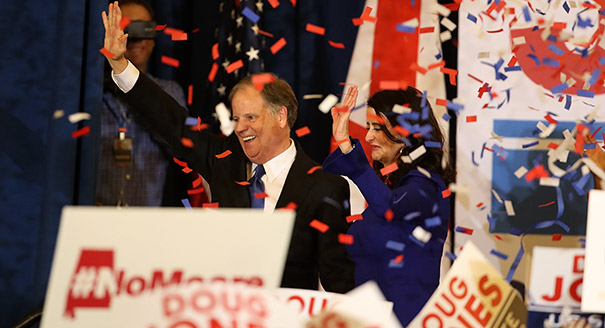
The defeat of Roy Moore in Alabama is a huge energizer for not just the Democratic Party, but also for women who have been victims of sexual assault.
Source: CNN
There is nothing like a political upset to energize the party out of power.
And Tuesday night's election was a whopper of an upset -- a huge energizer for not just the Democratic Party, but also for women who have been victims of sexual assault.
Yes, Roy Moore was a deeply flawed candidate long before he was accused of sexual abuse, allegations he denies. But Alabama is a deep red state that has not elected a Democrat since 1992, and that Democrat, Richard Shelby, became a Republican just two years later.
Doug Jones ran a smart, Alabama-focused campaign, and stayed out of the national spotlight. He smartly focused on African-American turnout in the closing weeks and it worked.
As special elections go, this is an earthquake that will have repercussions far into 2018.
What will they be?
First, Democrats are going to feel emboldened to run in states and districts next year where traditionally they would have no business running. This carries some danger because Democrats are still behind Republicans in fundraising on the national level. Democrats' time, energy and money should be focused on an expanded list of races where they have the best chance of winning.
There is no doubt now that both the Senate and the House are in play for 2018. The Jones win will help Democrats with fundraising and candidate recruitment. And even in states, like Alabama, where the turnout wheels have been rusty, it is clear that the energy and the enthusiasm is there to be tapped into.
Second, this is a win for the establishment Republicans. And a loss for Steve Bannon -- and more importantly Donald Trump. Trump put himself out there for Roy Moore -- not just with presidential tweets, but with a trip to an adjoining media market. This loss is far worse for Trump's political power and for Steve Bannon's political wisdom than was the Republicans' loss in the Virginia governor's race last month.
But it is still a mixed bag for Mitch McConnell and Republican leaders. Yes, it weakens the insurgency they faced in the Republican Party, but leaves them down a Senate seat at a time when they can't afford it. It also weakens the wing of the party that was actually energizing Republicans, the Trump-Bannon wing.
Third, this is a win for the victims of sexual assault who bravely spoke out in Alabama. It will no doubt embolden other women to speak out against men in power who they say assaulted them. And on the political front, Democratic Senators like Kirsten Gillibrand, who have in the last week raised the stakes on Donald Trump and made clear that Democrats are going to have a zero tolerance policy for sexual harassment and sexual assault, now have the wind at their backs.
Finally, it is a win for morality and human decency. The candidate accused of sexual abuse, who opposed gay marriage and consensual homosexual relationships, who questioned whether Muslims could serve in the United State Congress, lost.
And the candidate who talked not about Donald Trump, but about the importance of the CHIP program, a program that helps provide health insurance to tens of thousands of children every year that Congress has failed to fund, was the winner.
In a tough political year for morality, let's hope this is a sign of things to come next year.

Jen Psaki
Former Nonresident Scholar
Jen Psaki was a nonresident scholar at the Carnegie Endowment for International Peace.
Carnegie does not take institutional positions on public policy issues; the views represented herein are those of the author(s) and do not necessarily reflect the views of Carnegie, its staff, or its trustees.

The books, podcasts, and films that explain the world it made.

Andrew Leber

U.S. trading partners in Asia are closely watching the dispute for signs of how it may affect their own interests.
Barbara Weisel
By abandoning past U.S. pro-democracy policies and adopting several lines of pro-autocratic action, the Trump administration has fundamentally repositioned the United States vis-à-vis democracy in the world.

Thomas Carothers
Chinese strategists are once again debating whether American power is declining and whether U.S. hegemony is experiencing irreversible decay.
Wu Xinbo

In the tenth year of his presidency, President Mirziyoyev’s system is becoming even more personalized than that of his predecessor Karimov.

Galiya Ibragimova