

Commentary
Andrei Kolesnikov
{
  "authors": [
    "Andrei Kolesnikov"
  ],
  "type": "legacyinthemedia",
  "centerAffiliationAll": "",
  "centers": [
    "Carnegie Endowment for International Peace",
    "Carnegie Russia Eurasia Center"
  ],
  "collections": [],
  "englishNewsletterAll": "",
  "nonEnglishNewsletterAll": "",
  "primaryCenter": "Carnegie Endowment for International Peace",
  "programAffiliation": "",
  "programs": [],
  "projects": [],
  "regions": [
    "Russia"
  ],
  "topics": [
    "Political Reform"
  ]
}
Source: Getty
The Kremlin will face a new Navalny, protected by a force field of Western public opinion.
Source: Moscow Times
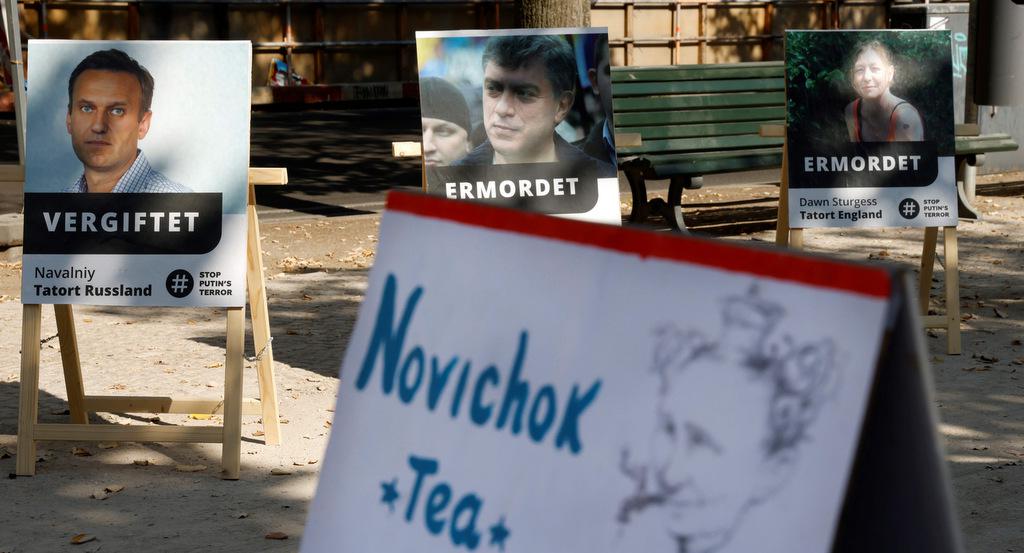
When Russian opposition leader Alexei Navalny returns to Russia, he will find his apartment and bank account under government arrest. In fact, Kremlin leaders do not want him to return at all.
Not only would they have preferred giving Navalny the classic KGB-style “choice” between forced labor and forced emigration, they especially dislike that Navalny is returning in triumph rather than defeat.
The attempt to silence Navalny failed, and President Vladimir Putin’s efforts to “cover his tracks” have only succeeded in causing a near-fatal breakdown in Russia’s relations with the West.
The Kremlin’s amoral tactic of “playing dumb” — used after the poisoning death of former KGB agent Alexander Litvinenko, the downing of Malaysian Airlines Flight 17 and the poisoning of former spy Sergei Skripal and his daughter in England — only underscores how toxic Russia has become under Putin.
A sort of political force field now surrounds and protects Navalny, even if he does not receive the Nobel Peace Prize, because his reputation has gained global and not merely national dimensions.
The Kremlin has always portrayed Navalny as an insignificant figure, a harmless but annoying gadfly who prevents decent people from performing their state duties — “a simple troublemaker" (“un simple trublion,” as French President Emmanuel Macron reportedly heard Putin describe him.)
However, this “troublemaker” and “blogger” nearly managed to force a second round of voting in the Moscow mayoral elections in September 2013.
This was the result of a tactical blunder by the authorities: Advisors had mistakenly convinced Putin that Navalny would garner only a few percentage points of the vote and that permitting him to run would publicly expose him as a political lightweight.
Immediately recognizing the threat Navalny posed, the authorities stripped him of all legal right to participate in party politics and elections.
Their actions demonstrated just how much they feared Navalny and his true significance for them. Ironically, it was the authorities’ harassment, provocations and refusal to call their opponent by name that painted the clearest portrait possible of Navalny’s real worth.
And his stubborn refusal to back down prompted those in power to reach a “final decision” regarding him. They opted for a technique that has become almost routine in today’s Russia, where officialdom barely even tries to conceal its crimes — poisoning.
And, once again, the authorities miscalculated, underestimating the consequences of trying to eliminate this “blogger.”
They probably wagered that the wave of indignation would die down quickly and that the opposition would be very slow to recover from the loss of its leader.
Once it became clear that Navalny might survive the attempt on his life, Putin graciously agreed to his medical evacuation to Germany.
Putin thereby demonstrated that he considered the incident too trivial to spoil relations between the pragmatic politicians for whom the Nord Stream project was more important than all the Navalnys of the world combined.
However, the Kremlin yet again underestimated the opposition politician’s importance, even while it overestimated the cynicism of Western politicians.
Putin’s personal rapport with German Chancellor Angela Merkel and Macron did not save Russia’s relations with Germany or, it seems, with France — and, as a result, with Europe. Human values outweighed material interests.
For years now, domestic Russian politics have boiled down to “Putin vs. Navalny.”
The absurd effort to get Putin nominated for a Nobel Peace Prize just to irk the opposition was proof of this. Navalny is the most recognizable opposition politician, and he is a politician in the true sense of the word — someone fighting for a change of power.
To be fair, “the Navalny brand” had suffered a series of setbacks of late. He had quarreled with journalists over trivialities, become fixated on the mechanics of “smart voting” and seemed to be losing money in his fight against Yevgeny Prigozhin, the so-called “Kremlin chef.”
He played no role in the civil protests that have broken out in different parts of the country, even though supporters of various conspiracy theories consistently claimed that he was behind them all. However, it was his poisoning that revealed exactly whom the Kremlin — or its hired killers — considered the main figure opposing Russian authoritarianism.
Navalny will emerge from this dramatic incident an even stronger figure, only underscoring for domestic, and especially overseas audiences, that Russian politics is a binary construction consisting of “Navalny vs. Putin.”
The Kremlin and its inner circle come out of this episode with a double toxicity, both political and chemical. This toxic authoritarian government is poisoning its opponents.
It is unclear just how to communicate with a leadership that covers up murders and has degenerated into permanently trolling its now former “Western partners.” The situation is worse now than it was during the Cold War. Then, at least, there were certain rules. Now, none exist.
Putin’s Russia, which has consistently flirted with distancing itself from what it claimed was an inferior or unfair West, now finds itself in a very real state of self-induced isolation, its political radioactivity scaring everyone else away. Kremlinology is gradually becoming toxicology.
The problem is that rulers who have become this isolated from the world are not bound by the usual rules of decency and no longer care if decent people respect them. This could be dangerous for Navalny, even with global public opinion behind him.
But Navalny will return to Russia — and the Kremlin authorities will just have to live with it.
Former Senior Fellow, Carnegie Russia Eurasia Center
Kolesnikov was a senior fellow at the Carnegie Russia Eurasia Center.
Recent Work
Andrei Kolesnikov
Andrei Kolesnikov
Carnegie does not take institutional positions on public policy issues; the views represented herein are those of the author(s) and do not necessarily reflect the views of Carnegie, its staff, or its trustees.

Russian strikes are weakening the economy sustaining Ukraine’s war effort. Closing the growing funding gap will require more European support and politically contentious reforms in Kyiv.

Balázs Jarábik

Ex-president Gurbanguly Berdimuhamedov remains interested in politics, but his son Serdar, Turkmenistan’s current president, is becoming increasingly independent and willing to break with his father’s legacy. If their covert rivalry goes too far, both risk losing power.

Galiya Ibragimova

Europe is facing rising populism internally as well as external pressures from Russia, China, Turkey, and the United States.

Dimitar Bechev

A notable degree of participative democracy has firmly arrived in Europe. But to have more far-reaching impact, democratic deliberation needs to move into a radically new phase.

Richard Youngs

Despite a new textbook, an influx of Russian teachers and managers, and an end to the teaching of Ukrainian, the Kremlin is unlikely to have “reprogrammed” locals.

Konstantin Skorkin