

Paper
Lucas Fluegel
{
  "authors": [
    "Lucas Fluegel"
  ],
  "type": "commentary",
  "centerAffiliationAll": "dc",
  "centers": [
    "Carnegie Endowment for International Peace"
  ],
  "englishNewsletterAll": "ctw",
  "nonEnglishNewsletterAll": "",
  "primaryCenter": "Carnegie Endowment for International Peace",
  "programAffiliation": "TIA",
  "programs": [
    "Technology and International Affairs"
  ],
  "projects": [],
  "regions": [
    "United States"
  ],
  "topics": [
    "Technology",
    "Global Governance",
    "United Nations"
  ]
}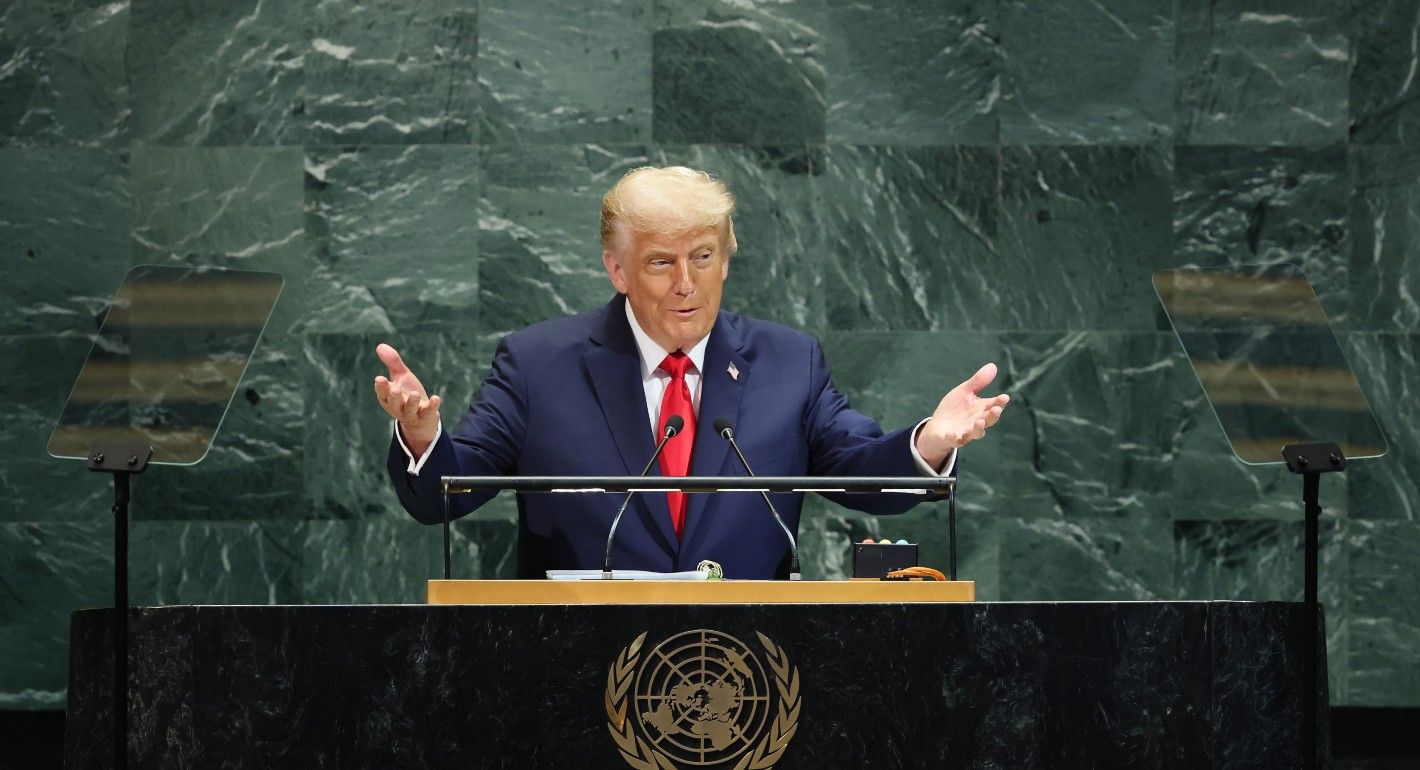
U.S. President Donald Trump speaks during the United Nations General Assembly (Photo by Michael M. Santiago/Getty Images)
But parties to the Biological Weapons Convention will have to shift their focus from analyzing the details of his proposal to capitalizing on the unexpected political opening.
In his wide-ranging speech to the United Nations in September, U.S. President Donald Trump inserted an unexpected declaration: “I’m announcing today that my administration will lead [an] international effort to enforce [the] Biological Weapons Convention . . . by pioneering an AI verification system that everyone can trust.”
For those hoping to strengthen the Biological Weapons Convention (BWC), this statement presents a meaningful opportunity. The BWC is the world’s only international treaty against the deliberate use of disease as a weapon, compelling virtually every nation never to develop biological agents like anthrax or smallpox for hostile purposes. Despite this important role, the treaty has long been criticized as weak. In comparison to its nuclear and chemical counterparts, the BWC lacks useful enforcement mechanisms and is heavily under-resourced. As it stands, the convention essentially functions as a gentleman’s agreement with diplomatic trappings.
Proposals to strengthen the BWC are nothing new, and like Trump’s, they are frequently focused on developing a system to verify countries’ compliance. However, such discussions have remained largely stagnant since the United States refused to support a 2001 verification proposal that was developed over years of negotiation. Indeed, some BWC experts increasingly believe that true verification may be impossible. This conclusion is motivated by the dual-use nature of biotechnology: The same equipment and processes used to develop and manufacture a therapeutic can be deployed to engineer and weaponize pathogens. Verification becomes unattainable, as an observer cannot immediately distinguish between research toward legitimate applications and covert weaponization programs. Still, Trump’s comment should not simply be labeled as out of touch with current discussions and subsequently ignored. Instead, it reflects a meaningful rhetorical shift from a country that has traditionally been resistant to many high-profile proposals to strengthen the BWC.
Though it is only one narrow element of these discussions, the verification debate is illustrative. For decades, other countries’ appeals for legally binding verification protocols have resulted in tepid and ambiguous statements from U.S. officials. Trump’s remark has abruptly challenged this paradigm. Adding to the intrigue, Russia was quick to label the proposal “brilliant” despite ongoing geopolitical tensions, including years of Russian disinformation campaigns surrounding U.S.-Ukrainian biological laboratories. And, just a few years ago, the BWC established an ongoing working group to “strengthen the effectiveness” of the convention. These converging factors reflect a window of opportunity to empower the BWC.
And yet, BWC stakeholders seem to have missed the importance of Trump’s political signal, instead focusing on the technical substance behind his comment. Technical objections to his statement are well founded: Simply put, AI will certainly not be a newfound panacea for verification. Among BWC experts, there is both strong skepticism and significant enthusiasm about how useful AI will be for verification activities, but no one sees a path for AI tools to singlehandedly plug this contentious, fifty-year gap in the convention. Nevertheless, Trump’s comment offers utility for those who want to strengthen the BWC in a broader sense.
Incorporating AI into BWC-related activities is not limited to verification regimes, and BWC stakeholders should think creatively about how to integrate AI in a way that can draw further U.S. attention. For a president fixated on AI dominance and his own image as a savvy diplomat, the prospect of exporting American AI technology to address a long-standing international challenge offers potential motivation for sustained investment from an otherwise multilateralism-skeptical administration. The value of high-level political attention in any form, especially from a historically reluctant country, can be significant. In tandem with the positive signals from frequently obstructionist Russia, these factors may well be sufficient to help the BWC develop much-needed momentum. Therefore, the states parties to the BWC must urgently act to make the most of this window of opportunity before it closes.
The prospect of exporting American AI technology to address a long-standing international challenge offers potential motivation for sustained investment.
A key first step will be to stretch Trump’s brief comment into a dialogue. Although he has an affinity for rapid-fire bursts of diplomacy and “dealmaking,” the slow-moving nature of BWC negotiations dictates that attention must be sustained over time to yield impact. This inconvenient necessity may drive the U.S. administration to consider other disarmament forums or abandon the commitment entirely if a path forward is not solidified. Given the lack of further action since the president’s speech, this hypothetical outcome is quickly becoming a reality.
To leverage the remaining momentum and generate high-level commitment from the administration, diplomats and civil society must engage proactively and decisively. The upcoming working group meeting is an ideal forum. Using the first meeting since his speech to appeal to the president and reference his message via both formal and informal channels would send a clear signal of intent that would serve to capture further attention from the administration. Importantly, these first discussions do not need to be particularly concrete: Politically reinforcing U.S. commitment would be an accomplishment in and of itself that would pave the way for a more detailed exploration of paths forward.
Then, efforts can pivot to identifying substantive proposals that frame the objectives of BWC states parties within the rhetorical boundaries of Trump’s foreign policy. This process will harness the captured energy of the administration toward actions that mutually benefit his vision and the convention. The potential roles for AI in BWC-related activities are extremely diverse, ranging from scanning open-source information to identify hints of covert bioweapons programs to assisting with the drafting of dense treaty-related documentation. So, importantly, there are likely many angles that could be explored to convince nations to support its adoption. Areas of focus could include obligations under Article X (perennially contentious cooperative activities to “help build capacity in less developed countries”) and confidence-building measures (voluntary reports made by states parties on the status of their implementation of the convention). By facilitating the diffusion of U.S.-developed AI tools to low-resource nations for biomedical science and confidence-building, the United States could simultaneously fulfill its cooperation mandates while also establishing a high-profile channel to export its stack of AI technologies.
Such an approach is likely to be attractive to Trump and will provide a political incentive for meaningful U.S. action in areas that are important to many BWC states parties. Moreover, these efforts can be characterized not as submission to a multilateral institution but instead as an evolution of the international order driven by American innovation, further commanding the administration’s attention. Opportunities like these are missed if the president’s comment is interpreted solely as a call for AI-enabled verification, but they are widespread when Trump’s speech is framed as a general political signal.
These efforts can be characterized not as submission to a multilateral institution but instead as an evolution of the international order driven by American innovation.
As modern biotechnologies expand what is possible for would-be bioweaponeers, renewed interest in strengthening the BWC is sorely needed. Though countries’ objectives vary widely, high-level buy-in from key actors like Trump will inevitably be required to help the convention modernize. Therefore, stakeholders must move beyond a narrow assessment of his suggestion of AI verification and instead envision a broader course of action that can capitalize upon this unexpected signal of political attention. Trump may be an ironic advocate for the strengthening of a multilateral institution. But, in the current geopolitical climate, the BWC cannot afford to be picky about its champions.

Visiting Scholar, Technology and International Affairs Program
Lucas Fluegel is a visiting scholar in the Technology and International Affairs Program at the Carnegie Endowment for International Peace, where he explores the implications of advanced biotechnologies for international governance and global stability.
Recent Work
Carnegie does not take institutional positions on public policy issues; the views represented herein are those of the author(s) and do not necessarily reflect the views of Carnegie, its staff, or its trustees.

The real test may come after the leaders leave the room.



Sheena Chestnut Greitens, Oriana Skylar Mastro, Yukon Huang, …

The new U.S.–Denmark–Greenland agreement will help Washington exert political, economic, and financial dominance under the guise of security. Yet, it acknowledged Copenhagen’s and Nuuk’s sovereignty on the island.

Marc Pierini

The nuclear relationship between China and the United States is increasingly shaped by widening perception gaps rather than deliberate strategic design.

Tong Zhao
AI technology has proliferated extensively and offers authoritarian leaders three crucial advantages: scale, speed, and efficiency. As a result, it has undoubtedly become a crucial tool of repression. But AI tools also give individuals and activists the means to organize, resist, and hold their governments accountable. Today, it is far more difficult for autocratic leaders to hide their corrupt practices and govern in darkness.

Steve Feldstein, Shreya Joshi
Washington needs to recognize that influence in the Western Hemisphere comes from presence, delivery, and reliability. It also must recognize that while the United States remains the key external actor, it no longer operates in a permissive environment and cannot presume deference from regional players who have other options, namely China.
Juan S. Gonzalez