

Commentary
Uri Dadush
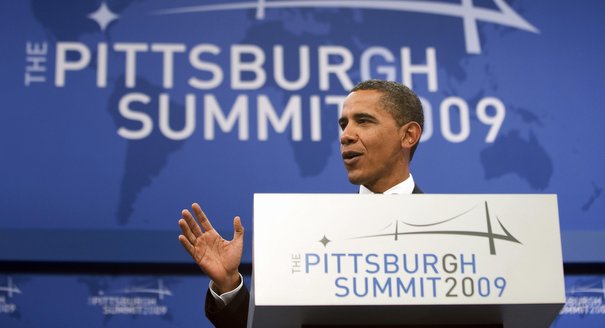
Source: Getty
The G20 has claimed its spot as the world’s leading economic forum. Though it failed to adequately address trade, the group did discuss climate change, signaling a shift from crisis control to a long-term focus.
In a historic shift, the G20 emerged from its summit in Pittsburgh today as the world’s official forum on global economic issues, replacing the outdated G8.
As expected, the group addressed two main crisis-related challenges—supporting the recovery by maintaining stimulus packages and rebalancing the global economy, and applying lessons learned from the crisis to financial regulations and international financial institution (IFI) reform. In addition—and in keeping with its new-found status—it approached a crucial long-term issue, climate change, for the first time. While the G8 may continue to deal with issues of foreign relations, the G20 has clearly stepped into its role as the main economic global forum. This shift is the single most important result to come out of the summit, but is not its only achievement.
The G20 has stepped into its role as the main economic global forum. This shift is the single most important result to come out of the summit, but is not its only achievement.
An analysis of recent data published today confirms that the world economy is on the mend, but that serious vulnerabilities persist. The recovery to date has come sooner and faster than forecasted, and owes much to the massive government support that previous G20 meetings helped to orchestrate. In light of these trends, the decision not to withdraw stimulus at this juncture is an important and welcome one. It is consistent with an objective assessment of the global economy and associated risks. Continued government support is essential to maintaining the recovery.
Global rebalancing, another element of a sustained recovery, was highlighted by the leaders as well. Surplus countries agreed to increase domestic demand, with trade deficit nations called upon to reduce government deficits and increase household savings. Leaders agreed to ensure that this would be a global process, with plans for country to country peer-reviews of progress in collaboration with the IMF.
Although this is not a new concept (previous G8 summits set up similar and, as it turned out, ineffectual frameworks), the Pittsburgh agreement appears to have greater buy-in by China. It is also more in line with what both U.S. and Chinese authorities have determined they need to do anyway. Since global imbalances are just a reflection of the more significant domestic imbalances in both countries, international and domestic policy objectives are aligned. This gives one more confidence that things could turn out better this time.
In a more substantive move, leaders also called for higher capital requirements, but implementation will depend on the domestic regulations of individual countries.
The leaders addressed financial regulation, another hot topic, by calling for moderation of bonuses for bankers. Tighter bonus rules, which may tie bonuses to returns and capital and defer payouts, will be finalized by the end of 2010 and then eased into place over the next two years. Regulators will have the authority to review and impose changes in compensation practices.
In a more substantive move, leaders also called for higher capital requirements, with exact standards for heightened quality and quantity to be set by the end of 2010, including building counter-cyclical capital buffers. Each member will also adopt an internationally harmonized leverage ratio as part of the Basel II framework by 2011, and systemically important firms will create “living wills” to facilitate their orderly resolution in the event of collapse. These changes come at the right time, as the recovery may decrease momentum for them soon. Implementation will depend on their incorporation into the domestic regulations of individual countries. If this actually happens and is successfully and widely enforced—by no means a foregone conclusion—it will have a salutary effect on global financial stability.
As it looked for ways to bolster confidence in the financial system during the darkest days of the crisis, the G20 refinanced the IMF with a massive new injection of share and loan funds. In Pittsburgh, it worked to improve the IMF’s legitimacy by calling for at least 5 percent of votes to be reallocated to under-represented countries (mainly away from European nations and to the emerging markets). This is a crucial step towards ramping up the organization’s legitimacy and effectiveness, and also points to the difference in outcomes that can be expected from the G20 as compared to the G8.
In a crucial move, the G20 leaders seriously addressed climate change for the first time, broadly dealing with a huge, long-term agenda that requires global coordination.
The gathering also called for increasing the resources of the multilateral development banks (MDB), and set a deadline for reviewing their capital requirements in the first half of 2010. Voting shares in the World Bank will also be rebalanced in favor of developing countries, and the institution was asked to lead on food security and climate change.
In a crucial move, the G20 leaders seriously addressed climate change for the first time, broadly dealing with a huge, long-term agenda that requires more global coordination than any other issue at the moment. They agreed to phase out oil and fossil fuel subsidies over the medium term, though they did not set up a concrete timeline or determine a concrete financing sum. However, the simple fact that such discussions are occurring in the G20 forum is critical, as discussions in a larger body are unlikely to be effective and any held in the G8 context would be too limited. In addition, this sends a strong signal that the G20 has claimed its territory.
Nonetheless, the world leaves this G20 summit better off than it entered it.
The weak outcome regarding trade, Pittsburgh’s neglected child, is regrettable though not unexpected. Leaders embarrassingly called again for a conclusion of the Doha Round by the end of 2010 and vowed not to engage in protectionism. In short, trade—a vital aspect of global integration and a significant determinant of confidence—was left behind. This inaction is largely the result of an overburdened domestic agenda in the United States, and unwillingness among a broad spectrum of leaders to confront trade opening in the middle of a severe recession.
Nonetheless, the world leaves this G20 summit better off than it entered it. Most significantly, one can hope that an empowered and representative mechanism has finally been established to deal with the many unmet global challenges.

Former Senior Associate, International Economics Program
Dadush was a senior associate at the Carnegie Endowment for International Peace. He focuses on trends in the global economy and is currently tracking developments in the eurozone crisis.
Recent Work
Uri Dadush
Uri Dadush
Carnegie does not take institutional positions on public policy issues; the views represented herein are those of the author(s) and do not necessarily reflect the views of Carnegie, its staff, or its trustees.
Economic recovery has brought Sri Lanka a modicum of stability, but domestic strains and great-power rivalry could test how long it lasts.

Avinash Paliwal
Policy proposals on sovereign debt must both match the scale of the challenge and be implementable within existing political constraints.
David McNair

For every ruble allocated to social policy, health, and education in 2027, double that amount is earmarked for the army, the police, and the security services.

Alexandra Prokopenko

The European Commissioner for Trade is headed to China. But after President Xi’s bridge-building visit to Washington, can a more isolated EU overcome Beijing’s stranglehold on critical raw materials? Who will blink first?

Rym Momtaz, ed.

The domestic impacts of how long it is taking to end the war in Ukraine have pushed the French electorate to the political extremes and compromised the country’s diplomatic capacity.
Rym Momtaz