

Commentary
European Commission President Ursula von der Leyen is about to give her annual address on the state of the EU. Here’s what she won’t—but should—say.
Rym Momtaz
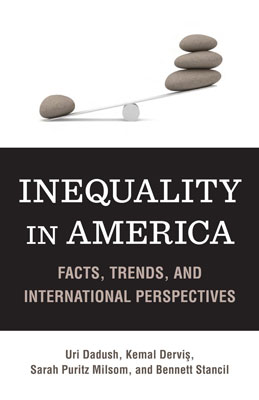
Tackling the worst effects of inequality requires increased investment in crucial public goods, including education, a more progressive and simplified tax system, and increased international cooperation to avoid a race to the bottom.
Source: Brookings Institution Press, 2012


Inequality in America provides a snapshot of the issues posed by the growing concentrations of income, focusing on the United States but drawing on international comparisons to help set the context. The authors examine the economic, technological, and political drivers of inequality and identify worrying trends associated with its rise. They demonstrate how specific factors have exacerbated income inequality, including technological change, international trade, changes in labor market participation, and the increasing role of the financial sector. Their clear and concise exposition makes the issues surrounding income distribution accessible to a wider public.
As they write in the conclusion: “We have argued that tackling the worst effects of inequality and re-establishing a measure of equal opportunity requires increased investment in crucial public goods: first, education; second, a more progressive and simplified tax system; and third, increased international cooperation to avoid a race to the bottom. Education, tax, and other such policies are pursued by other highperforming advanced countries and can be shaped for the United States in a way that is fully consistent with an efficient and competitive American economy.”

Former Senior Associate, International Economics Program
Dadush was a senior associate at the Carnegie Endowment for International Peace. He focuses on trends in the global economy and is currently tracking developments in the eurozone crisis.
Kemal Dervis
Sarah Puritz Milsom
Bennett Stancil
Former Research Assistant, International Economics Program
Carnegie does not take institutional positions on public policy issues; the views represented herein are those of the author(s) and do not necessarily reflect the views of Carnegie, its staff, or its trustees.

European Commission President Ursula von der Leyen is about to give her annual address on the state of the EU. Here’s what she won’t—but should—say.

Rym Momtaz

Depleted financial reserves and a shrinking tax base mean it is no longer possible to simultaneously deliver high defense spending, price stability, and economic growth.

Alexandra Prokopenko

Understanding the climatic pain points is necessary for policymakers hoping to minimize the war’s negative environmental consequences.



Alejandro Martin Rodriguez, Joy Arkeh, Sarah Yerkes

Huawei pushed hard to enter the Egyptian data centers market, until the Americans made a better offer.

Angie Omar

Radical-right parties are expected to do well in upcoming elections in four of the EU's biggest member states. If successful, they could prevent the union from addressing key challenges ahead.

Stefan Lehne