

Article
Trade between India and Pakistan has been suspended since 2019. Yet an agreement on this issue could help facilitate broader cooperation.
Source: Getty
Cargo time release studies offer a path to greater economic gains and higher trust between neighboring countries.
Time is arguably South Asia’s most overlooked trade barrier. The region’s trade challenges are often framed in terms of tariffs, connectivity gaps, or infrastructure deficits. Yet much of the actual friction comes from the time it takes for cargo to move through ports and to cross borders. In a world where supply chains stretch across multiple countries and a disruption in a single node can stall an entire network, the ability to clear goods with speed and predictability has become a core determinant of competitiveness. What was once considered only a national administrative concern is now a regional priority and a test of cooperation, resilience, and trust among trading partners.
Within this context, time release studies (TRSs) developed by the World Customs Organization (WCO) offer governments a practical and data-driven way to understand where delays occur and how to eliminate them. By measuring the actual time needed for goods to move from arrival to release, TRSs help countries align their procedures with global standards and pursue reforms that meaningfully improve clearance performance. Because the methodology spans all border agencies, not just customs, it provides a comprehensive picture of the real constraints affecting trade across sea, land, and air entry points.
Time release studies developed by the World Customs Organization offer governments a practical and data-driven way to understand where delays occur and how to eliminate them.
For South Asia, the challenge is no longer whether to modernize border processes, but whether countries can use data and measurement tools to turn unilateral reforms into a genuinely regional project of trust-based trade.
Trade between India and Pakistan has been suspended since 2019. Yet an agreement on this issue could help facilitate broader cooperation.
A TRS measures the time between a shipment’s arrival and its release, giving governments a clear, objective picture of where delays occur and who is responsible for them. TRSs began as a diagnostic exercise and are now emerging as a mechanism for accountability. India’s experience illustrates how quickly TRSs can move from a pilot activity to an anchor of national trade governance.
India pioneered the use of TRSs in the region, starting with the first WCO-aligned study at the Jawaharlal Nehru Custom House in Mumbai in 2013. Since then, India has institutionalized TRSs across multiple ports, expanding their scope to examine the activities of customs officials, terminal operators, port and airport authorities, carriers, traders, and various cross-border regulatory agencies. This systemwide approach has turned TRSs into a central performance management tool, allowing authorities to identify bottlenecks and streamline procedures.
The National Committee on Trade Facilitation has embedded TRSs into India’s National Trade Facilitation Action Plan, requiring regular studies at ports to meet the transparency commitments set out in the World Trade Organization’s Trade Facilitation Agreement. The plan sets ambitious release-time targets—48 hours for sea and land imports and 24 hours for air imports, as well as 24 hours for sea and land exports and 12 hours for air exports. TRSs provide the evidence base to track performance against these goals. Led by the Central Board of Indirect Taxes and Customs and supplemented by third-party analysis, India’s national TRS portfolio covers fifteen major customs stations that together handle roughly 80 percent of bills of entry and 70 percent of shipping bills. This broad coverage ensures that the findings reflect the realities of India’s trade ecosystem rather than isolated case studies.
Bangladesh has also begun using TRSs as both a diagnostic and a catalyst for reform. Its first agro-focused TRS in 2021–2022—followed by studies at key land, sea, and air entry points—demonstrates a growing institutional commitment. The National Board of Revenue’s 2023 TRS at three land ports, supported by the Asian Development Bank (ADB), provided actionable insights that are already informing efforts to improve border efficiency and regulatory transparency.
Bhutan’s first TRS in 2024 demonstrates how smaller economies can leapfrog through measurement. Covering five land ports and aligning closely with ongoing customs modernization, Bhutan’s study identified procedural bottlenecks and created a foundation for targeted reforms and long-term capacity building. Nepal’s earlier TRS efforts, conducted intermittently with WCO and ADB support, underscore an ongoing intent to use measurement for policy improvement, providing a baseline for future reforms.
Taken together, these countries’ experiences show that TRSs are evolving into a regional instrument for accountability, allowing governments to measure clearance performance with far greater clarity and precision than before.
TRSs rely on real operational data, making them far more robust than survey-based assessments. Automated customs systems such as India’s ICEGATE, Bangladesh and Nepal’s ASYCUDA platforms, and Bhutan’s eCMS provide precise timestamps for every stage of documentary clearance. When supplemented with operational information from port authorities, TRSs offer a comprehensive view of the clearance process. Their coverage extends beyond customs to partner government agencies responsible for food safety, plant and animal quarantine, drug control, and technical standards. While many agencies have integrated into national single window systems, others still rely on manual clearance, highlighting areas for further reform.
What gets measured gets managed and eventually gets improved.
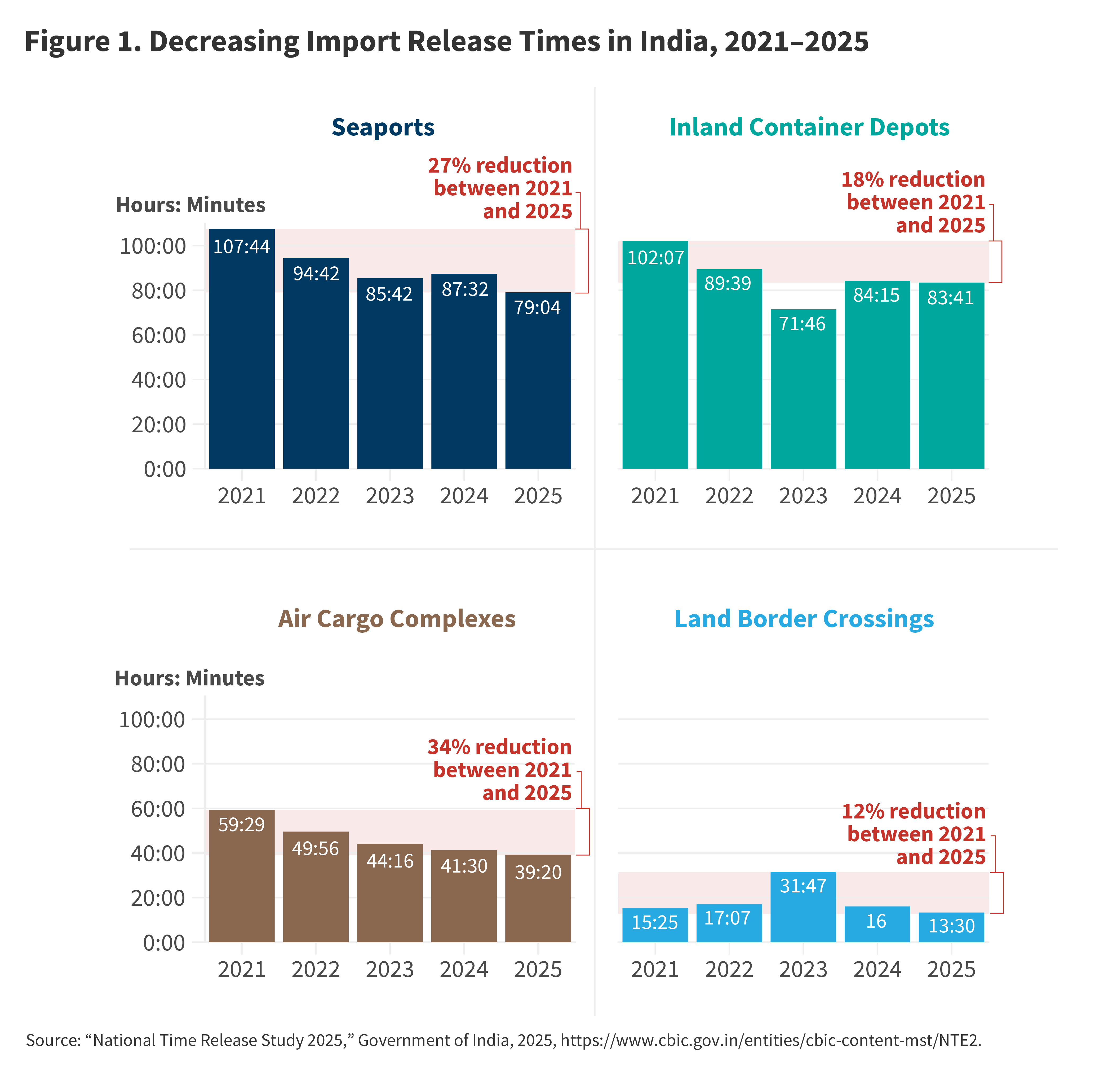
Ultimately, TRSs allow governments to track performance and continuously improve border processes. The World Trade Organization’s Trade Facilitation Agreement encourages use of TRSs for exactly this reason—what gets measured gets managed and eventually gets improved. India’s experience confirms the power of measurement: Between 2021 and 2025, import release times were reduced by 27 percent at seaports, 18 percent at dry ports, and 34 percent at air cargo complexes.
For countries like Bangladesh, Bhutan, and Nepal, TRSs create a baseline to guide modernization. For the region as a whole, they can lay the groundwork for deeper cooperation through shared benchmarks, interoperable digital systems, and more predictable corridors, especially for landlocked economies.
TRSs consistently highlight that delays are rarely caused by a single bottleneck; instead, delays accumulate through multiple small friction points across the clearance chain.
Weak or uneven risk management is a major challenge. In some countries, risk assessment happens late in the process, or relies on incomplete data, forcing customs agencies to examine more cargo than necessary. Without robust risk engines classifying shipments into low-, medium-, and high-risk categories, compliant traders get stuck in queues meant for higher-risk consignments. Extending risk-based processing to all partner government agencies could create a unified front at the border, replacing fragmented controls that slow release.
Additionally, bureaucratic silos can compound delays. Approvals from food safety, drug control, quarantine, or standards agencies often require lab tests or paper-based documentation or are limited by staff availability. Even when a customs agency’s processes are fully digitized, partially offline processes elsewhere create gaps, prolonging clearance. Until all agencies digitize, upgrade labs, and link to single-window systems, inter-agency referrals will remain a major bottleneck.
Payment timing is another friction point. Many traders delay duty payment until goods physically arrive, especially when quantities may vary. This cautious approach avoids refund claims but slows the start of clearance. Wider adoption of reliable refund systems, digital pre-payment tools, and clearer pre-arrival processes would help shift payment earlier in the chain, reducing idle time at ports.
Frequent amendments to import declarations add yet another layer of delay, indicating deeper issues: missing shipment documents, inconsistent data from carriers, or gaps in the capacity of customs brokers. Each amendment restarts scrutiny and adds administrative work. Better documentation standards, stronger data-sharing between countries, and targeted capacity-building for brokers and importers can significantly reduce unnecessary amendments.
These friction points vary by country, port type, commodity mix, and institutional capacity, but the pattern is clear: Delays arise not from one broken link but from many small ones. Addressing them requires coordinated digitalization, skilled border agencies, stronger risk systems, and a region-wide commitment to measurement and reform.
Friction points vary by country, port type, commodity mix, and institutional capacity, but the pattern is clear: Delays arise not from one broken link but from many small ones.
The good news is that South Asia is digitizing trade at a remarkable speed. Pre-arrival processing, automated customs processes, and paperless clearance systems have reduced dwell times, cut congestion, and enabled risk assessment before cargo reaches ports. These reforms are essential for synchronizing procedures and strengthening institutional confidence between neighboring countries.
Digital customs initiatives, such as India’s Turant Customs, show how faceless, contactless, and paperless systems can eliminate discretion, standardize decisions, and accelerate clearance. Regionally applied, these systems enable real-time data exchange, coordinated risk management, and seamless transit, which are essential for resilience amid geopolitical and supply-chain shocks. South Asia now has the opportunity to invest in interoperable platforms and common data standards that allow border agencies to communicate across borders as easily as within them.
But digitization alone will not deliver the next leap in competitiveness. Trust-based trade, built through authorized economic operator (AEO) programs, is key. The AEO model shifts from “verify, then approve” to “trust, then verify”—granting compliant traders faster clearance, fewer inspections, and deferred payments. India leads the region with thousands of AEO-certified entities, but adoption elsewhere is slow, frameworks are nascent, and awareness remains limited. Bhutan, for example, has provisions for authorized compliant traders but no certified operators yet.
Expanding trusted trader programs and integrating them with regulatory agencies such as food safety, quarantine, and drug control is the next policy step. If South Asian economies develop mutual recognition agreements for trusted traders, they could dramatically reduce delays and strengthen supply-chain security. Digitization lays the rails; AEO programs and trust-based frameworks provide the engines.
South Asia stands to gain significantly from regional coordination on trade facilitation, yet it remains one of the least integrated trading regions globally. Uneven reforms, fragmented border procedures, and limited system interoperability mean gains often stop at the border. TRSs can bridge this gap, giving countries a shared language of performance and a common method to identify bottlenecks.
Global experience demonstrates what is possible. Countries including Nigeria, Eswatini, South Africa, New Zealand, Singapore, and Australia have adopted TRSs as part of regional or bilateral cooperation. Eswatini and South Africa conducted a joint TRS in 2023, while Australia used a TRS to push import release times near zero by completing documentation pre-arrival. Coordinated measurement supports harmonized procedures, smoother transit, and aligned expectations.
While one must approach port-to-port comparisons across countries with caution due to differences in infrastructure, resources, and institutional capacity, global benchmarks can inform policy dialogue, reveal what is achievable, and motivate reform. Regional coordination around TRSs through the Bangladesh-Bhutan-India-Nepal (BBIN) initiative, the Bay of Bengal Initiative for Multi-Sectoral Technical and Economic Cooperation (BIMSTEC), or bilateral initiatives would allow South Asia to benchmark trends over time, identify corridor-level bottlenecks, and strengthen cross-border trust. For a region that remains chronically under-integrated, shared measurement could help convert fragmented national reforms into coordinated regional gains.
Regional coordination around TRSs would allow South Asia to benchmark trends over time, identify corridor-level bottlenecks, and strengthen cross-border trust.
Institutionalizing TRSs in South Asia remains vital. Regular TRSs provide policymakers with a real-time performance dashboard, highlighting bottlenecks, tracking reform progress, and guiding resource allocation. Evidence from other regions underscores the stakes: In Peru, each day of delay raises costs by up to 1.6 percent for all firms at airports; in Central Asia, a 10 percent reduction in border time boosts trade by 1–2 percent. Applied to South Asia’s $1.4 trillion in annual trade, even small reductions in clearance time could yield major economic gains.
Unlocking these benefits requires four steps. First, countries should institutionalize TRSs in national regulatory frameworks and conduct regular evaluations. Second, they must feed findings into National Trade Facilitation Action Plans aligned with World Trade Organization commitments. Third, governments should promote regional benchmarking through platforms such as BBIN and BIMSTEC to enable corridor-level improvements. Fourth, countries in the region should share TRS outcomes with the private sector to build trust and co-ownership of reforms. More than a measurement tool, TRSs are a governance instrument: Strategically embedded, they can drive continuous improvement, strengthen trusted trader programs, enable interoperable digital systems, and advance regional integration—turning the hidden cost of time into a visible driver of competitiveness.
Note: This article draws on findings from the World Bank’s ACCESS knowledge series note, titled “Timing Trade, Syncing Systems: A Primer on Time Release Studies for Swift Cargo Clearance.”

Nonresident Scholar, South Asia Program
Nikita Singla is a nonresident scholar in the Carnegie South Asia Program.
Recent Work
Nikita Singla
Carnegie does not take institutional positions on public policy issues; the views represented herein are those of the author(s) and do not necessarily reflect the views of Carnegie, its staff, or its trustees.

Rubio’s recent visit brought welcome attention, but more capital requires governance changes that may be a hard sell for regional governments.

Jennifer B. Murtazashvili

Despite public disputes over trade and immigration, the strategic partnership’s foundations remain sturdy.

Sameer Lalwani

Without a ceasefire with Ukraine on attacking each other’s energy infrastructure—to which the Kremlin is unlikely to agree—the diesel agreement between Putin and Trump is largely for show, rather than representing a genuine increase in the volumes of Russian diesel on the global market.

Sergey Vakulenko

Much has been said of the changes Brussels is trying to make to the EU enlargement process. Here’s why gradual integration might—or might not—be the answer.

Dimitar Bechev

Economic recovery has brought Sri Lanka a modicum of stability, but domestic strains and great-power rivalry could test how long it lasts.

Avinash Paliwal