

Research
- +5
Herbert Crowther, Darcie Draudt-Véjares, Walter James, …
Source: Getty
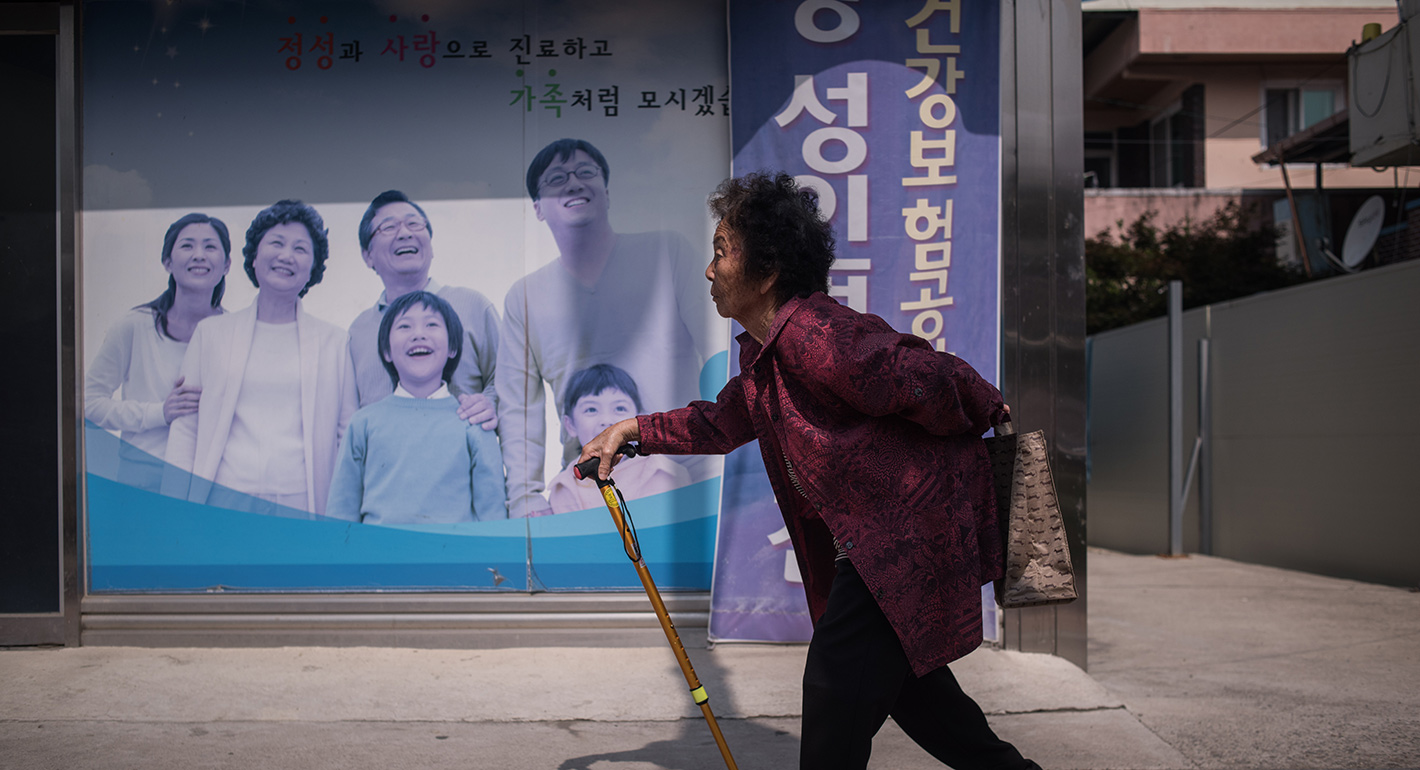
South Korea’s rapid demographic transition previews governance challenges many advanced and middle-income economies will face. This paper argues that aging is not only a care issue but a structural governance challenge—reshaping welfare, productivity, and fiscal sustainability, and reorganizing responsibilities across the state, private sector, and society.
In 2024, South Korea surpassed the 20 percent threshold that defines a super-aged society, with more than 20 percent of the population being over the age of sixty-five. By 2036, this will reach 30 percent; and by 2050, it will double to over 40 percent.1 This transformation is occurring at an unprecedented speed—Korea took less than twenty-five years to move from “aging” to “super-aged” compared to over 140 years for France (see figure 1).2
Advanced economies around the world have reached aged or hyper-aged status in the twentieth century (see figure 2). While hyper-aging is the trendline across all regions except sub-Saharan Africa,3 Korea’s exceptionally compressed demographic transition makes it an instructive case for understanding the governance pressures that aging economies will confront. Traditional arrangements—especially family-based care and employment-linked welfare—will prove inadequate under demographic strain.
Demographic decline poses fundamental questions about social and economic governance: If aging societies cannot easily expand public services or redistribute costs, how will governments seek to manage care, public safety, and productivity pressures instead? How are expectations around work, skills, and productive citizenship reshaped when longer working lives collide with aging bodies and shrinking labor forces?
This paper uses Korea’s experience to develop an analytical framework for understanding how population aging transforms governance. Governance here refers to how states organize and distribute responsibility for providing care, ensuring safety, and maintaining productivity. Rather than treating welfare, labor, and public safety policies as separate domains, it shows how population aging creates crosscutting pressures that force politically difficult choices about responsibility when traditional arrangements prove inadequate under demographic strain.
Understanding Korea’s response to hyper-aging requires an understanding of how the country has historically organized the relationship between economic development and social welfare provision.
As the country transitioned from poverty to prosperity between the 1950s and 1980s, it experienced the dual forces driving population aging—falling birth rates and rising life expectancy—simultaneously and at an accelerated pace. Mortality rates fell as healthcare access expanded, while birth rates declined sharply through both the natural demographic transition of industrializing societies and deliberate state family planning campaigns.4
These shifts fundamentally altered Korea’s dependency ratio—the balance between working-age adults and dependents. Korea’s dependency ratio fell sharply from 80 percent in 1960 to 42.5 percent in 2024—a seemingly positive trend suggesting fewer dependents per working-age adult (see figure 3a.) But disaggregating by age reveals a fundamental shift in the age composition of dependents and their relationship to the economy. Across advanced industrialized countries—from Japan and China to Italy, Germany, and the United States—young dependency ratios have declined as fertility fell (see figure 3b.) while old-age dependency ratios have risen as people live longer (see figure 3c.). Critically, from an economic perspective, young dependents represent future workers who will eventually contribute to the national economy, while elderly dependents will not re-enter the workforce or do so in a limited capacity—making the composition of dependency ratios, not just their total, a key governance challenge.
Korea initially benefited from favorable demographics: The post-Korean War baby boom in the 1950s created a large workforce that fueled export-driven industrialization in the 1970s–80s. Influenced by Cold War–era Malthusian fears of overpopulation and resource scarcity, in the 1960s the Korean government, in consultation with foreign health agencies, initiated a concerted family planning campaign to decrease birthrates.5 This resulted in workers supporting fewer dependents. This dynamic is observable across East Asia, where the “demographic dividend” was so powerful that demographers estimate this population trend alone accounts for one-third to one-half of East Asia’s economic miracle.6
But as birth rates continued to plummet in Korea from the 1980s onward, this advantage reversed. The working-age population peaked around 2020 and is declining sharply, while the elderly population continues to grow and youth population contracts (see figure 4). Today, a shrinking workforce must generate the tax revenue, caregiving labor, and economic productivity to support a rapidly growing elderly population. The burden on working Koreans intensifies dramatically: By 2065, pension contributions alone will consume one-third of workers’ income as the system exhausts its reserve fund by 2055.7
Korea’s postwar development prioritized economic growth through industrial policy—coordinating investment, building export industries, and expanding educational infrastructure.8 Social welfare remained limited, organized primarily through employment-based insurance and especially family care networks.9 In this developmentalist orientation, the state created favorable conditions for citizens to be economically productive rather than directly providing extensive social services.10 This configuration worked during rapid industrialization and the demographic dividend era.
However, today’s unprecedented rate of super-aging disrupts this arrangement by simultaneously straining both economic capacity and social support systems. The same demographic shift that shrinks the workforce (economic pressure) also increases care demands (social pressure) while eroding family care capacity (structural change). These aren’t separate challenges—they’re interconnected dimensions of a single, though complex, social transformation.
Korea has already crossed a threshold where the scope of state responsibility for social risk management is structurally expanding as the population ages and social insurance systems mature. Over the past three decades, the Korean state has rapidly universalized its core social insurance systems, including national health insurance (1977), pensions (1988), employment insurance (1995), and long-term care (2008).11
This expansion, however, has been uneven and politically constrained. Following democratization in 1987 and more decisively after the 1997 Asian Financial Crisis, successive governments expanded social insurance coverage and increased public involvement in childcare and eldercare provision, while simultaneously restructuring labor market institutions.12 Post-1997 reforms thus constituted an adaptive—but often internally contradictory—reconfiguration of state governance: Welfare expansion proceeded alongside labor market liberalization as policymakers responded to democratic constraints and emerging demographic pressures.13 The political consensus forged by the 1997 crisis enabled successive progressive presidents—Kim Dae-jung (1998–2003) and Roh Moo-hyun (2003–08)—to rapidly expand social insurance coverage. Yet these reforms produced contradictory outcomes: even as coverage expanded, the newly liberalized labor market generated a growing class of non-regular workers—comprising over 40 percent of wage earners by the mid-2000s—whom these employment-based programs struggled to reach.14
The central challenge facing Korea today is therefore not the absence of a social safety net but adapting its governance to demographic transformation by coordinating governance around workforce development, extended working lives, and eldercare provision. The state increasingly works to mitigate demographic risk, but responsibility for care provision and workforce adaptation remains fragmented across families, markets, and firms. As a result, pressures are shifting away from questions of coverage toward contested debates over contributions, productivity, and the governance of longer working lives.
This transformation, in turn, creates three specific governance pressures for super-aged societies that expose how economic and social policy can no longer be separated:
Each pressure involves both economic dimensions (labor supply, fiscal costs, productivity) and social dimensions (care provision, safety nets, quality of life). Traditional policy responses treated these separately—welfare expansion addressed social needs, while labor policy addressed economic needs. Like all aging societies around the world, Korea’s pressures are interconnected: Solving care without addressing productivity is impossible, extending working lives without care support is unsustainable, and protecting isolated elderly without considering fiscal constraints is politically unviable.
Advanced economies worldwide are grappling with unprecedented aging pressures, experimenting with different policy responses as traditional arrangements prove inadequate. In fact, high- and middle-income countries from all regions should take note of Korea’s experience with hyper-aging, because they already are or will soon be facing the same pressures.
Some countries, such as Germany and Japan, have expanded insurance-based long-term care coverage, accepting significant fiscal commitments and new state obligations.15 Scandinavian countries invested heavily in public care services, fundamentally altering the division between family and state responsibilities.16 Japan in particular stands out for having emphasized technological innovation, directing substantial public investment toward eldercare robotics and automation systems.17 Each approach involves different trade-offs between fiscal costs, institutional change, and technological adaptation—with no clear consensus emerging about optimal strategies.
As Korean policymakers and researchers became concerned about demographic decline as early as the 1990s, Korea’s response focused on reversing demographic decline through increasing the family size. In the 1990s and 2000s, declining fertility rates dominated government concern. As population growth slowed—and ultimately turned negative in 202018—public anxiety centered on preventing “population extinction,” reinforcing the emphasis on birthrate recovery as the primary policy objective.
The government has invested ₩280 trillion ($197.5 billion) since 2006 on policies aimed at increasing birth rates, including cash subsidies and support for infertility treatment, 19 and pursuing targeted temporary migration to supplement workforce shortages.20 This approach treats super-aging as a problem to be solved through demographic engineering rather than institutional adaptation.
These efforts reflected long-standing assumptions about family-based welfare provision and demographic correction, but their limited effectiveness in slowing aging trends has become increasingly apparent. As fertility continued to decline and workforce contraction accelerated, the limits of demographic reversal as a governing strategy grew clearer.
Korea’s unprecedented rate of super-aging creates three interconnected governance pressures that expose how economic and social policy can no longer be separated. Each pressure involves both immediate crisis management and long-term structural adaptation, forcing the government to address social needs while maintaining economic priorities.
Korea’s care crisis reflects population dynamics that have rendered traditional family-based arrangements nonviable. In 2024, 37.8 percent of elderly lived alone, with 18.7 percent having no assistance when ill.21 This represents a dramatic acceleration: Among elderly women, only 3 percent lived alone in 1960, but 31 percent did so by 2010; now, half of all elderly widows are living alone.22
The care gap widens as traditional caregivers enter the workforce while care demands multiply. Female labor force participation has grown dramatically among educated women, especially baby boomers born 1955–74.23 Simultaneously, the workforce that historically provided care is rapidly shrinking—from 72 percent to 56 percent of the total population by 2040.24
The same governance logic straining family-based eldercare is also fragmenting Korea’s health care system, which faces rising demand and remains ill-equipped for a hyper-aged population
Korean women shoulder a heavier burden for unpaid labor at home, similar to Japan, clocking in around five times longer than their male peers—double the gap from the OECD average.25 This creates a central paradox for Korea’s aging economy: The government expects women to extend their workforce participation to drive productivity gains,26 while the care ecosystem simultaneously demands they absorb a disproportionate share of unpaid labor at home—yet the government treats these as separate policy problems while they effect the same population.
The same governance logic that overloads families and women is fragmenting healthcare delivery. Korea’s healthcare system faces mounting pressure not simply because of rising demand, but also because existing governance structures for care are poorly aligned with the needs of a hyper-aged population. Although Korea’s overall health spending is close to the OECD average, elderly patients account for a disproportionate share of utilization: People aged sixty-five and older consume nearly half of total healthcare expenditures while comprising roughly one-fifth of the population.27 At the same time, availability of care workers is shrinking and aging. As one researcher involved in age-adaptive technologies noted, younger workers are increasingly unwilling to enter physically demanding, low-paid care occupations, leaving a rapidly growing elderly population supported by a thinning labor base.28
Care delivery remains fractured. A significant share of older patients receive treatment across multiple providers with minimal coordination, contributing to high rates of polypharmacy and potentially inappropriate prescribing.29 Korean medical practitioners and researchers attest that while government healthcare discussions address shortages in pediatrics, obstetrics, and emergency care, the need for primary care and geriatric medicine remains notably absent from policy discussions.30 This conclusion reflects the perspective of the policy community as well. According to a former Ministry of Health and Welfare official, debates over National Health Insurance financing are exposing deeper governance challenges related to care delivery, coordination, and the absence of institutionalized primary and geriatric care.31
Korea’s protection crisis emerges from eroding traditional safety nets, creating new state obligations for monitoring isolated elderly populations. Regional demographic patterns concentrate vulnerable populations in distinct ways that will shape the protection needs differently across the country. By 2020, sixteen rural regions reached “super-aged” status—four years prior to the national average reaching that threshold. Every region, both urban and rural, is predicted to reach this threshold by 2029.32
Safety-wise, vulnerable elderly face increasing risks, as seen in the surge of missing dementia patients. Annual dementia patient missing person reports increased 21 percent from 2019 to 2024 (from 12,131 cases to 14,677). Discovery time increased from 8.0 to 8.2 hours, indicating strained emergency response capacity. Despite available monitoring technology, only 2.9 percent of eligible dementia patients use detection devices—down from 4.6 percent in 2019.33
Emergency response systems face pressure from aging demographics, particularly in disaster scenarios. For example, about 73 percent of Korea’s seasonal wildfire fighters are over sixty years old, while more than 52 percent of residents in farming and forestry towns are now sixty-five and older.34 This creates situations where both vulnerable populations and emergency responders are predominantly elderly. The geographic dimension of aging creates a two-tier protection system where rural elderly face systematically higher risks despite having contributed to Korea’s development through decades of agricultural and industrial work.
Korea’s productivity challenge stems from population dynamics not only depress efficiency, but it renders traditional economic arrangements unsustainable. Firstly, productivity will decline due to the decrease in total labor population. Leading Korean economist Kim Sejik projects that demographic aging alone will cause Korea’s GDP growth rate to fall by one percentage point every three years, faster than the historical pace of one every five years.35 From a purely economic perspective, an aging workforce is framed primarily as a productivity problem: A shrinking labor force threatens growth unless offset by gains in labor productivity through innovation and efficiency improvements.36
Many employers informally force older workers to exit primary employment before meeting the statutory retirement age.
But the productivity costs are compounded by the elderly dependency ratio, which will grow from 28 percent in 2024 to 155 percent in the 2080s—faster than any other OECD country.37 Sectors with aging workforces face substantial transitions: employment in agriculture, forestry, and fishing declined 35.3 percent between 2010–19, and nearly two-thirds of agriculture and fisheries workers were elderly as of 2009.38
Current arrangements cannot support Korea’s aging population. Seniority-based wage systems cause compensation to rise automatically with tenure, even as firms’ legal barriers to dismissal make older workers costly to retain and difficult to reassign. As a result, many employers informally force older workers to exit primary employment before statutory retirement. Older workers then must re-enter the labor market through irregular contracts that lack stability and benefits.39 This pattern contributes to weak income security in later life: Nearly 40 percent of elderly Koreans live below the relative poverty line—the OECD’s highest rate.40
Traditional approaches—expanding taxation or reducing benefits—face both economic limits and political resistance, forcing the government to seek alternatives that enhance productivity without expanding fiscal obligations.
Individual labor market vulnerability is compounded by rising fiscal pressures: Korea’s health insurance systems will consume over one-quarter of worker income by 2072, as National Health Insurance premiums must rise from 7.09 percent to 25.09 percent while long-term care insurance (LTCI) increases fifteen-fold from 0.91 percent to 13.97 percent, breaching legal ceilings by 2028.41 These trajectories resemble those observed in most OECD countries that have introduced LTCI, including nearby Japan, where long-term care expenditures also rapidly outpace healthcare spending.42
Crucially, these fiscal pressures generate intergenerational conflict. Younger and middle-aged workers increasingly question subsidizing disproportionate elderly consumption, creating political resistance to expanded support precisely when demographic realities demand higher transfers.43 While the government still has space to raise funding through tax revenue—which remain lower than those of many advanced economies—the binding constraint is political rather than fiscal. As former officials in both the Ministry of Health and Welfare and the Ministry of Employment and Labor emphasized, resistance within the legislature and bureaucracies center on the political difficulty of justifying higher contributions to the younger cohorts already facing labor market insecurity and high housing costs.44 Traditional approaches—expanding taxation or reducing benefits—face both economic limits and political resistance, forcing the government to seek alternatives that enhance productivity without expanding fiscal obligations. In this sense, productivity pressure operates not only as a growth challenge, but as a governance problem shaped by institutional design and political feasibility.
Today, Korea faces a narrowing set of governing options and a mounting political and economic pressure to address aging. Traditional family-based care arrangements have become demographically unsustainable; welfare state expansion has carried escalating fiscal and intergenerational political costs; and alternative adjustments through immigration or labor market restructuring remain politically constrained. Yet the pressures of care, protection, and productivity cannot be deferred.
Under these conditions, the central policy challenge is no longer whether Korea can slow population aging, but rather how competing objectives are prioritized within institutional constraints and political considerations. Hyper-aging represents a stress test of Korea’s growth-oriented social policy model. Governing an aging society becomes a core challenge for Korea’s development strategy itself, forcing policymakers to confront trade-offs that the growth-first model was designed to defer rather than resolve.
While policy attention and fiscal resources focused on fertility recovery, parallel but more fragmented initiatives sought to adapt institutions to population aging. Over the past decade, Korean policymakers have responded to these pressures through a mix of care integration reforms,45 smart city legislation,46 and industrial modernization initiatives47 aimed at sustaining national productivity as the workforce shrinks. Taken together, these measures suggest discrete, politically negotiated efforts to manage demographic strain within the existing growth-oriented governance model.
Korea’s experience also carries broader implications for other aging societies around the globe. As one of the earliest cases of hyper-aging, Korea shows how rapid demographic aging can strain welfare and labor institutions long before it produces an outright fiscal crisis. The challenges of care provision, workforce adjustment, and fiscal sustainability are not unique to Korea, but Korea’s compressed transition makes visible how political constraints and institutional design shape the range of available responses. In this sense, aging societies face not only demographic or economic pressure, but a governing challenge that forces difficult choices about how responsibilities are shared across families, markets, and public institutions.
This project has been supported by donations from the Korea Foundation and the NC Cultural Foundation. The author would like to thank Randall Jones for his helpful comments on an earlier draft of this article.

Fellow, Asia Program
Darcie Draudt-Véjares is a fellow for Korea studies in the Asia Program at the Carnegie Endowment for International Peace. Her research focuses on South Korean political economy, governance, and foreign policy, particularly the intersection of economics, technology, and geopolitics.
Recent Work


Herbert Crowther, Darcie Draudt-Véjares, Walter James, …
Darcie Draudt-Véjares
Carnegie does not take institutional positions on public policy issues; the views represented herein are those of the author(s) and do not necessarily reflect the views of Carnegie, its staff, or its trustees.

A deep dive into the policy ecosystems behind battery development in China, South Korea, Japan, the European Union (including some of its member states), the United States, Canada, and India.

Milo McBride, Herbert Crowther, Darcie Draudt-Véjares, …

A look at why states without nuclear weapons are seeking naval nuclear propulsion, whether they can legally and technically deliver it, what it will cost them, and what responsible stewardship of the capability would look like.

Jamie Kwong

Over the past decade, China has moved from marginal player to major producer of all things batteries. The United States, Europe, and others are aiming to balance the market.
Milo McBride
Lee’s tour shows how Seoul is reorganizing its diplomacy away from Pyongyang and toward industrial networks and the geography of the compute economy.
Darcie Draudt-Véjares
President Lee marked his first year in office after one of the most tumultuous periods in South Korean politics. Though Lee has enjoyed a high approval rating, a large majority in the National Assembly, and foreign policy victories, Lee and his party’s political fortunes depend on generating economic growth, learning the right lessons from the recent local elections, and managing contentious factional strife within his political base.
Chung Min Lee