

Paper
Producing nuclear fuel quickly enough remains a major risk factor for the emerging advanced reactor industry.
Elmer W. Dyke
Source: Getty
The nuclear weapons threshold is increasingly important for proliferation strategy and policy. Policymakers should better understand the implications of the threshold phenomenon in the current international security environment and plausible strategies to deal with the growing challenge that it presents.
It is an honor for me to provide introductory thoughts to this essay on the nuclear weapons “threshold” by my friends and leading scholars in the field, Ariel (Eli) Levite and Toby Dalton.
The nuclear weapons threshold is a concept that is cited frequently but has not been rigorously studied. Eli and Toby, with this essay, have now begun that work. I believe this work is vital because we are likely to find more countries heading, either intentionally or unintentionally, toward being at the threshold of developing nuclear weapons. And, as a result, policymakers in Washington, Beijing, Moscow, and many other capitals are likely to face the thorny challenges of attempting to divine intent, measure time to a weapons capability, and craft policy responses that are attentive to both the specific case and the broader phenomenon.
Nuclear proliferation and the effort to arrest it have been high on the U.S. national security agenda since the advent of the nuclear age. The U.S. Intelligence Community (IC) and U.S. policymakers have spent significant time and resources to both understand the threat posed by proliferation and evaluate how to mitigate it. In most cases, our track record has been reassuringly good. In the few situations where either the IC failed in its work (such as in Iraq) or policymakers failed in theirs (for example, with North Korea), the consequences have been profound.
The phenomenon of the nuclear threshold, because of its ambiguity, represents an especially acute intelligence and policy challenge, leaving little room for either intelligence officers or policymakers to fail. Intelligence must first establish, at any given time, the exact status of the individual pieces needed to build a nuclear weapon and to decipher the intentions propelling a state toward the threshold. Policy must assess and implement the best options to influence a state’s behavior in a way that can be both viable and effective.
The United States and other states concerned about proliferation have relied on a rich toolkit for addressing nuclear programs of concern. Nevertheless, this study is most helpful in broadening the aperture for dealing with the nuclear threshold as the extreme edge of proliferation. It offers analysts a rich menu of tools for better understanding the dynamics and manifestations of such pursuit and elaborates on means policymakers could employ to contend with the challenges it poses.
While we all have focused over the past two decades on the threshold issue as it has related to the Iranian nuclear program, it is not the first time the United States encountered this challenge: Pakistan, Taiwan, South Korea, and North Korea immediately come to mind, though numerous other cases have also been of concern in the past among both U.S. allies and foes. Nor is Iran likely to be the last. And, as Eli and Toby show us in this paper, there is much to learn about the nuclear threshold from the past that can be applied to the future.
Michael Morell
Former Deputy Director, CIA
Former Career Intelligence Analyst, CIA
In a February 12, 2024, television interview, former Iranian Atomic Energy Organization chief Ali Akbar Salehi asserted that when it comes to the capability to build nuclear weapons, Iran had surpassed “all the thresholds of nuclear science and security.” He went on to say, “Here’s an example: Imagine what a car needs; it needs a chassis, an engine, a steering wheel, a gearbox. You’re asking if we’ve made the gearbox, I say yes. Have we made the engine? Yes, but each one serves its own purpose.”1 In effect, Salehi was describing the results of Iran’s efforts to accumulate the necessary technical and military capabilities to build nuclear weapons should its leaders decide to do so.
Observing Iran’s achievements, former secretary of the U.S. Department of Energy Ernest Moniz assessed, “The bottom line is Iran today is what we call a threshold state—it may not have a weapon today, but it has the capabilities and is very close to getting there if they choose to do so.”2 U.S. Secretary of State Marco Rubio asserted that by enriching uranium to 60 percent U-235, “You are in essence a threshold nuclear weapon state, which is what Iran basically has become. They are at the threshold of a nuclear weapon.”3 International Atomic Energy Agency Director General Rafael Grossi similarly noted that, “Iran is accumulating a vast amount of highly enriched uranium. And this is something that, of course, draws our attention because no other country without nuclear weapons is enriching at these high levels.”4
While the Iran case has become the most salient, it represents a broader and intriguing phenomenon. It also raises a handful of vexing questions: What does it mean for a state to pursue and then arrive at the nuclear threshold? What political, technical, and other dynamics follow from a decision to pursue from the outset, or perhaps subsequently settle on, a threshold status? And what are the broader normative and policy implications?
Nuclear proliferation scholars and national security practitioners alike have long been preoccupied with the motivations for and consequences of the pursuit of nuclear weapons, both generically and by a range of states over the last seventy years. In this context, the literature gives some attention to the outer edge of non-nuclear status, the line before a state acquires nuclear weapons, which is often loosely termed the nuclear threshold.5 Yet the literature tends to treat the nuclear threshold as a transient state—a passing phase on the path to nuclear weapons—or to downplay its significance. As such, there is no clear agreement in the nuclear analytic community on how to define or measure the threshold, that being, what activities or behaviors would signify that a state had achieved it, such as enrichment of uranium above 20 percent U-235, for which there are few legitimate peaceful applications, or conducting experiments on implosions of heavy metals. Nor does the otherwise extensive literature dealing with nuclear proliferation discuss the rationale for and general implications of a state pursuing and attaining a nuclear threshold capability, either as a permanent condition or even as a temporary holding pattern.6 By extension, there is little corresponding policy discussion on what the international community should do to dissuade states from seeking a nuclear threshold status or how to treat and respond to the emergence of threshold states.
Historically, the threshold phenomenon emerged in the 1950s to the 1980s, a time when some thirty states explored acquiring nuclear weapons, including a threshold capability. One noteworthy and early case is Israel, which the U.S. intelligence community considered to be capable of assembling nuclear weapons in very short order—simply by connecting the “last wires”—as early as 1968, although it has since maintained a policy of calculated ambiguity around its nuclear status.7 Similarly, India was at the threshold prior to its “peaceful nuclear explosion” test in 1974, and likely maintained that status between 1974 and a subsequent decision in the late 1980s or early 1990s to begin to manufacture nuclear weapons, followed formally by carrying out nuclear weapons tests in 1998 and declaring itself to be a nuclear weapon state. In contrast, Japan has possessed many of the technical capabilities needed for nuclear weapons, especially plutonium reprocessing, since the 1970s and likely could develop nuclear weapons within a matter of months. There is little public evidence to indicate Tokyo has active plans for a nuclear weapons option, though it is reviewing its long-standing three non-nuclear principles.8 Most states that flirted with the nuclear threshold ultimately stopped short or reversed course. A few opted to go beyond and seek nuclear weapons: India, South Africa, Pakistan, and North Korea succeeded and Israel is assumed to possess them, while Iraq and Iran (to date) were halted.
After a period of relative dormancy, the nuclear threshold is again prominent and policy relevant as additional states consider nuclear weapons options. Although the Iran case has been the most visible, it is far from unique and the analysis that follows is not merely a generalization of its implications. Indeed, several countries appear to be eyeing that status at present, especially among U.S. allies fearful that Washington will withdraw from long-standing security arrangements. For instance, Polish President Karol Nawrocki stated that Poland should pursue a security strategy “based on nuclear potential.”9 Many South Korean politicians and some former officials similarly urge development of “nuclear latency,” which they explicitly frame in terms of capability to develop nuclear weapons.10 And in June 2026, the Finnish Parliament amended the nuclear energy law to remove a categorical ban on nuclear weapons.11 In the aftermath of the U.S. and Israeli “Epic Fury” war with Iran, some states, including Iran, might conclude that a threshold status is not sufficient and the weapons themselves are necessary, while others could re-evaluate the costs and risks of pursuing a threshold status.
Furthermore, a massive expansion in nuclear energy use around the world, coupled with easing access to nuclear-capable delivery systems and changes in enabling technology, could provide states with more, easier, and potentially cheaper pathways to the nuclear threshold. This would be compounded by increased access to and production of fissile materials and exemption of fissile material from traditional safeguards monitoring for non-proscribed military uses. Together, these trends raise the significance of the challenge to differentiate nuclear programs that are solely designed to support peaceful purposes from those that are intended to serve as a platform for advancing nuclear weapons ambitions. Thus, it is timely to do a deep dive into this phenomenon: to understand its attributes, dynamics, and consequences, to analyze its policy implications, and to consider plausible courses of action to address it.
This essay argues that a nuclear threshold represents a distinct analytic category of interest that is increasingly important for proliferation strategy and policy. Regardless of whether a state consciously pursues a nuclear threshold capability as an end result, as a trial balloon, or as a temporary holding pattern before proceeding to nuclear weapon possession—as its original or evolved intention—it constitutes a far more robust posture than meets the eye. Moreover, the pursuit of the nuclear threshold unleashes a unique set of dynamics that have serious operational, political, strategic, and often geopolitical implications. Among these dynamics are profound dilemmas that will confront policymakers in states that may feel compelled to respond to a threshold aspirant’s advances.
Accordingly, this essay advances a possible definition of the nuclear threshold and discusses its attributes and different approaches to operationalize and measure it. It reflects on the diverse potential rationales undergirding national efforts for pursuing it, as well as the challenges of discerning intentions as a state nears the threshold. It then proceeds to explore the dynamics and implications that are unleashed by the pursuit of a nuclear threshold, and the special challenges these create for the International Atomic Energy Agency (IAEA) in fulfilling its mandate to verify that nuclear activities are not being diverted to weapons purposes. Finally, the paper concludes with some reflections on the policy implications of the threshold phenomenon in the current international environment, suggests questions that policymakers in responding states could use to help evaluate options, and lays out some plausible strategies to deal with the growing challenge that it presents.
By establishing clear definitions, measurement tools, and policy parameters, this essay aims to help foster more informed and less charged deliberation among potential threshold aspirant states on the putative costs and benefits, and among others—be they adversaries, partners, or allies—on how to respond. Though some may find it desirable to ban or at least delegitimize a nuclear threshold status, doing so would be politically, legally, and technically infeasible, and the alternatives could also pose acute challenges. Nevertheless, states that reach or aim to reach the nuclear threshold should face greater liabilities and transparency obligations to demonstrate that the threshold is not merely an interim point on the line toward full-fledged weapons acquisition. By the same token, other states, nuclear energy technology suppliers, and international organizations should demand credible reassurances that states won’t surpass the nuclear weapons threshold.
It is helpful to start with some simple definitions that will set the stage for the deeper analysis to follow. Confusingly, some of these terms (especially latency and hedging) are often used interchangeably in the nuclear literature, thus the need to be as specific and concrete as possible in differentiating these phenomena:
A nuclear threshold state is one that has accumulated the necessary means to acquire at least one nuclear explosive device within roughly three to six months of a decision to do so. This timeframe is generally tied to steps a state would need to complete to cross the threshold based on a capability to produce fissile materials, to weaponize those materials into an explosive package that could be mated to delivery systems, and military capabilities and plans for nuclear operations.
The threshold may be a specific target and the most advanced form of a broader nuclear hedging strategy, under which a state develops the necessary capabilities to build nuclear weapons while choosing to hold back from proceeding further for the time being.12 This is further distinguished from nuclear latency, which involves the unintended accumulation of advanced nuclear capabilities as part of peaceful nuclear or other military programs that could be relevant to nuclear weapons, but without the political motivation or a plan to create a nuclear weapons option.13
The nuclear threshold results from a state’s strategy to accrue the necessary means to develop nuclear weapons on its own within a short period of time, without acquiring actual weapons.
The nuclear threshold results from a state’s strategy to accrue the necessary means to develop nuclear weapons on its own within a short period of time, without acquiring actual weapons. This strategy implicitly assumes that a state could achieve a threshold capability without unequivocally crossing the legal bounds of the Nuclear Non-Proliferation Treaty (NPT) and while remaining in compliance with IAEA safeguards, even if it encroaches the norms behind these instruments. A threshold status may be the original aim or the consequences of a midcourse adjustment, and intended to be interim or indefinite. Yet the nuclear threshold is not necessarily a tipping point to weapons acquisition, leaving room for an open-ended standstill or even rollback of capabilities. The strategy necessarily entails overt and covert plans for protecting the achievement of a threshold capability from efforts to deny, undermine, cap, or reverse it, and to maintain the capability to proceed with nuclear weapons production should a political decision to do so be made. These plans would likely cover diplomatic, technical, and operational actions. A threshold strategy also involves a conscious aim, either before or once it has been attained, and either publicly or secretly, to use the status for domestic or international political ends, including for coercion or deterrence. Reaching the threshold, similar to nuclear latency or hedging, is primarily the result of choices (though not necessarily formal or explicit) made during politico-technical decisionmaking by state officials.
To illustrate the phenomenon described here, it is useful to place the nuclear threshold on a rough scale of nuclear weapons acquisition that combines temporal and technical elements:
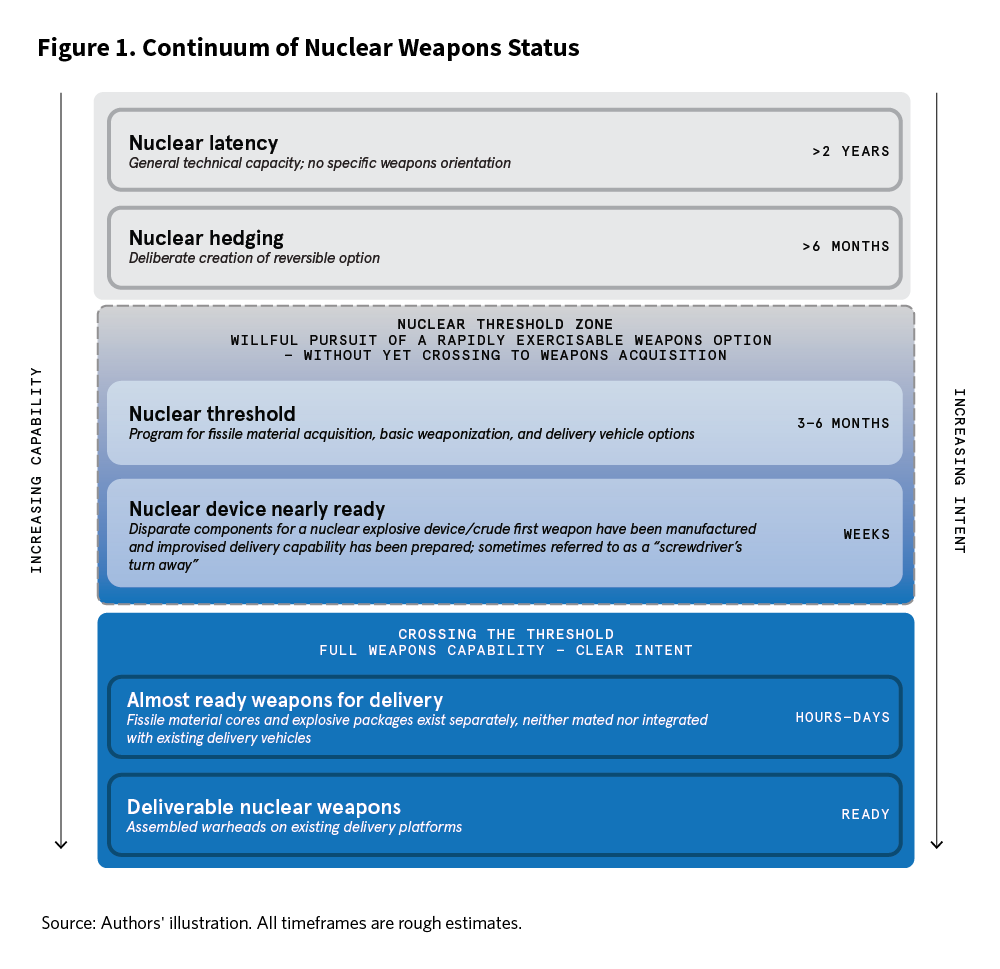
In short, the nuclear threshold may be seen as a discrete zone in a range that represents a willful pursuit of an option to acquire nuclear weapons, including a plan and the wherewithal to produce upon further decision deliverable weapons by the end of a specified time period. At the lower end of the range are more recessed forms of nuclear hedging, while at the higher end is full-fledged nuclear weaponization.
Threshold states will possess several common and necessary features. First, an intention, even if not fully articulated, to become a threshold state, but not (at least immediately) to proceed beyond it. Second, a program to acquire the requisite technical and operational capabilities to become a threshold state, especially in the domains of fissile material, weaponization and systems integration, delivery systems, and militarization. Third, a plan to quickly transform (upon further decision) the threshold capabilities into nuclear weapons. And fourth, a concept for how to leverage the threshold for domestic or international political or strategic gains. A threshold capability ultimately is determined by the cohere of these attributes to advance a nuclear weapons option toward maturity.14
Within the threshold category, states may be more or less advanced in having surpassed some technical milestones or even tested some key parts. Generically, states at a threshold capability would still need to produce weapons components before these could be integrated. Further, some militarization activities and delivery elements would probably still be embryonic or missing outright. This suggests there could be significant variation within the threshold category in how far along states are in developing or acquiring the requisite attributes, as well as how they pursue them, which could manifest in varying degrees of transparency and secrecy. Thus, a state could publicly reveal its threshold intentions, for instance by subjecting itself to IAEA safeguards and even using the engagement with the agency to bolster its claims to have reached a threshold status and done so “legitimately.” A state could accumulate near–weapons grade fissile material while being somewhat further behind at amassing the requisite weaponization, militarization, and/or delivery capability for nuclear weapons. That state could therefore be closer to producing a nuclear explosive device in the three to six months’ timeframe, but likely require more time to achieve a deliverable warhead. In contrast, another threshold state might be behind on acquiring the requisite fissile material but further along in weaponization and delivery vehicles, which could enable it to more quickly achieve a deliverable warhead as soon as it possessed sufficient fissile material.
Once a state produces fissile material cores and weapons components, however, it arguably has surpassed the threshold, even if it hasn’t assembled them into a device or a weapon or conducted a nuclear explosive test. This status has been colloquially referred to as being a “screwdriver turn away.” States that have achieved it (for example, India and Pakistan during the 1990s) are understood to exercise “non-weaponized deterrence,” given that they would need just hours or days to assemble the device or the bomb.15
To illustrate the threshold phenomenon, consider an analogy of a state on this proliferation continuum as a mountaineer. The mountaineer’s journey to the peak begins casually with a moderate uphill hike for which the individual only needs adequate clothing and supplies for the duration. At this stage of the journey, individuals with the simple intention of hiking this portion intermingle with those pursuing the uppermost peak. The path is safe, and the hiker can stay on it as long as they want or turn back without losing face, upsetting anyone, or harming themselves. This is the nuclear latent state, in which those pursuing a commercial nuclear energy program might be indistinguishable from those harboring ambitions for acquiring nuclear weapons as a derivative or under the cover of a peaceful energy program.
Those who continue up the mountain reach the first stretch of cliffs and glaciers. To complete this stretch, some technical know-how and supportive gear is necessary. Attempting the climb without either of these can be dangerous as the climber could find themselves physically incapable or not adequately supported by their equipment. But the climber could elect to stay put for a while to recharge and resupply, reflect on conditions for going further, or turn around and head back with hardly any loss of face and only modest incremental cost. The climber at this point is a hedging state, a country that has neither committed to the proliferation journey nor decided against it yet has consciously acquired some pertinent capabilities to advance further should it deem it propitious to proceed.
A threshold state is a mountaineer that has elected to go further, either obtaining a permit to reach a base camp or sneaking forward to reach a point just short of the mountain peak. Regardless of whether it had intended all along to proceed beyond the threshold to reach the peak and is taking a break and assessing readiness or had only wanted to get this far first and then evaluate its options, the peak is now within reach. And the mountaineer possesses a far superior vantage point on the prevailing conditions close to the peak, as well as many of the additional skills, assets, or equipment needed to get there. But equally the mountaineer faces a daunting choice: Heading onward to the mountaintop or conversely turning back toward home base are both possible, but each course of action is bound to be highly demanding and risky (albeit in different ways). Unlike a mountain climber who knows full well that a stay at an advanced base camp very close to the peak can only be brutally brief, a threshold state would have to consider the requirements of remaining there permanently. In both cases, though, procrastinating and prolonging the stay at the base camp for an extended period is also a viable option, but not entirely straightforward due to its inconvenience, maintenance costs, and persistent high risks, including that others may seek to force you up or down. The threshold also subjects the mountaineer to persistent conflicting pressures to make a decision, to either go further or backward. Prestige considerations, anxiety, fatigue, investment, competition, and doubt now all come into play in influencing the choice. So too are likely mounting pressures from friends and foes alike, some with strong vested interests in the choice.
There are two process-based approaches to operationalizing the threshold concept which work essentially as a function of proximity to attaining nuclear weapons.16 Both approaches aim at inferring nuclear status, but focus on different observables to measure the distance that needs to be travelled to reach a point of readiness to assemble nuclear weapons, though neither defines the threshold zone explicitly as such. One approach focuses on a specific activity that symbolizes crossing beyond the threshold. The other centers on possession of or an effort to acquire a set of capabilities that individually or collectively indicate a state has reached the nuclear threshold.
The activity-based approach is the least discussed in the nuclear proliferation literature. When it does receive attention, it commonly focuses on an observable action symbolizing achievement of a nuclear weapons capability, or at the very least advanced preparations to achieve it, namely a hot or cold test of a nuclear explosive device. (A cold test does not involve fissile material and therefore does not produce a nuclear yield.) Indeed, preparing to conduct such a test is very closely associated with the nuclear threshold even if, in practice, testing of a device instead of the testing of a weapon could be interpreted as moving to the extreme end of a non-weapons status but not fully crossing over to weapons possession.
Notably, Soviet and U.S. discovery in 1977 that South Africa was readying a nuclear test site in the Kalahari desert—even before it had produced highly enriched uranium—led both countries to pressure Pretoria to cease its weapons development activities short of a test.17 The Indian explosion of a nuclear device in 1974 is a somewhat different case in point, given that it was probably not until sometime in the 1980s or early 1990s that India actually began to produce a stockpile of weapons components, if not actual weapons.18 In these instances, albeit in very different ways, explosive testing had an indeterminate relationship to the threshold. Despite U.S. and Soviet pressure not to test, South Africa clandestinely passed through the threshold rather quickly to acquire a handful of nuclear weapons, whereas India seemingly lingered for roughly two decades before deciding to manufacture and ultimately test and deploy nuclear weapons. Similarly, Brazil prepared two shafts to conduct nuclear device tests, presumably as an exercise in developing the capacity to conduct “peaceful nuclear explosion,” but never carried out the tests (and sealed the shaft in 1990), nor acquired nuclear weapons.19 These cases thus indicate the challenges in using exclusively the activity-based approach to assessing proximity to the threshold.
A different activity that marks a far less observable surpassing of the threshold has been the acquisition of otherwise disparate components of a nuclear weapon, but at least temporarily holding back from mating a nuclear core with the nuclear warhead. For example, Pakistan in the early 1990s purportedly began to manufacture nuclear weapons but kept the fissile material cores, warheads, and delivery vehicles separate: an example of the more advanced “screwdriver turn away” status noted above.20 Finally, a public statement attesting to the (indigenous) possession of all the ingredients to acquire nuclear weapons in short order could also serve as the type of action associated with moving beyond the threshold. Such a public statement could be made formally, but might also be attributable to a leak and could originate either in the state undertaking nuclear development or another one observing its behavior. As with nuclear testing, other actions that might demarcate crossing beyond the threshold ultimately offer little analytic purchase for understanding behavior and implications within the threshold zone itself.
Unlike the activity-based characterization of the nuclear threshold, a capability-based approach typically focuses on attainment of an advanced state of nuclear readiness. This readiness results from meeting certain technical milestones that are only possible through a concerted, multi-disciplinary effort and considerable investment of resources over a significant period of time. One such milestone is accumulating a “significant quantity” (1 SQ) of fissile material, sufficient for a single nuclear weapon.21 Leaked intelligence from the United States in 1970, for instance, asserted that Israel had obtained sufficient plutonium for a nuclear weapon and had “component parts available for quick assembly,” meaning its nuclear possession was merely a matter of connecting the “last wire.”22 These leaks did not elaborate on the technical elements assessed to be in place to bring Israel to that state of readiness, however.
A nuclear threshold status is developed through planning and acquisition of technical capabilities in five areas: fissile material, weaponization and system integration, delivery vehicles, militarization, and policy and strategy. Not all attributes must be pursued simultaneously, let alone achieve the same degree of maturity.
Assessed through the capabilities lens, proximity to the threshold has come to be understood primarily in terms of breakout time. This would follow a state’s decision to “break out” of its commitment not to pursue nuclear weapons, including IAEA safeguards or other formal agreements. However, assessment of breakout time is heavily scenario dependent, thus it is important to consider how various conditions might affect the time to acquire nuclear weapons. For instance, pursuing nuclear sneak-out (instead of breakout) through a stealthy effort to move forward presumably would prolong the time required. That said, a contemporaneous, rigorous assessment of the time difference between the two scenarios would be extremely difficult and contingent on the nuclear base camp from which the state aimed to approach the peak.
A temporal measure of proximity to nuclear weapons acquisition is ultimately a function of possession or development of pertinent capabilities across the threshold attributes described above. In theory, these five attributes are observable, hence potentially lend themselves to objective, empirical assessment. This includes whether they are already present or missing in any given case and, if the latter, how long it would take to acquire them, assuming there is no interruption or intervention to stop or delay acquisition. Yet in practice, monitoring all five attributes is challenging intellectually, institutionally, and empirically. Unsurprisingly, therefore, one of these five—fissile material—has been the most commonly employed measure. This is the case primarily because fissile material acquisition constitutes a critical, relatively observable, and comparatively more quantifiable bottleneck toward nuclear weapons development. Typically, this is operationalized as the time to generate 1 SQ of weapons usable fissile material, which for a first-generation nuclear weapon is conservatively estimated by the IAEA as 8 Kg of Pu or 25 Kg of HEU.23
Fissile material assessment needs to factor in not only the technical parameters of the production process, but also the availability of personnel, equipment, special materials (for example, maraging steel or carbon fiber for centrifuges), and infrastructure to carry it out. An essential element for a state seeking to proceed quickly beyond the nuclear threshold is the ability to scale up production of fissile materials from pilot level to at least quasi-industrial scale, which is challenging, costly, and risky. (Iran’s accumulation of multiple SQs of near weapons-grade uranium is notable in this regard, given that it had no plausible and legitimate civil or commercial purpose.) Consistent with the centrality of the materials-based approach to measuring proximity to the threshold, the sole international institution in existence to monitor for nuclear proliferation and provide timely warning of potential illicit or illegitimate uses of technology and materials for nuclear weapons development is the IAEA. Its nonproliferation remit, however, is exclusively focused on fissile materials and associated activities. And even there, the agency is confined to assessing the completeness and correctness of a state’s fissile material declarations. No other international institution presently exists with the formal mandate to assess the other indispensable building blocks of a nuclear weapons program (for example, weaponization or delivery vehicles).
The prevalent temporal approach to measuring proximity to the threshold focusing on fissile material is understandable for its relative simplicity, even though this reductivity can yield very misleading assessments. Nevertheless, it is important to recognize that practically any assessment methodology is bound to be subjective and significantly affected by the perspective of the assessor. It is plausible that even if in command of all pertinent expertise, acting in good faith, and possessing significant knowledge about the subject nuclear program, various stakeholders may nevertheless employ different yardsticks to assess proximity to the threshold. And these may yield quite distinct outcomes. This is true both for those outside the threshold state as well as those within, and in both cases divergent assessments might be influenced by the relative weight assigned to the status (or likely pace of progress) in accruing threshold capabilities.
It is important to recognize that practically any nuclear threshold assessment methodology is bound to be subjective and significantly affected by the perspective of the assessor.
Internally, there is likely to be divergence in outlook both on what constitutes a threshold and proximity to it between the technical and scientific community working on the program and their policy or political leadership; this may be impacted by factors such as the latter’s confidence in the indigenous capacity to reach nuclear weapons in short order or information siloes. Externally, a threshold state’s adversaries and allies might take quite different views based on partial information and qualified intelligence estimates. Presumably, for instance, Egyptian officials had an assessment of Israel’s nuclear capability after 1968, and especially ahead of the Yom Kippur War, that informed their calculus of the potential risks of nuclear use during a military conflict; this assessment could have varied significantly from the views of officials in other powers such as the United States and United Kingdom, or even Israel itself.24
Even if one ignores the likelihood that some observers of a program might be institutionally or politically inclined to make worst case assessments, and others more benign ones, there is still likely to be considerable divergence in perspective in measuring proximity to the threshold from inside and outside the program. Experts assigned to carry out proliferation assessments may well differ in the values they attach to key variables, reflecting legitimate biases.
Experts within the program typically possess intimate knowledge of the status of relevant activities yet lack practical knowledge and first-hand experience of putting together the five elements to credibly reach or surpass the nuclear threshold. Theoretical knowledge as well as hands-on experience on how to weave together the various disciplines in such a sensitive and complicated project is especially challenging and may seriously affect the time frame and end result. Notably, experts inside the program may underestimate the difficulties involved and the time required to overcome them. They also may be unaware of or underestimate the effects of external efforts, whether political or operational, public or covert, to stymie or delay the program. Political and military leaders may be even less adept at evaluating technical progress and implications of counterproliferation actions. Inside experts might also manifest other, at times even opposite, biases. For example, some might be consciously inclined to under- or overestimate time required for progress they report to superiors. They might also be motivated to undersell the risks and the requirements for progress in order to get top level blessing for moving ahead, as appears to have been the case of Iraqi nuclear scientists who promised a pace of progress toward weapons to Saddam Hussain that was not technically feasible.25 There is also the potential for insiders to be motivated to protect themselves or embellish assessments and proposals in order to secure personal and institutional benefits by leading the way forward.
Foreign experts assigned the task of assessing a foreign nuclear program approaching the threshold may suffer from other biases. These experts, typically drawn from established nuclear weapon states, tend to adopt a risk perspective and assign values to these indicators based on their own experience and practices. However, that experience might be several decades old and reflect their own judgments about optimizing between various considerations (such as caution or reliability) that could be very different from those of the threshold state. Another factor is the potential for selective knowledge and insight into the program, including perhaps access to intelligence of insider’s assessments or promises. They may also have knowledge of outside efforts to disrupt a threshold nuclear program, though they may also overestimate the effects of such efforts. Relaxing the assumption about intimate access to the program by outside experts (given how secretive these programs typically are), the divergence in assessment between various internal and external stakeholders is likely to be considerably greater.
Finally, there is also the political and policy context within which indicators of progress toward a nuclear threshold are interpreted.26 Political and military leaders, for instance, may be prone to treat such information quite differently, whether to amplify concerns or to play them down in service of other objectives. Hence, strong exogenous considerations are typically in play that could bias assessment on how close a nation is to a nuclear threshold, only partially influenced by the so-called objective reality on where a state stands in terms of its physical capacity to assemble or deliver a nuclear explosive device.
In sum, the nuclear threshold represents a distinct and potentially enduring posture, in which a state is delicately poised—technically, politically, and operationally—between continued nuclear weapons abstinence and possession. One of the most important and vexing features of the threshold in this regard is how this uncertainty manifests in the challenge of measuring proximity to nuclear weapons, especially in terms of time. Even if there are clear equations that can be used to calculate how long it would take for a given state to produce 1 SQ, that measurement alone gives at best a partial and imprecise indication of the conditions that might lead that state to do so, as well as how long other states might have to mount a response before the instigating state had acquired nuclear weapons. To better address these considerations, it is more relevant to assess potential motivations and intent, which this essay evaluates next.
An extensive literature exists on the motivation of states to seek nuclear weapons.27 Some works also consider the motivations of states to pursue a nuclear hedging strategy. But the proliferation and hedging literatures do not explicitly address in any systematic way the unique considerations that shape the behavior of states that would seek to reach and stay at the nuclear threshold. Nor do these literatures address the distinction between pursuit of the threshold as a conscious strategy from the outset or as the result of subsequent developments that motivate states to settle for a more restrained form of nuclearization, or a far more advanced form of hedging. Regarding the latter, it seems quite plausible that the bargain represented by reaching but not moving beyond the threshold may not be the intended aim but rather a compromise reached later in the game. For instance, it might serve to deflect internal or external pressure and placate or reassure domestic opponents or foreign states (adversaries as well as allies), aiming for acquiescence to a threshold status as a preferable alternative to either going all the way to possession or settling for less capability.
This gap in the literature in many respects reflects the legal and normative complexity that surrounds the threshold phenomenon, which is integral to the question of motivation. Essentially, the nuclear threshold occupies a notable gray area in the normative and legal landscape for nuclear weapons. The Treaty on the Non-Proliferation of Nuclear Weapons (NPT) mandates that states without nuclear weapons undertake “not to manufacture or otherwise acquire” them, and to “accept safeguards” by the IAEA for verifying fulfillment of the treaty’s objectives in preventing diversion from peaceful to nuclear weapons applications.28 Yet, the NPT does not specifically define what it means to “manufacture or otherwise acquire nuclear weapons,” while IAEA safeguards are limited to verifying the correctness and completeness of a state’s declaration of nuclear materials, facilities, and activities. Practically, this means that a threshold capability could be acquired in compliance with the terms of these agreements, which negotiators understood at the time.29
The nuclear threshold occupies a notable gray area in the normative and legal landscape for nuclear weapons.
The underlying rationale for maintaining the NPT gray zone in which a threshold status exists was the widespread belief that nuclear weapons aspirant states could be persuaded to formally renounce weapons acquisition only so long as they could still maintain a nuclear weapons option in extremis. Specifically, states wanted the assurance that they could withdraw from their nonproliferation commitment on national security grounds with ninety-days’ notice, and de facto retain the capacity to quickly re-orient their programs toward weapons using the very same nuclear assets and materials that they had amassed legitimately for non-weapons purposes. Similarly, states could be persuaded to apply comprehensive safeguards to their fissile material activities, provided there were no proscriptions on producing and stockpiling significant quantities of weapons usable fissile materials, nor on other activities associated with nuclear weapons development. Several key premises undergirded this bargain: that acquisition of weapons-grade fissile material not only constituted a critical bottleneck to acquiring nuclear weapons, but was also technically and operationally challenging to undertake, let alone conceal; that non-nuclear states would largely forswear accumulation of significant quantities of weapons grade (or close to it) fissile materials under the false pretense of either peaceful or non-proscribed military applications; and that the accumulation and use of unsafeguarded weapons-grade fissile material for non-weapons applications (so-called non-proscribed military applications) would largely remain a practice confined to established nuclear weapon states. As a result, this gray area not only provides cover for pursuing and maintaining a threshold status, but also further eases the inhibition and trepidation leaders face when weighing the risks of pursuing this course of action.30
So while nuclear hedging—up to and including a threshold capability—was understood to not contravene the NPT or IAEA safeguards, the question of how far a state could go before it would have materially violated these provisions remains. If a state is within hours or days of being able to assemble a nuclear weapon, it has presumably surpassed the threshold.
These considerations are clear in the evidence from some historical cases that reaching the threshold may have been the goal from the outset, with the intention that decisionmakers would have political and strategic elbow room to decide later whether and how far to proceed. For example, Taiwanese officials were quite explicit in articulating a threshold status as the desired aim early in their program’s development in the 1970s and 1980s.31 In this way, a threshold strategy can provide leaders room for procrastinating over their final, potentially fateful, nuclear choice, as well as plausible deniability about their intensions and a face-saving option for reversal should conditions warrant—all within the bounds of the nonproliferation regime.32
Thus, the main contribution to the proliferation literature of this discussion is in dissecting possible unique motivations for pursuing the threshold as distinct from simpler forms of hedging or outright nuclear weapons possession, and the considerations that shape them. It also sets up further policy consideration below regarding opportunities and avenues to influence these considerations.
Before turning to the issue of motivation, it is useful to focus first on rationales for a state to seek the threshold and corresponding behaviors. The following plausible rationales that drive states to pursue the nuclear threshold are drawn from a review of historical cases. Although each is distinct, it is very likely that a leader could be driven by more than one of these rationales at any given time in their state’s nuclear development, and that their primary rationales shift over time as they navigate domestic and international opportunities and challenges. The rationales are presented in two clusters: the first pertains to domestic constituencies and allies, the second to adversaries.
Flexibility: Seeking a threshold status offers considerable flexibility, for it offers to placate both nuclear hawks and doves trying to influence government decisions on nuclear and security issues. A threshold strategy allows the leadership to keep options open to move either forward (toward weapons) or backward (toward a less capable form of hedging) fairly quickly, yet without imposing on them the need to decide far in advance if and when to do so. Furthermore, the flexibility afforded by a threshold status at least partially eases the anxiety accompanying key nuclear decisions that would otherwise be fraught with risk, positioning the nation within striking distance of weapons possession but equally able to backtrack without losing face.
The appeal of the threshold is further enhanced by the fact that it is not currently prohibited by any international convention, most glaringly the NPT and the Treaty on Prohibition of Nuclear Weapons.
Legitimacy: The appeal of the threshold is further enhanced by the fact that it is not currently prohibited by any international convention, most glaringly the NPT and the Treaty on Prohibition of Nuclear Weapons. Although both treaties ban weapon acquisition, neither bans a state from developing a threshold capability. Neither defines in either technical or other terms what constitutes weapons acquisition and the dividing lines between a threshold and weapons possession. And neither bans accumulation of materials, components, or other elements that would enable a decision to rapidly acquire nuclear weapons. This includes materials such as highly enriched uranium or weapons-grade plutonium that lack any conceivable peaceful application. Even the outer edge of threshold capability is not fully proscribed: One seminal disarmament agreement, the Tlatelolco Treaty creating a Latin American Nuclear Weapons Free Zone, explicitly allows for an “explosion of nuclear devices for peaceful purposes -- including explosions which involve devices similar to those used in nuclear weapons.”33
Presently there are few relatively well-defined technical applications that demarcate a weapons purpose. Notably, enriching uranium beyond 20 percent U-235, converting uranium and plutonium into metal, and casting uranium or plutonium metal are all activities that have few legitimate peaceful or non-weapons uses in contemporary nuclear energy practice. Although these are observable and symbolic as potential indicators of nuclear weapons, they are not legally proscribed, nor does there appear to be international consensus to ban them. Here, it is worth highlighting IAEA Director General Rafael Grossi’s observation that until its enrichment facilities were bombed in 2025, Iran was the only state without nuclear weapons to be enriching uranium to 60 percent, creating a stockpile without clear civilian purpose. Nevertheless, the significance of the apparent legitimacy of a threshold status was not lost on Iran, whose officials have explicitly repeated long-standing claims that Iran’s nuclear capabilities are permitted under international law and were achieved without violating the NPT.
Reassurance: Another salient rationale for seeking a threshold is the potential to reassure domestic or foreign audiences about one’s nuclear intentions, albeit with conflicting aims. Domestically, a threshold strategy can reassure hawks that the nation and its leadership are not abandoning the pursuit of a nuclear weapons capability and would be in a position to cement it in quick order if needed. By the same measure, the threshold can ease anxieties of domestic doves, allies, and at times even foes that, although the nation could develop nuclear weapons it has chosen not to pursue them.34
Leverage: Perhaps above all a nuclear threshold capability is strategically desirable for the potential leverage it affords. A threshold status endows its developer with leverage it might not otherwise have to obtain tangible benefits in return for committing to go no further. The benefits sought could be symbolic, material, or formal; in the personal, institutional, political, or strategic realm; and domestically or internationally valuable. In all such instances, it seems unlikely that these benefits would have been offered or received in the absence of the unique leverage that progress toward the nuclear threshold confers. By the same token, it is also unlikely that benefits would be offered for anything short of a credible commitment to hold back from crossing the threshold to weapons possession.
Historically, there were instances in which the motivation to make progress toward a nuclear threshold was envisaged from the outset as a means to obtain other benefits (such as extended security guarantees or arms supply). For example, during its nuclear weapons exploration in the 1950s, Sweden was able to gain civil nuclear energy cooperation and also a tacit commitment of protection from the U.S. nuclear umbrella.35 Yet in other cases, it appears that the potential utility of threshold leverage emerged later as an ad hoc response to pressures (and offers of a bargain) in return for exercising restraint. Another noteworthy permutation, potentially exercised by nuclear weapons averse leaders, is to evolve toward the threshold as a means to invite external pressures to desist, alongside offers to reward such restraint. Italian efforts to draw U.S. attention to its nuclear weapon co-development with France and Germany appears to fit this pattern, eventually rewarding Italy with a participation in the North Atlantic Treaty Organization’s (NATO) nuclear sharing arrangement in return from opting out of a European weapons program.36
Dissuasion: A threshold status also affords a different type of leverage against foes that pose a political, economic, conventional military, or subversion threat. In these instances, the aim is to draw on the threshold status to persuade those who might attempt to corner the state or otherwise adversely affect its security to pause or desist, utilizing the threat of surpassing the threshold if they persist or further escalate their hostile actions. Implied in this rationale is the notion that pushing a threshold state over the edge would make them less vulnerable to a foe’s threats and could also trigger a chain reaction that would hurt the adversary elsewhere.
A derivative of this rationale involves utilizing the nuclear threshold to discourage attacks or other coercive actions directly targeting the nuclear program. In this case, the threat involves a promise to proceed beyond the nuclear threshold specifically if the nuclear program is attacked or the state is threatened or subjected to other harsh measures to contain or roll back its nuclear program.
Deterrence: Distinct from dissuasion, a threshold status can also be utilized as a form of proto-nuclear deterrence that is directly and more narrowly targeted at adversaries’ nuclear intentions.37 The aim in this instance is to deter adversaries that may be interested, actively pursuing, or even already possessing nuclear weapons programs themselves. What is unique about this posture is the effort to leverage it to deter others from acquiring or employing nuclear weapons by communicating to them a threat to respond in kind, as Saudi leaders have stated Riyadh will do should Iran proceed to acquire nuclear weapons.38 The implied threat is that an adversary would not only fail to gain the nuclear leverage they seek but also find themselves in a nuclear arms race and potentially subject to nuclear retaliation.
Obviously, invoking the possession of a nuclear threshold capability lends credibility to both dissuasion and deterrence in ways that a more distant hedging option would not credibly do. Exercising the nuclear threshold for these purposes is equally predicated on offering adversaries credible reassurance in return, namely a promise of continued nuclear restraint if they hold back from antagonistic steps. Without such reassurance, the deterrent threat might not only fail but actually prove counterproductive, triggering the opposite actions they were intended to influence.
Offensive sanctuarization: Whereas dissuasion and deterrence rationales are more defensive in nature, a threshold status can also be used to create or expand operational space to engage in lower-level adversarial actions. Here, the aim is to attain the threshold to deter reprisals when the state seeks to subvert or even attack (covertly or overtly) at lower levels of violence: If the opponent threatens to counter with unacceptable potency, the threshold state can threaten to nuclearize. Interestingly the tendency to date has been to associate such coercive conduct with states that already possess nuclear weapons (such as Pakistan, North Korea, and more recently Russia). But as the Iran case reveals, it is possible, perhaps even tempting, to do so even before or instead of moving beyond the threshold, albeit when Iran already possessed the indigenous wherewithal to do so quickly.
These potential rationales indicate the many reasons that the nuclear weapons potential inherent in a threshold status may be potent and the driver for numerous states that contemplated it previously. Ultimately, it would seem that much of the appeal of the threshold rests with a common assessment that it offers many of the benefits associated with nuclear weapons with fewer of the risks and requirements of possession—that, as some Israeli leaders are alleged to have asserted, “an A-bomb that is, or is believed to be, ‘only a screwdriver away,’ is nearly as effective a deterrent as one that is openly brandished.”39 Yet this assessment is necessarily offset by concern that refraining from taking steps closer to the bomb can also carry significant risks, especially for states living in a highly unsettled security environment or facing serious (even existential) current or potential security risks. Leaders in Tehran, for instance, may reasonably conclude that stopping short of the bomb ultimately left Iran vulnerable to Israeli and U.S. attacks in 2025 and 2026, especially when comparing their own fate (and others that relinquished or were driven back from nuclear weapons, including Ukraine, Libya, and Iraq) to that of North Korea.
There are clearly certain similarities in the motivations that combine to produce a nuclear threshold with those that propel nations and their leaders toward acquisition of nuclear weapons: a lesser posture of hedging or latency, or renunciation of weapons altogether. Nevertheless, there are also important differences because the threshold represents a unique status and a course of action that manifests at the same time degrees of assertiveness and restraint. In essence, a state seeking the threshold must strike a balance between the desire to acquire nuclear weapons and the inclination to renounce them. It must simultaneously manage the tensions among considerations that point in diametrically opposed directions, while also projecting an aura of non-weapons purposes for sensitive capabilities to sustain their notional legitimacy under international norms, even as they leverage the threshold for various political ends. Given these tensions and the degree of careful balancing that managing them requires, leaders may be reluctant to admit some of the variables shaping their thinking given the potential for embarrassment or political controversy.
The threshold represents a unique status and a course of action that manifests degrees of assertiveness and restraint. A state seeking the threshold must strike a balance between the desire to acquire nuclear weapons and the inclination to renounce them.
A core question analysts must grapple with is not merely whether physical proximity to a nuclear threshold is observable in any particular case, but whether such development is the result of a conscious choice and active effort to approach, reach, or move beyond the nuclear threshold. This question is germane because certain attributes of physical proximity to the threshold could also be an unintended consequence of a broadly scoped peaceful nuclear energy program (latency) but could equally be indicative of a strong push toward outright acquisition of nuclear weapons, in which case a threshold status is merely a transient (and perhaps indistinct) phase. Even when the intent to reach the threshold can be credibly ascertained as the aim at any given time, it might still conceal the ultimate goal. For example, is the threshold strategy to possess all the elements necessary to quickly put together a fully deliverable warhead and launch it? Or, more modestly, is it to possess the capacity to quickly assemble and test a nuclear explosive device? These complications already make it exceptionally difficult to discern the motivations that drive decisions toward a threshold, and even more so to point to one primary motivation among multiple overlapping ones for seeking or settling for a threshold capability. Motivations are also likely case specific and could evolve over time.
In parsing possible threshold motivations, it is also important to bear in mind that the leadership of a nation that appears to be engaged in a nuclear weapons program may not be entirely consistent, decisive, unified, or explicit in articulating aims for the program. It is also probable that changes in political leadership can impact a nuclear program’s composition as well as its objectives over a typically long lifespan. This may occur because progress reassures the leadership that the threshold goal is within sight, or conversely, because reaching the threshold proves elusive, costly, difficult, and risky.
Furthermore, motivations might evolve as a function of shifting domestic considerations, or potentially due to the impact of external intervention(s)—whether diplomacy or more coercive acts, ranging from covert insertion of bugs to preventive military action—to set back the country’s nuclear ambition. Leaders may also engage in active concealment and outright deceit about their true aims, for example, to gain credibility for bargaining leverage or to defuse domestic pressure either to move forward in the nuclear development, to soften resistance to holding back, or even to pave the way for reversing course.40 Untangling the personal, institutional, political, and/or strategic threads in determining what constitutes a nuclear threshold is thus a considerable challenge.
Motivations therefore not only impact the underlying activities that propel states toward a nuclear threshold, but also the aim, pace, trajectory, and modalities for attaining it. These are reflected in timelines for progress, secrecy and compartmentation, and potentially also safety and reliability standards. Occasionally they also appear in publicity to reveal interest in a nuclear weapons option, as was clear from Ali Akbar Salehi’s car parts analogy regarding Iran’s nuclear activities. Admittedly, though, the impact of these softer factors in assessments of threshold motivations can be imprecise and subjective.
Understanding the motivational factors that underlie an observable nuclear reality becomes especially relevant the closer a nation approaches the threshold.
Yet, these motivations have repeatedly proven to be critical in their impact, having a bearing on whether states ultimately decide to: (1) pursue a threshold; (2) settle for a threshold rather than outright quest for a bomb; (3) walk back from the threshold; and (4) accelerate or slow down their actions, as well as the pace at which they proceed to do one or more the above. Understanding the motivational factors that underlie an observable nuclear reality becomes especially relevant the closer a nation approaches the threshold. As the U.S. intelligence assessments of Iran’s nuclear pursuit during the Joe Biden administration illustrated, once Iran reached a nuclear threshold status the ultimate key to the measurement of the gravity of the threat had become how one assessed its leadership’s intentions.
The preceding discussion highlighted some of the most prominent difficulties inherent in parsing the motivations that drive activities and determining whether these are a mere artifact of a nuclear energy program or are oriented toward creating a nuclear weapon capability. And, if the latter, whether they aim to yield a nuclear threshold capability, a weapon, or merely a more recessed hedging posture. It also highlighted how these challenges are compounded by the dual-use nature of nuclear technology, the secrecy and compartmentation, deception, and shifting rationales that can accompany nuclear programs, and by the absence of a widely accepted definition of what is a nuclear weapon and therefore what constitutes nuclear weapons development activity. The threshold phenomenon represents an extreme version of this challenge given the nominal legitimacy of this posture on the one hand and the short window to undertake corrective actions on the other, if it cannot be credibly established to be no more than a base camp for a weapons option.
Here it is worth recalling some earlier work, most prominently Carnegie’s Nuclear Firewall Project, that endeavored to address this conundrum.41 Recognizing that single indicators of potentially sensitive nuclear activity or intent are neither reliable nor sufficient in and of themselves, that work suggested some additional analytical tools to assess nuclear proliferation intent, status, and trajectory by leveraging context to help interpret pertinent but otherwise inconclusive nuclear signals. Four of these are especially applicable to the threshold phenomenon. First, the need to broaden the examination of the trajectory of a nuclear program to encompass all five threshold attributes: policy and strategy, fissile material, weaponization and system integration, delivery vehicles, and militarization. Second, to employ pattern analysis, assessing the significance of individual indicators of potential proliferation concern alongside others within and across these domains against known patterns of programs designed to bring a nuclear program, whether peaceful and weapons oriented, to fruition. Third, to employ additional, mostly public, contextual factors to assess the trajectory of a state nuclear program, assessing both the presence and absence of attributes of peaceful nuclear energy programs. Finally, to complement the IAEA safeguards’ focus on correctness and completeness (the two common Cs) of state declarations with analysis of three more Cs: compatibility, cohesion, and consistency. Together these would constitute the “5Cs” approach.
Compatibility addresses the degree to which individual activities are commensurate with their stated peaceful purposes, to include the scale, sequence, and given commercial or research justification. Cohesion assesses whether diverse, individual activities may be interconnected and reflective of observed pathways to acquire a nuclear weapons capability. Lastly, consistency reflects whether attributes of a nuclear program include the established features of non-weapons applications of nuclear technology (for example, in safety, security, environment, and liability).
The main reason that these tools are especially apt for assessing the nuclear threshold is that they are geared toward analysis of an advanced nuclear capability short of possession of weapon components. Further, their point of departure is the reverse of what has been commonplace in the nuclear proliferation literature, namely that they start from nuclear weapon requirements and walk backward toward the individual necessary elements. The 5Cs approach assumes that peaceful use of the nuclear fuel cycle and other advanced nuclear activities are legitimate and instead focuses on ways to discriminate between those activities and others that do require greater vigilance. They therefore can help highlight not simply why one ought to be concerned about a specific proliferation sensitive activity, but rather what (if anything) is still missing to possess nuclear weapons, thereby indicating whether a state is already at or approaching a threshold status, appears to be surpassing the threshold, or remains lower down the nuclear hedging spectrum. Finally, this type of contextual analysis can help to reveal whether a window of opportunity to influence the trajectory of a threshold program exists, an issue to which the essay turns after examining some practical aspects of the nuclear threshold to date.
Thus far, the analysis suggests that a nuclear threshold, once attained, can endow a state’s nuclear weapons option with considerably greater credibility and leverage, yielding a range of prospective benefits that could satisfy various motivations. And, as noted, the appeal of a threshold status is greatly enhanced by the fact that it is neither normatively proscribed nor operationally defined, and that apart from fissile material in most cases it is not comprehensively monitored. Consequently, as compared to a state that is aiming for nuclear acquisition, achievement of a threshold status could plausibly carry a diminished international price tag in terms of sanctions or other punitive measures, or even other downstream consequences such as arms racing by adversaries. Furthermore, a state seeking the threshold might conclude that fears of an armed effort to arrest a nuclear program are inflated and that a threshold capability could thus spare the country the need to invest more heavily in a fully-fledged, survivable nuclear arsenal.
However, this characterization of the various motivations to pursue a nuclear threshold and the putative benefits associated with it could inadvertently paint such pursuit as benign, compelling, largely inexpensive, or mostly risk free. None of these necessarily hold true in practice. Although a state seeking a threshold status could end up accruing the coveted results, it might also achieve far fewer gains and even end up exposed to serious risks.
The implications of a threshold strategy and, further, the dynamics that it can unleash—both for the threshold aspirant and for other states impacted by it—could revolve around several associated factors:
Cost: Unlike more recessed hedging postures or latent nuclear capabilities, reaching a fully-fledged threshold capacity requires a multi-dimensional effort with considerable and potentially scarce resources to attain and maintain over time. Efforts to reach the threshold on the cheap are likely to fall short while running other risks (for example, compromises in safety or reliability) in the process.
Expectations: A successful approach to the threshold is likely to generate unintended and potentially undesirable expectations, even pressure not to settle for a threshold but to take the program all the way to weapons acquisition. For instance, technical staff may push the boundaries without the explicit knowledge or authorization of officials. For officials in positions of influence, it would be tempting to go further to consolidate some of the benefits and gains the threshold confers, while potentially better deterring retributive actions. The calculus of Indian leaders in 1998 to order a series of nuclear weapons tests and thus formally surpass the threshold may exhibit this logic.
Escalation: The mere pursuit of a nuclear threshold, once detected, might spur various counteractions by those fearing such a program, including both allies or foes. They could impose sanctions or undertake covert actions and even military strikes to slow, halt, or reverse the program. Such actions might not only exact a toll but potentially also unleash internal or interstate contestation that could drive the program in unintended directions. For example, the escalation might lead some to favor restraint and halt the program, while others might seek to expedite, reconstitute, or expand the program well beyond its original aim.
Misinterpretation: The precarious balance between assertiveness and restraint required by the threshold carries serious potential for the intentions and actions underlying the pursuit to be badly misinterpreted by others. Underestimation could lead others to ignore or downplay the program, forcing those pursuing the threshold to intensify and amplify their actions to lend it sufficient credibility to achieve desired objectives. Conversely, overestimation of intentions (that is, assuming an aim to cross rather than stop at the threshold) could drive others to take the kind of escalatory actions noted above.
How various stakeholders and states navigate these factors, balancing between the risks and the opportunities presented by pursuit of a nuclear threshold, spurs disparate internal and external dynamics that shape potential outcomes. This context is likely sui generis, even as there would be some commonalities across cases.
One distinguishing feature of a nuclear threshold status among other proliferation strategies is the unique dynamics that follow from the incentives and complications enumerated above. These are driven by the combination of a sense of empowerment, perception of vulnerability, and the pressures these can trigger within the threshold state to go all the way to weapons or to backtrack, along with the difficulties for other states to evaluate and respond to the challenge presented by the threshold state.
Internally, these dynamics likely frame debates over the attributes required to attain, sustain, and protect the status. The lack of widely agreed benchmarks for operationalizing a nuclear threshold—as distinct from a capability that is either short of or has surpassed the threshold—create fertile ground for personal and institutional jockeying. Similar dynamics are likely to persist even after the threshold capability has been reached, fueled by the various costs associated with sustaining it over time, contention over suspending ongoing activities, and debates about the putative benefits of not proceeding to weapons acquisition. Although some threshold capabilities (for example, fissile materials) do not significantly atrophy over time, facilities, knowledge, and personnel do, requiring a conscious and costly effort to effectively maintain them.
Debates within Iran about the lessons to be learned from its experience in becoming a nuclear threshold state are not fully clear to outside observers, yet appear to have revolved around these issues. In particular, Iranian officials seemingly wrestled with how far to take its uranium enrichment activities and even more so its weaponization work; how much information to reveal about its posture as well as its capabilities to endow the nuclear weapons option with sufficient credibility so as to deter counteractions; and whether and over what terms to engage diplomatically on the scope and direction of its nuclear program.42 Some within the Iranian regime presumably argued to proceed to acquire weapons given the costs Iran was bearing from sanctions and other retributive measures; others likely argued over the sanctity of the fatwa against nuclear weapons issued by Iran’s supreme leader.43 Yet the Israeli and U.S. strikes on Iran’s nuclear facilities in June 2025, and broader attacks beginning in February 2026, indicate that Iranian officials did not manage the issue in a manner that spared them from military attack. Iranian officials profess determination to hold on to their nuclear gains but go no further, but it remains to be seen whether they conclude in the future that they can and should settle for a threshold, proceed to weapons acquisition, or backtrack to a lesser posture.44
Similar dynamics likely would apply outside the threshold state as others seek to make sense of and decide whether, how, and how forcefully to respond. As discussed above, much of the external discourse is rooted in the absence of clear and agreed upon benchmarks to gauge a nuclear status short of weapons acquisition. Complicating this debate is that many indicators for interpretation are subject to compartmentation, obfuscation, and manipulation on the part of the threshold state, lending themselves to widely contrasting interpretations. For outsiders assessing these indicators, objective interpretation is intrinsically difficult and further compounded by political and institutional biases that tend to inflate or downplay concerns. In particular, the interplay between the intelligence and policy functions in observing states can be highly charged, regardless of whether the threshold state is an adversary that poses a direct security threat or an ally whose status poses other risks and complications.
The intensity of the deliberation for intelligence departments would be fueled by the difficulties of reaching a definitive judgment on both the material progress toward a threshold status and the intent of the leadership in seeking that status. The policy debate, on the other hand, stems from the complex calculations and tradeoffs involved in responding to such developments. At the heart of these debates are the unique attributes of the case at hand as well as the broader and possibly precedential implications of the response. As explored further below, the main calculus pertains to the need to strike the right balance between incentivizing restraint and preventing progress toward a more advanced posture, while refraining from rewarding a threshold status in a manner that would entice others to follow suit. A closely related consideration is how to endow the response with sufficient appeal to be seriously considered by the target audience, yet avoid making commitments that are not feasible or desirable to fulfill.
An additional set of dynamics unique to the nuclear threshold concentrates on the IAEA and its role as the sole international entity with a mandate and some visibility to monitor nuclear programs and warn about any deviations from their intended peaceful orientation. However, past cases (South Africa, Iraq, Iran, and Libya, for instance) make clear that the IAEA’s ability to track and assess the nature of nuclear programs as they approach a threshold capability is constrained by its mandated focus on verifying the correctness and completeness of nuclear declarations. Furthermore, as noted above, IAEA safeguards pertain exclusively to fissile materials and unless otherwise empowered by the United Nations (UN) Security Council in specific cases the agency has no routine mandate to investigate other necessary dimensions (those being, weaponization and system integration, delivery vehicles, and militarization). The IAEA is also heavily dependent on the monitored state’s cooperation with requests for information and unimpeded access to pertinent documents, facilities, and people.
Thus, in threshold cases, the IAEA can institutionally do little more than report findings to its board of governors; warn about lack of cooperation with its inquiries if and when denied necessary access; confirm that the state has acquired the fissile materials it claims to possess; or indicated the state has failed to declare some fissile materials and activities if it can draw such a conclusion based on sufficient access. In none of these cases can it directly attest to the existence of a weapons program, let alone its status. However, there is precedent for the IAEA director general to issue statements in a personal capacity to contextualize the agency’s findings, as Raphael Grossi has repeatedly done on Iran.
Worse still, the agency might actually be used by a threshold state to document its progress in acquiring fissile material in compliance with safeguards arrangements, even as the agency is denied the capacity to ascertain that the materials are intended exclusively for peaceful or other non-nuclear weapons applications. In other words, as was partly evident in the Iran case, the IAEA might controversially be used to confirm that a state is playing by the safeguards rules while actually laying the groundwork to develop nuclear weapons. Moreover, the agency could inadvertently lend credibility to a state’s claims (based on their fissile material accomplishments) that they legitimately reached a threshold status, while being deprived of the capacity to provide timely warning if and when these could be leveraged to acquire nuclear weapons.
Notwithstanding the presumed appeal of a nuclear threshold, of the many states that contemplated or pursued nuclear weapons programs from the 1960s to the 1980s, relatively few decided to seek or sustain a threshold status. And even after most of these have abandoned the outright pursuit of nuclear weapons, few others have opted for a threshold since. Why might this be the case? Although no definitive answer is possible, the historical record of states suggests a few plausible explanations that naturally bleed into more generic observations on nuclear timidity or emboldening, albeit with some unique nuances. None of these are mutually exclusive and all have some empirical evidence to support them, though none can be conclusively proven.
First, several states that might have been tempted to seek a threshold status were persuaded by the offer of external security guarantees, the threat of pressure, or some combination thereof, to walk back from sustaining an advanced nuclear program. Another way of seeing this is that some states succeeded in using the threshold prospect for bargaining.45 Evidence for this hypothesis is found in the U.S. security guarantees extended to NATO members through the Article V commitment to collective defense—and to unique nuclear sharing arrangements with those NATO members that explored nuclear weapons options most seriously, namely Germany and Italy—and individual defense commitments in other forms to Japan, South Korea, Australia, and, to a lesser extent, Taiwan and Sweden. Similarly, the Soviet Union’s protections for Warsaw Pact nations may have diminished threshold incentives, if Moscow would have tolerated such efforts. Ukraine’s 1994 decision to surrender the Russian nuclear weapons on its territory in the context of the ultimately weak security guarantees provided under the Budapest memorandum is a more recent, though nuanced, case. To the extent that this hypothesis—that the provision of security protection can be a better alternative than pursuing threshold status—would apply to contemporary or prospective cases, changes in the perceived credibility of U.S. security guarantees could influence traditional U.S. allies to seek a nuclear threshold, or, in the case of European allies, to collectively pursue a nuclear umbrella alternative. Recent statements by some leaders and prominent politicians in a few European capitals, as well as in Tokyo and Seoul, lend support to this possibility.46
A second explanation is that at least some states and leaders concluded that a nuclear threshold status would not bring greater benefits than its assessed costs, leading them to either surpass the threshold or settle for a lesser nuclear capability. For some highly security-conscious leaders (such as Kim Jong Il in North Korea in the mid-2000s and Pakistan’s civilian and military leaders in 1998), going all the way was presumably seen as more expedient on the assumption that the costs and risks of staying at the threshold would not be significantly less than those of actually acquiring weapons. Conversely, others (such as South Korean leaders in the 1970s, who faced threats from the United States to withdraw security protections if they persisted with a nuclear weapons effort) may have assessed that the benefits of seeking or stopping at the threshold would be less than the risks. Cost considerations involved in building a credible nuclear threshold capability and sustaining it over time might factor in this calculus. This would especially be the case if they factored in a capacity that is less vulnerable to preventive strikes or includes enough redundancy to allow quick reconstitution after such an incident.
A third explanation centers domestic political inhibitions to pursuing a nuclear threshold status. These could be ideological in nature, rooted in general aversion to nuclear weapons as seen in Japan from the 1960s to today. But such inhibitions might be amplified in the context of the threshold, predicated on the fear that mobilizing the technological, scientific, industrial, bureaucratic, and broader political infrastructure necessary to reach a threshold might generate momentum that would eventually make it politically impossible to actually stop there once the status was achieved. The domestic pushback against the Japanese prime minister’s 2025 announcement that her government would re-assess its long-standing non-nuclear principles may be one example of this phenomenon.47
In most historical cases, leaders that considered or even initiated steps toward the nuclear threshold ultimately desisted.
Clearly, for one reason or another, in recent decades fewer states have decided to contemplate a threshold status compared to earlier periods of nuclear history. In most historical cases, leaders that considered or even initiated steps toward the nuclear threshold ultimately desisted. However, the plausible explanations elaborated above may not hold to the same extent in the future. Ongoing developments in the international system might spur more states to seek a threshold status, perhaps even quickly. If this phenomenon were to emerge, it would impose very difficult dilemmas on already overstretched policymakers struggling to confront myriad pressing domestic and international challenges.
Devising effective responses to future threshold cases will be incredibly challenging given the inherent uncertainty regarding the pursuing state’s intentions and capabilities. This would hold even in cases where this uncertainty miraculously could be eased such that it was clear whether or not a threshold status was intended as a temporary stop or a long-term base camp with agreed parameters about proceeding further. Nonproliferation-minded decisionmakers would still face painful dilemmas in calibrating a response that would neither reward the threshold aspirant and invite other states to follow suit, nor hasten the program, harden the aspirant’s resolve, or push it beyond the threshold. These dilemmas essentially revolve around the fear that getting it wrong would limit the viable options to counter, potentially leaving highly unpalatable choices ranging from acquiescence to military confrontation. The very nature of a threshold status exacerbates these dilemmas given acute time pressures for response decisions. Notably, all these issues can be seen in the situation created by the piecemeal responses to the advances in the Iranian nuclear program since the early 2000s. Hanging over leaders is a broader question and concern about how a threshold state (or a newly nuclear-armed state) might behave.
The bottom line is that nuclear threshold cases force policymakers to confront vexing and high consequence choices, often under conditions of uncertainty and time pressure and framed by worst-case assumptions that serve to offset uncertainty both about the risks of inaction, but also the likely adverse consequences of acting with force. Judging by the cumulative experience to date, policymakers tend to respond to threshold cases in two ways. First, they procrastinate on the grounds that some of the uncertainties could dissipate with the accumulation of more pertinent information, or to avoid failure on their watch.48 Examples of such procrastination can be found in the inconclusive U.S. deliberations over preventing China’s nuclear weapons acquisition in the 1950s and 60s and subsequently North Korea’s effort from the late 1980s.49 Less obviously, Israeli leaders arguably procrastinated before deciding to strike Iraqi, Syrian, and subsequently Iranian nuclear facilities. The latter is probably the most telling of the lot because Israel, despite persistent debate, over many years held off from attacking Iran militarily, even when Iran had obviously and significantly surpassed the 20 percent enrichment level Prime Minister Benjamin Netanyahu had publicly identified as a red line in a 2012 UN General Assembly speech.50 Yet Israeli officials repeatedly agonized over a military strike against Iran’s nuclear installation and refrained from doing so until mid-2025. Even then, Israel elected to proceed only after apparently reaching the conclusion that Iran was moving beyond a threshold status, which it had achieved a few years previously, toward even closer proximity to nuclear weapons.51
Second, in addition to procrastination, policymakers are likely to reject suggestions to employ military measures to prevent a state from reaching the threshold, even if they do not preclude the option to use force to prevent it from crossing the threshold. Inhibitions about the commitment necessary to produce a kinetic success and anxiety about the immediate escalation that such attack might trigger are key concerns. Most critically, however, policymakers are likely to defer use of force in consideration of the odds that a successful strike might delay nuclearization but not yield enduring benefits, and in particular might even expedite and harden a decision to move beyond the threshold thereafter.
These inclinations may frame the policy debates, but within these bounds are a series of both case-specific and generic issues that government officials will need to evaluate. Beyond these immediate questions, governments would also be wise to consider measures to better manage the risks that could arise if more states opt to seek nuclear threshold status in the future.
As policymakers agonize over how to deal with a state approaching the nuclear threshold, they will inevitably confront a series of difficult policy questions. The parameters of debate described above turn around these questions, which tend to fall into two categories relating first to the specific case at hand, and second to the implications for broader security and proliferation issues. This list of questions hardly lends itself to definitive generic answers, but it can serve a useful purpose by cueing policymakers to the issues they may wish to consider if and when presented with a concrete threshold case.
Naturally, real-world policy deliberations are unlikely to seriously address all of these considerations, at least concurrently. Nevertheless, for policy planning purposes it might be helpful for officials to have a check list in mind to focus information collection and analysis and development of policy options. Such broad preparation can help to mitigate the challenges involved in predicting in advance which issues will resonate with officials charged with developing the policy options or choosing amongst them.
Dozens of nations harbored nuclear weapons ambitions from the 1950s to the 1970s—what might be considered the proliferation heyday. Some were determined to acquire weapons, while others were content to position themselves to be able to do so quickly, yet procrastinate the decision on whether to go all the way. Initially, no universal norms were in place against nuclear weapons acquisition. The NPT was only concluded in 1968, went into effect in 1970, and took another two decades to reach almost universal adherence. Similarly, safeguards on nuclear material activities only came into being in the late 1950s and similarly took many years to gain broad global adherence even in their most rudimentary form. Thus, the quest for nuclear threshold status was widespread in practice during this period, yet de facto also seen as consistent with the overall effort to stem the pursuit of nuclear weapons, as discussed above.
This approach to the bargain generally worked. It allowed for NPT negotiations to conclude and succeeded at wooing numerous states to ratify the NPT and apply comprehensive IAEA safeguards. Many states that considered nuclear weapons subsequently walked back from pursuing or even maintaining nuclear threshold status, especially as the appeal of nuclear weapons subsided and the value of extended security guarantees from the major powers grew in importance. And, apart from North Korea, proliferation threats from the 1980s to the early 2000s largely resolved with this bargain intact.
However, changing circumstances and technologies cast the tradeoffs inherent in this historical arrangement in a new light. And some decisions or accommodations that in the past looked like prudent concessions to make headway in universalizing the nonproliferation norm now look more dubious in the current geopolitical and technological environment. For example, contrary to earlier premises, dissemination of centrifuge enrichment technology has greatly eased the technical, operational, and economic barriers to obtaining militarily significant quantities of fissile materials. Enrichment facilities can be constructed and operated far more covertly than imagined, making their discovery much more challenging. The growing appeal of commercial energy production as well as non-proscribed military applications involving nuclear fuels with higher levels of enrichment provide an incentive and could serve as a cover to create a fissile material threshold capability. Similarly, though not inherent to the early nonproliferation bargain, yet increasingly relevant to the contemporary threshold challenge, ballistic and cruise missiles and other remotely piloted aerial vehicles that can deliver nuclear weapons have become more widely available. Moreover, information and sources of supply related to weaponization and militarization are more accessible and further blur the lines between nuclear and conventional weapons.
Meanwhile, the normative space around the threshold remains, albeit unequally applied and tricky to navigate. For example, in 1988 the United States consented to Japan’s uranium enrichment and plutonium reprocessing program, but has not granted equivalent permissions to South Korea, where there is an active, public nuclear threshold movement that clouds perceptions of the non-weapons legitimacy of its interest in the fuel cycle.52 In Brazil, the navy operates an enrichment facility which is intended to produce fuel both for civilian purposes and a nuclear-powered submarine, thus blurring the boundaries between these domains. Some states, therefore, may achieve a robust threshold status while claiming legitimacy for their activities and without formally violating any international norm, yet with no viable guarantees that they would desist from going further, nor an adequate system to give timely warning if and when they elect to do so. Conversely, there are limited institutional arrangements states can utilize to reassure others of an intention not to exceed the threshold.
Given the analysis presented in this essay, there is growing need to explore various policy options to address the nuclear threshold predicament. The contemporary context is hardly conducive for achieving broad cooperative international action necessary for progress on this front, however. North-South relations are polarized over the stalemated disarmament agenda. Traditional P5 cooperation on nonproliferation matters has increasingly given way to geopolitical competition between them. Previously close security relations among the United States, the UK, and France are strained. Growing anxiety about long-standing extended U.S. security guarantees appears to be increasing the appeal of nuclear weapons options among several U.S. allies in Europe and Asia.
Nevertheless, there are numerous options that states could explore that are at least theoretically plausible, with varying degrees of practical or political difficulty. Some of these would apply generically, with the goal of improving general transparency and reassurance around nuclear activities, while others would focus specifically on sensitive nuclear practices of relevance to the nuclear threshold.
Building on the discussion of potential policy options for managing the nuclear threshold, a few general political considerations will influence the odds that any steps would be broadly endorsed and implemented.
First, the natural tendency has been and remains to be to treat threshold cases on an ad hoc basis, even among those policymakers who recognize the problematic situation presented by the broader phenomenon. A transactional, case-specific approach toward proliferation challenges in general appeals to many in the policy world who despair at the difficulty of building support to address it holistically. The threshold challenge likely appears to them no different. Yet notwithstanding the virtues of the case specific approach, devising such solutions would face fierce resistance over perceptions that they favor one state’s allies or discriminate against its foes. In contrast, a generic framework would help create a normative context within which to address individual cases, just as the NPT has done for the broader proliferation problem.
Second, and relatedly, the political stalemate over balancing the three pillars of the NPT—disarmament, nonproliferation, and peaceful nuclear energy—does not create a conducive environment within which to tackle proliferation challenges. Specifically, it seems inconceivable to make additional demands of, or impose restrictions on, non-nuclear states while progress on nuclear disarmament remains deadlocked.. Proposals for new normative arrangements that could be perceived to encroach further on the rights of non-nuclear states to peacefully develop nuclear energy or unduly impose additional burdens on them are bound to face fierce resistance. At the same time, intense geopolitical competition between major powers is driving expansion of their nuclear arsenals while also frustrating the type of cooperation that would be needed for more effective nonproliferation. That said, it is worth testing the proposition that various forms of positive incentives, especially in the nuclear energy domain, might make such arrangements more feasible.
Third, it seems advisable to make a concerted effort to avoid feeding the deeply held perception that new arrangements and requirements to tackle the threshold phenomenon implicitly cast doubt on the sincerity of non-weapons states’ NPT obligations. To that end, it would be important to present and package any new pertinent arrangements as universal and non-discriminatory (that is, applicable to all), offering a more straightforward path for any state to reassure others about its peaceful nuclear intentions. These would be applicable only to states that scale up their nuclear fuel cycle activities in ways that indicate a trajectory toward the threshold. Here, it is critical to align expectations of conduct (reassurance and transparency) with the type, level, and scope of nuclear activity. Nuclear technology providers should be willing to increase assistance, facilitate exports, and ease the reassurance burden on states that undertake no fuel cycle activities, while raising expectations of those who pursue such activities unilaterally.
Whether Iran might have remained at the nuclear threshold without the 2025 U.S. and Israeli strikes on its nuclear and missile programs is debatable. What isn’t up for debate is that it had carefully built a nuclear threshold capability and was using it for political ends, and that it has been highly reluctant to give up that capability even when facing severe sanctions and ultimately military attacks. Trendlines suggest that several other states could follow Iran’s path, presumably aiming to avoid its perceived missteps. This supports the contention that a prominent international political challenge going forward is to further develop the analytical tools to accurately diagnose threshold cases and the policy options to address them effectively in ways that are neither overly alarmist nor unduly conciliatory. This challenge is growing in importance against the background of renewed interest in the growth and spread of dual use nuclear energy technologies.
As the repeated crises over Iran’s nuclear program vividly demonstrated, a sustained failure to find a peaceful solution to the challenge presented by a threshold state could result in a military confrontation, which might not be able to adequately resolve the proliferation problem and might even make it far worse, in addition to causing other adverse effects. Regrettably, the current state of international politics is not auspicious for developing a more consensual approach to dealing with this challenge. Recognizing this reality, this essay offers for consideration an especially broad range of analytical tools and diplomatic options tailored to the unique considerations that attend the threshold phenomenon, with the aim of encouraging both scholars and practitioners to take these further in their studies and policy deliberations.
We wish to thank Celia McDowall and Cara Wilson for excellent and comprehensive research support in producing this essay. We also are grateful to George Perkovich, Corey Hinderstein, Amit Grober, and Chris LaRoche for constructive critiques on the draft. We benefited greatly from conversations with Eric Brewer and Avner Cohen, and feedback from colleagues during briefings and workshops in Washington, Paris, Vienna, and Beijing. We remain responsible for any remaining errors of omission or commission.

Senior Fellow, Nuclear Policy Program, Technology and International Affairs Program
Levite was the principal deputy director general for policy at the Israeli Atomic Energy Commission from 2002 to 2007.

Senior Fellow and Co-director, Nuclear Policy Program
Toby Dalton is a senior fellow and co-director of the Nuclear Policy Program at the Carnegie Endowment. An expert on nonproliferation and nuclear energy, his work addresses regional security challenges and the evolution of the global nuclear order.
Carnegie does not take institutional positions on public policy issues; the views represented herein are those of the author(s) and do not necessarily reflect the views of Carnegie, its staff, or its trustees.

Producing nuclear fuel quickly enough remains a major risk factor for the emerging advanced reactor industry.

Elmer W. Dyke

The real test may come after the leaders leave the room.



Sheena Chestnut Greitens, Oriana Skylar Mastro, Yukon Huang, …

The nuclear relationship between China and the United States is increasingly shaped by widening perception gaps rather than deliberate strategic design.

Tong Zhao

A look at why states without nuclear weapons are seeking naval nuclear propulsion, whether they can legally and technically deliver it, what it will cost them, and what responsible stewardship of the capability would look like.

Jamie Kwong

Congress should ask tough questions about the agreement’s more unique features and whether they advance U.S. interests or compromise them.

Jane Darby Menton