

Commentary
The Horn of Africa countries are among those facing a new security calculus.
Andrew Leber, Lesley Anne Warner
{
  "authors": [
    "Andrew Leber",
    "Jane Darby Menton"
  ],
  "type": "questionAnswer",
  "blog": "Emissary",
  "centerAffiliationAll": "dc",
  "centers": [
    "Carnegie Endowment for International Peace"
  ],
  "collections": [
    "U.S. Nuclear Policy",
    "Responsible Nuclear Energy"
  ],
  "englishNewsletterAll": "menaTransitions",
  "nonEnglishNewsletterAll": "",
  "programAffiliation": "MEP",
  "programs": [
    "Middle East",
    "Nuclear Policy"
  ],
  "regions": [
    "Saudi Arabia",
    "United States",
    "Middle East",
    "Iran",
    "United Arab Emirates"
  ],
  "topics": [
    "Nuclear Energy",
    "Nuclear Policy",
    "Foreign Policy"
  ]
}
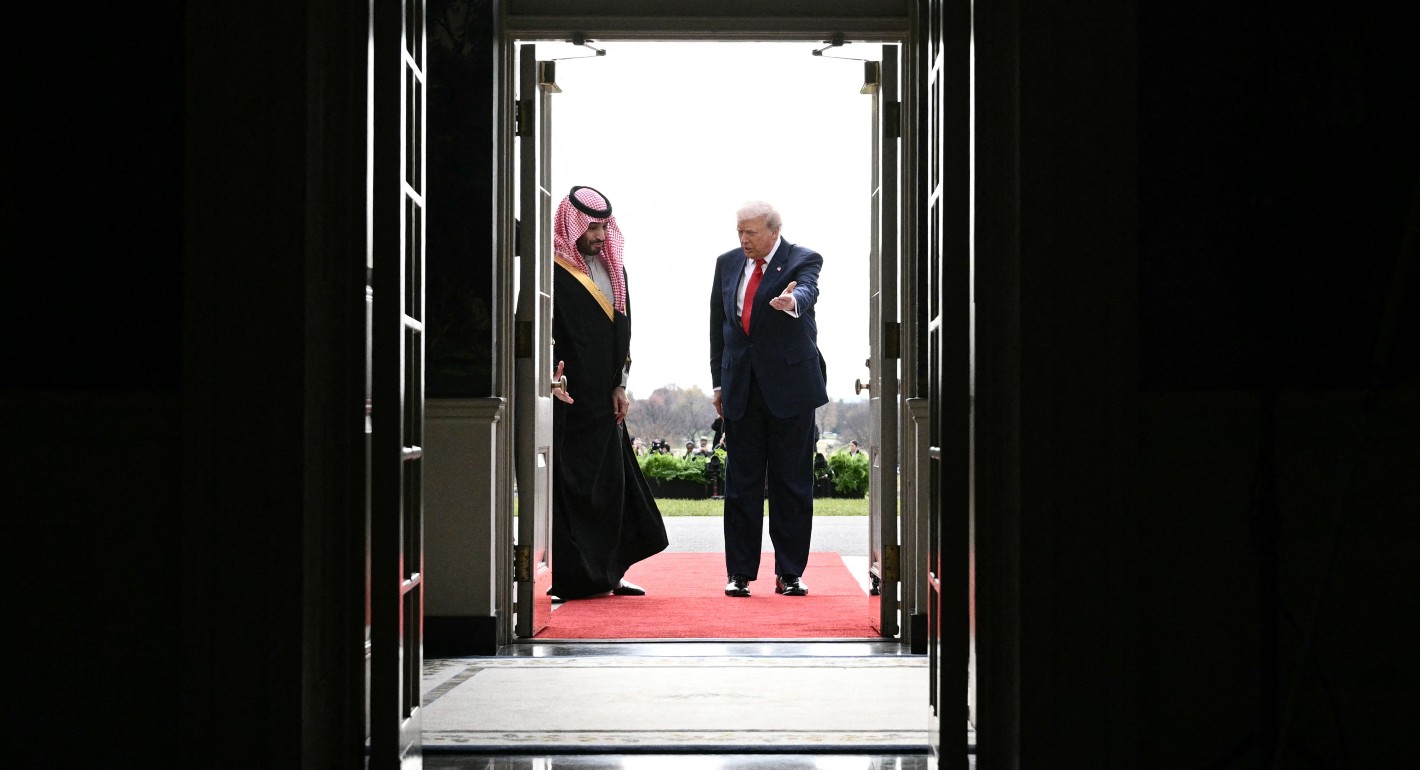
Trump and MBS at the White House in 2025. (Photo by Brendan Smialowski/AFP via Getty Images)
Despite the agreement’s uncertainty, it’s still a significant development in regional and nuclear policy.
Why is the U.S.-Saudi nuclear agreement a big deal?
Jane Darby Menton: Peaceful nuclear cooperation agreements, known colloquially as 123 agreements (after the relevant section in the U.S. Atomic Energy Act), rarely make headlines, but this one stands out. Although the administration has not yet released the full text, the agreement reportedly will not require Riyadh to categorically forgo fuel cycle activities that would be conducive to a nuclear weapons program (namely enrichment and reprocessing) or to accept the highest standard of International Atomic Energy Agency (IAEA) safeguards, known as the Additional Protocol, or AP. These were key sticking points in previous nuclear negotiations with Saudi Arabia and other partners.
I should caveat that there’s a lot of uncertainty swirling around this agreement, not least because President Donald Trump has posted conflicting information on social media, including emphatically denying that it permits enrichment. Still, the deal clearly departs from the United States’ own “gold standard” for nuclear technology–sharing, and this matters, especially in a region that has a long and troubled history of covert nuclear weapons programs. On that point, this announcement comes in the middle of a conflict that was predicated (at least in part) on concerns about Iran’s nuclear program. Saudi leaders have also brought scrutiny on themselves by explicitly saying that the kingdom will pursue nuclear weapons if Iran acquires them.
Andrew Leber: The agreement is a big deal given longstanding U.S. concerns about nuclear proliferation in the Middle East. The only previous 123 agreements signed with countries in the region were with Türkiye, a NATO treaty ally, and the UAE, which adopted the so-called gold standard, forgoing the right to enrichment and agreeing to additional IAEA inspection protocols.
The United States has had a much more troubled relationship with Saudi Arabia, between the domestic Saudi radicalization that contributed to the 9/11 terrorist attacks and more recent U.S. outrage over a Saudi-led military intervention in Yemen and human rights abuses at home. The U.S.-Saudi relationship has improved in recent years, but—as Jane noted—de facto Saudi ruler Mohammed bin Salman (MBS) has continued to pledge that Saudi Arabia would follow suit should Iran ever develop nuclear weapons. An added irony is that Iran’s own nuclear program began with a U.S.-Iranian agreement under President Dwight D. Eisenhower’s administration.
What’s the deal with the Abraham Accords?
Jane Darby Menton: During the Joe Biden years, civil nuclear cooperation—including a version of this agreement—was bundled into a larger project to reorder the Middle East. However, the October 7, 2023, Hamas attacks and Israel’s war in Gaza, derailed a broader diplomatic grand bargain with Saudi Arabia, which would have also included defense commitments and normalization with Israel under the so-called Abraham Accords.
On Wednesday, when this agreement was announced, it looked like Washington was willing to deal narrowly with the nuclear file (at least for the time being). But as of Thursday morning, the issue of Saudi Arabia joining the Abraham Accords appears to be back in play. If the administration insists upon this linkage as a condition for delivery, the entire deal may fall apart.
Andrew Leber: Trump’s transactionalism seemed to acknowledge the limited incentives for Saudi Arabia to normalize ties with Israel after October 7. Still, the U.S. president has veered between setting aside normalization to focus on business gains and warning Saudi Arabia that it should join the Abraham Accords—or else.
The White House justification for the change on Thursday was simply that Trump is “always the final deal maker.” With this in mind, Saudi officials will likely wait for Trump to change his mind again before commenting.
How is news of the deal being received in different circles?
Andrew Leber: Initial Saudi reactions to the deal were triumphant, with media outlets and online commentators heralding a “historic” agreement between the two countries. Local experts spoke of the agreement as economic gains as well as laying the foundations for more technological cooperation with the United States over the deal’s thirty-year run time.
However, Trump’s subsequent comments claiming to condition the deal on the Abraham Accords were met with a resounding silence. Instead, news media focused on Secretary of State Marco Rubio’s comments in support of a deal and Trump’s condemnation of Houthi attacks on Red Sea shipping.
Jane Darby Menton: Critics in the nuclear policy community are deeply concerned about the precedents this agreement sets, and breaks, especially in a moment of incipient global nuclear expansion. The decision to exempt Saudi Arabia from ratifying an AP will undermine longstanding efforts to push for universal adoption. (For context, over 140 states have signed on to these more rigorous IAEA safeguards, which were designed to make it harder to hide a nuclear weapons program.) According to administration officials, the U.S.-Saudi 123 contains bespoke provisions, including supplementary bilateral safeguards, which they say more than compensate for any alleged shortcomings, but it’s hard to assess such claims without seeing full text.
Enrichment is also top of mind. Initial reports suggested that the deal would crack open the door to enrichment on Saudi soil while stopping short of an unequivocal green light, pending conclusions of a joint U.S.-Saudi study on the economic viability of such a program. But Trump himself has since denied that enrichment is a part of the deal. It’s not clear whether Riyadh agrees.
Why now? It feels like an odd moment, given the administration’s war in Iran, ostensibly over nuclear issues.
Andrew Leber: This is not an administration that cares how contradictory its policies are or seem, and the ongoing war in Iran has never been a principled or calculated effort to prohibit nuclear proliferation in the region.
Still, the timing of the deal probably is related to the war. Although MBS and top Saudi officials have worked to provide diplomatic off-ramps and have declined to overtly participate in the fighting, they have still hosted some U.S. forces and operations—serving as pretext for some Iranian attacks and now a Houthi blockade of the Red Sea. Concessions like the nuclear deal, or a deal to sell sensitive technology to the UAE, are part of keeping the Gulf monarchies broadly on-side at a time when many are likely rethinking the U.S. security presence in the region.
A separate question is why the agreement has taken so long to negotiate. Part of the answer lies in Saudi officials’ insistence on getting a “better” deal than the UAE secured in 2009.
Jane Darby Menton: For the Trump administration, finalizing this agreement and signing more 123s are part of an ambitious plan to revive the ailing U.S. nuclear industry and regain competitive ground vis-à-vis Russia and China, which leverage their nuclear exports for global influence. The resumption of military operations against Iran this spring, however, delayed this announcement. The decision to sign it now may reflect geopolitical machinations, including the need to ameliorate relations with a partner that has absorbed blowback from the U.S. war with Iran, though more quotidian issues related to congressional calendars might also be a factor.
Who benefits from this agreement?
Jane Darby Menton: For months, the administration has effectively been pitching this agreement as a business proposition that will establish a legal foundation for “a decades-long, multi-billion-dollar nuclear energy partnership with the Kingdom.” As part of this arrangement, Saudi Arabia has allegedly committed to buying American when it comes to all things nuclear. At least in theory, the U.S. nuclear industry, and Westinghouse in particular—Saudi Arabia is expected to purchase its AP1000 reactors—will be key beneficiaries. This would also effectively shut other nuclear suppliers, namely China and Russia, out of a lucrative and strategically salient market.
As this deal progresses, what will you be watching for?
Andrew Leber: I’ll be looking to see if Trump sticks with a greater emphasis on Saudi Arabia joining the Abraham Accords or will cave to counter-lobbying by the kingdom and the nuclear industry. Given that the Iran war hasn’t delivered anything like the decisive victory Trump expected, he is definitely in the market for a foreign policy “win” that can boost his image and his own ego.
Jane Darby Menton: If the text does go to Congress for review, I am keen to see what is (and is not) covered by the bilateral safeguards agreement. In theory, Saudi Arabia could agree to something that looks like an AP, and quacks like AP, but isn’t actually called an AP. (Though this would raise questions about why such contortions were necessary in the first place.)
The entire nuclear policy community will also be tracking what happens with enrichment. It’s hard to envision a serious study endorsing such a program on its merits. States with much larger nuclear programs have ultimately concluded that purchasing enriched uranium from the global marketplace is cheaper than producing it. Though the fact that this door is even slightly ajar, given the misalignment between Saudi’s aspirations on enrichment and the actual size of its nascent nuclear program, is precisely why experts are concerned.
I’m also interested in how other states in the region will respond. I certainly doubt that it will make Iran’s nuclear program more tractable. The UAE's reaction, however, may be even more interesting. The UAE 123 agreement was the model for the so-called nonproliferation “gold standard,” whose value is rapidly depreciating. It also includes a clause that allows the UAE to relitigate these restrictions if another state in the region secures a nuclear cooperation agreement on more permissive terms.
Understand the world with the latest from our scholars around the world.

Nonresident Scholar, Middle East Program
Andrew Leber is a nonresident scholar in the Carnegie Middle East Program.

Fellow, Nuclear Policy Program
Jane Darby Menton is a fellow in the Nuclear Policy Program at the Carnegie Endowment for International Peace and director of the Carnegie International Nuclear Policy Conference.
Carnegie does not take institutional positions on public policy issues; the views represented herein are those of the author(s) and do not necessarily reflect the views of Carnegie, its staff, or its trustees.

The Horn of Africa countries are among those facing a new security calculus.

Andrew Leber, Lesley Anne Warner
Congress should ask tough questions about the agreement’s more unique features and whether they advance U.S. interests or compromise them.
Jane Darby Menton
As the monarchy appears to question its grandest projects, the state could do with more critical debate than rote cheerleading.
Andrew Leber
The conflict is exposing the flaws and fissures of their domestic governance and social cohesion.
Frederic Wehrey, Charles H. Johnson
One is hopeful. One is realistic. One is cautionary.
Andrew Leber, Sam Worby