

Paper
Producing nuclear fuel quickly enough remains a major risk factor for the emerging advanced reactor industry.
Elmer W. Dyke
Source: Getty
Nuclear recycling has emerged as a salient, cross-cutting issue, one that is heavily dependent on broader choices among reactor designs, fuel availability, economic resources, technological options, and political choices. States and nuclear industries seeking to advance recycling must devote sustained consideration now to the interplay of all these factors.
As part of the Carnegie Endowment’s work on responsible use of nuclear energy, we are publishing a series of deep-dive papers on issues that deserve greater scrutiny in ongoing debates. This paper by Etienne Pochon, who had an extensive career in the French nuclear program, provides a comprehensive assessment of the challenges and implications of more widespread use of reprocessing as part of a nuclear recycling strategy. It offers a sympathetic view of the potential benefits, but cautions that governments would need to address economic, national security, and other issues before proceeding; otherwise, they could put a broader nuclear energy expansion at risk. Carnegie does not take institutional positions on public policy issues; the views represented in these papers are those of the author(s) and do not necessarily reflect the views of Carnegie, its staff, or its trustees. Publication of these essays is made possible by generous support from the Skoll Foundation.
Corey Hinderstein
This paper analyzes the role that nuclear fuel recycling could play in a scenario of significant growth in nuclear energy, given the current relative abundance and regional distribution of uranium. Specifically, it assesses the prospects and implications of adopting a strategy of nuclear recycling based on considerations of economic profitability, environmental impact, and security and proliferation risks.
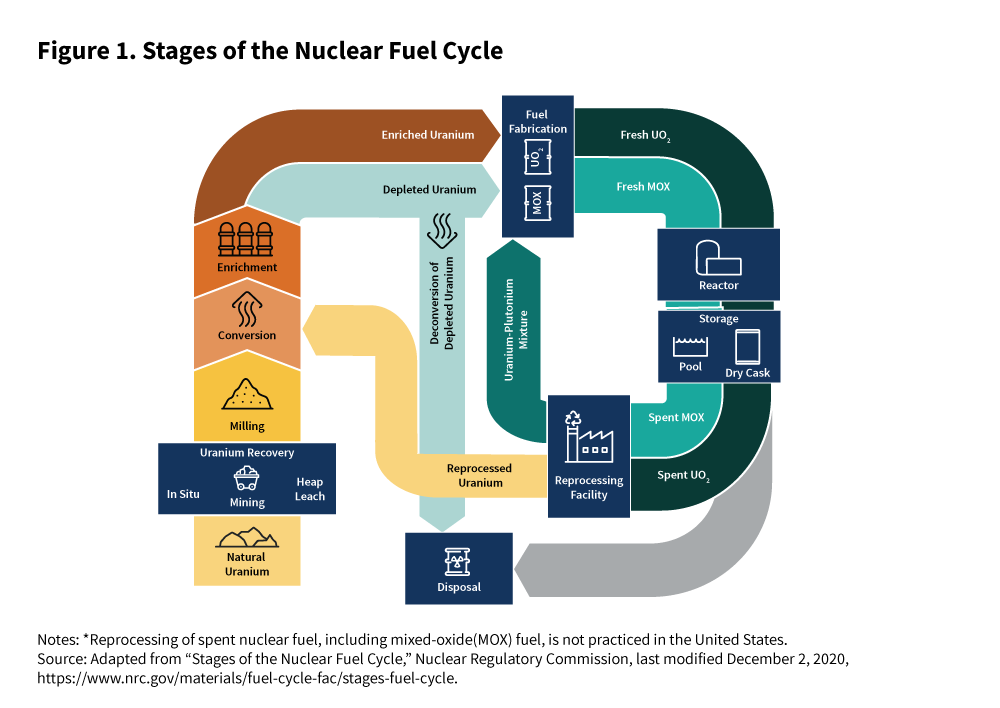
In all industrial activities, recycling is motivated either by the recovery of valuable materials for downstream re-use, or by environmental reasons to reduce the toxicity or volume of waste intended for permanent disposition. The production of electricity by nuclear energy is no exception. Today’s nuclear power reactors only utilize about 5 percent of the energy potential of their uranium fuel before it must be changed. In this context, recycling mainly refers to the reprocessing of irradiated reactor fuel to separate materials that contain approximately 95 percent of the remaining energy potential of uranium, and then to re-use those materials to fuel fast and thermal neutron reactors. A significant portion of the most highly radioactive elements can also be extracted through reprocessing for long-term storage or disposal.
Yet unlike in other industrial domains, the recycling of spent nuclear fuel is rare on a global scale—only a few countries have pursued it. There are several reasons for this. One unique factor is that reprocessing allows extraction of fissile materials, especially plutonium, that can also be used for nuclear weapons. Concerns arising from the dual-use nature of this sensitive technology have therefore spurred efforts to limit the use of reprocessing, especially among states that do not possess nuclear weapons. Some countries without nuclear weapons, such as Germany, committed to reprocessing only to later abandon it due to anti-nuclear sentiment. That said, it is mainly for economic reasons that until now no country, except France, has adopted a strategy of reprocessing irradiated fuel at scale. The current low price of uranium does not justify the additional investment required for a reprocessing plant. The relatively marginal role of nuclear power on a global level—accounting for only 4.7 percent of total energy supply and 9.1 percent of electricity generation as of 2023—has reinforced this calculus for decades.1
Today, however, there is renewed interest in nuclear recycling alongside aspirations for a global resurgence in nuclear energy. Concerns about energy security, climate change, and electricity supply are reviving interest in nuclear power. This was apparent at COP28 in Dubai, when over twenty states pledged to triple nuclear energy capacity by 2050.2 Plans to expand nuclear energy programs and the electrification of many activities previously powered by fossil fuels may portend an increase in the price of uranium, which could make the adoption of a closed nuclear fuel cycle with recycling more economically viable. These trends have also revived discussions about reprocessing to help manage growing stocks of irradiated fuel, most of which are currently in temporary storage awaiting a decision on disposition. At the same time, numerous innovative projects such as small modular reactors (SMRs) and advanced reactors (ARs) are emerging, with new architectures, new fuels, and options for reprocessing, creating additional possibilities for nuclear energy going beyond the strict production of electricity.
This essay assesses the past and potential future of nuclear recycling. It sorts through the technology, political, and economic changes that are driving renewed interest, and evaluates a range of implications and risks, including environmental, safety, security, and nuclear weapons proliferation. It concludes with an appeal: Although there are merits to the case for recycling and for near-term exploration of its potential, governments and nuclear industries need to thoroughly study the outstanding questions and develop the necessary arrangements to be sure that adoption of recycling does not undermine the broader aims of a global nuclear energy expansion.
Simplistically, nuclear reprocessing is used to separate different elements contained in irradiated nuclear fuel. The main elements of interest are various isotopes of uranium and plutonium, which could be recycled in further nuclear energy applications or, in the case of plutonium, also used in nuclear weapons. The second group of elements are termed minor actinides, such as neptunium, americium, and curium, which have high levels of long-term radioactivity and significant heat. A third grouping comprises shorter-lived fission products, such as strontium and cesium, which decay faster (a few centuries), but produce high heat that necessitates cooling irradiated fuel before it can either be reprocessed or placed in long term storage.
Most states that have mastered the processes and technologies for reprocessing did so at least initially for nuclear weapons purposes.
Most states that have mastered the processes and technologies for reprocessing did so at least initially for nuclear weapons purposes, namely, to extract pure plutonium from lightly irradiated fuel.3 These fuels were predominantly used in reactors dedicated to the production of military-grade plutonium, not commercial nuclear power plants producing electricity.4 Starting in the 1960s and 70s, some states also began to industrially develop large-scale reprocessing of spent fuel from nuclear power plants to extract reuseable materials. These states were principally motivated by concerns about energy security and the long-term costs and availability of uranium ore. France, in particular, invested heavily in reprocessing after the first oil crisis in 1973, with the aim of exploiting the energy potential of plutonium separated from irradiated nuclear power reactor fuel. It hoped to ultimately deploy a fleet of fast breeder reactors fueled by this plutonium, ensuring long-term energy independence by capitalizing on the full energy potential of natural uranium.5
This long-term vision was shared by some other countries, such as Japan, which followed a similar trajectory through a partnership with France for strictly civil nuclear energy applications. In 1993, Japan began constructing a spent fuel reprocessing plant in Rokkasho with a capacity of 800 tons per year.6 The facility is now scheduled to start operations in 2026 but has suffered repeated delays that raise doubts that it will ever actually operate.7
Despite these early efforts, however, over the years the scope of global reprocessing activities has remained limited. This has largely been due to a combination of proliferation concerns, safety reasons, and economic constraints.
As noted, the history of reprocessing is rooted in nuclear weapons development, a linkage that persists today. The few states that reprocess irradiated fuel for civilian programs rely on the same hydro-metallurgic process known as PUREX, short for plutonium uranium extraction, that was originally developed to generate weapons-useable material.8 In its basic version, PUREX separates recoverable fissile materials (uranium and plutonium) from fission products and minor actinides.9 With the exception of Japan, PUREX is utilized by states that already possess nuclear weapons. To mitigate proliferation risks, Japan implements a very stringent monitoring process under International Atomic Energy safeguards. France and the United Kingdom also have applied IAEA safeguards to their reprocessing facilities.
Inadequate safety protocols that accompanied many early reprocessing facilities also created persistent and expensive health and environmental challenges at some plants.
In addition to its association with nuclear weapons activity, inadequate safety protocols that accompanied many early reprocessing facilities also created persistent and expensive health and environmental challenges at some plants, such as the Hanford site, at which the United States produced plutonium for its nuclear weapons program from the 1940s to the 1990s.10 Failure to quickly stabilize fission product solutions in early waste streams through vitrification resulted in noxious leaks that the U.S. government has spent billions trying to clean up.11
But perhaps the most significant inhibitors of commercial reprocessing have been economic. The technologies and equipment used in reprocessing are complex, heavy, and expensive. Facilities require a very high level of physical protection against radiation, even after irradiated fuel assemblies have been cooled in pools for several years. Associated facilities, such as fast reactors that use recycled fuel, have proved economically unpredictable. By comparison, the costs of an open fuel cycle—in which irradiated fuel is stored or disposed of without reprocessing or recycling—have remained relatively low due to the abundance of natural uranium.
To make hydro-metallurgical processes more resistant to proliferation risks, several countries (in particular France and the United States) have proposed variants to reduce the potential for misuse of a civilian reprocessing plant for weapons purposes. France, for instance, is promoting the COEX process, which extracts a combined uranium plutonium oxide and thus avoids a pure plutonium stream. Other processes such as UREX and UREX+,12 which result in a combined stream of plutonium and neptunium or plutonium and lanthanides fission products, could create a more restrictive radiative barrier for the handling of these materials. Such process modifications may help to counter the potential theft of materials from installations or during their transport by sub-state terrorist organizations for use in an improvised nuclear device. At its Rokkasho facility, Japan has opted for a process that mixes uranium with separated plutonium before the combined material is converted to an oxide within the plant, which reduces the risks of transporting pure plutonium. Other reprocessing approaches such as pyro-processing are now being considered in the context of recycling and advanced reactors and are detailed later in the paper.
Even among nuclear weapon states, only France is systematically reprocessing its spent fuel in a partial recycling program. The La Hague site, which opened in 1976, can reprocess approximately 1,700 tons of irradiated fuel per year.13 France developed and now uses the separated plutonium from this reprocessing in mixed plutonium and uranium oxide (MOX)14 fuel in a significant part of its fleet of pressurized water reactors (PWRs).15
Yet France, too, has faced impediments in implementing a recycling strategy. Plans to develop a fully closed fuel cycle with fast breeder reactors have not panned out as the technology was deemed premature. Very early on, France invested heavily in fast reactor development, with the aim of evaluating technologies that could eventually provide energy independence advantages. In 1957, France conceived an experimental fast neutron reactor, Rapsodie (40 MWth), which operated from 1967 to 1983 and demonstrated the possibility of using fuel assemblies up to a very high level of burn-up (250 GW day/ton).16 Thereafter, France constructed a larger experimental fast reactor, Phenix (560 MWth / 250 MWe), which operated from 1974 to 2010.17
After the first oil crisis starting in 1970, France launched construction of a fast neutron breeder reactor prototype, Superphénix (1200 MWe), funded by a consortium involving France, Germany, and Italy.18 This reactor was completed and connected to the grid in 1986, only to be decommissioned in 1997, primarily due to domestic political considerations when the ruling Socialist Party had to form an alliance with the anti-nuclear Green Party to stay in office. New refueling equipment for the reactor was ready to be installed at the time it was scrapped, while a separate consortium project among several European countries (the European Fast Reactor, set to achieve 1500 MWe) that had been under study was abandoned. The main consequence of these decisions has been an indefinite postponement of full recycling through the deployment of a closed fuel cycle with fast neutron reactors.
The continuing spent fuel reprocessing and recycling plutonium in MOX fuel in PWRs keeps the La Hague industrial facility operational, and France continues to pursue research and development on fast neutron reactors (FNRs) pending a decision to fully close the fuel cycle.19
Recent discovery of several additional uranium mining sites in China and Canada has also shifted the deployment schedule for a fully closed cycle strategy—not only in France—since low uranium prices obviate the medium-term rationale of recycling nuclear fuel with fast reactors. In addition, the Fukushima Daiichi accident in 2011 put the brakes on a nuclear renaissance that was starting to blossom. To date, stocks of separated civil plutonium in France total around 90 to 100 tons,20 while the stockpile of irradiated MOX fuel, which does not have a disposition pathway pending a decision on future FNRs or multi-recycling in LWRs, is estimated at 2,500 tons.21
Other countries which have mastered spent fuel reprocessing (including the United States and United Kingdom) did not implement a systematic recycling strategy for their used nuclear fuel, albeit for different reasons.
The United States built and operated the West Valley reprocessing facility in New York from 1966 to 1972, which had a capacity of 300 tons per year.22 It was ultimately closed in 1976 due to growing safety requirements that were deemed not economically feasible to implement. In 1976,23 the U.S. government reversed its support for commercial reprocessing at home and abroad, citing concerns about nuclear weapons proliferation and the economic viability of a closed fuel cycle.
The United Kingdom’s main reprocessing work took place at repurposed facilities at Sellafield (part of its nuclear weapons program) called the Thermal Oxide Reprocessing Plant (THORP). THORP, which was built between 1978 and 1994 and commissioned in 1997, was designed to process both British and foreign fuels.24 The facility was closed between 2005 to 2007 following a radioactive leak from a burst pipe that revealed serious safety problems at the plant. By 2018, operational and economic challenges led the government to announce that the facility would cease operations after the completion of ongoing contracts and then be decommissioned.25 The total stock of separate plutonium is estimated at 140 tons. In January 2025, the UK government announced plans to immobilize the remaining plutonium pending disposal in a geological repository, rather than utilize it as MOX fuel.26
In Russia, the Mayak complex that had initially been dedicated to the extraction of plutonium for weapons purposes has been adapted into a reprocessing plant for spent nuclear fuel with a capacity of 400 tons per year.27 The facility has also been used to process military plutonium resulting from the dismantling of the Soviet Union’s nuclear arsenal. The possibility of transitioning the complex to commercial services for processing foreign spent fuel, however, has proven controversial, especially for the local community given environmental concerns.28 Russia is the only country that currently operates large-scale fast neutron reactors (BN 600 and BN 800) that enable it to fully close the fuel cycle.
China is reportedly building three reprocessing plants, each with a potential capacity of 200 tons of used fuel per year, at the Gansu Nuclear Technology Industrial Park.29 The first of these was projected to begin operating in 2025, though its status is not publicly known. These facilities are proximate to a demonstration MOX plant under construction since 2018. China is also working to build a fast breeder reactor fleet that would utilize the outputs from these plants.30 Additionally, a project to construct a reprocessing plant with a capacity of 800 tons per year is a key element of a France-China nuclear partnership.31
Part of the economic rationale that undergirded pursuit of recycling in France and the United Kingdom was the ability to offer fuel services to other countries.
Part of the economic rationale that undergirded pursuit of recycling in France and the United Kingdom was the ability to offer fuel services to other countries. They accepted irradiated fuel for reprocessing from other countries (mainly in Europe) with the proviso that all recycled products be eventually returned to the owner for reuse, interim storage, or final disposal. This includes both fission products and recoverable materials (for example, reprocessed uranium and plutonium). Some countries that were initially committed to developing their own long-term strategy for recycling ultimately contracted for French and UK reprocessing. This was the case for Germany, which has since phased out its use of nuclear energy. Japan had spent fuel reprocessed at La Hague while its own facilities were under construction. In both cases, fission products and vitrified minor actinides were returned to Germany and Japan. Reprocessed uranium can be returned with little problem but given the security implications plutonium must be handled differently and returned preferably in the form of MOX fuel. In the case of Japan, several fresh MOX fuel containers, with heavily enhanced physical protection, have been returned since 1999.32
Thus, the global situation regarding commercial (as distinguished from nuclear weapon oriented) spent fuel reprocessing is quite modest. About 10,500 tons of heavy metal (tHM) in irradiated fuel is discharged from reactors worldwide each year, but only about 15 percent of this spent fuel is currently reprocessed and the rest is stored for long-term disposal or awaiting a policy decision over its destiny.33 France continues to be committed to reprocessing despite postponement of future FNRs and continues to use MOX fuel in twenty-two LWRs.34 Russia reprocesses its spent fuel only to a very limited extent. China and Japan are clearly committed to adopting a similar strategy for the management, at least partially, of their spent fuels. The United States and United Kingdom mastered the processes and technologies to recycle their spent fuels, yet didn’t fully adopt this strategy and must now manage fuel in interim storage, awaiting decisions on future recycling or disposal. Regardless of the strategy adopted, unprocessed spent fuels, like the nuclear waste packages resulting from reprocessing, are intended to be stored in deep geological repositories. Only a few countries, such as Finland and Sweden, have decided to dispose of irradiated fuel directly in geological repositories. In other words, most countries do not have viable long-term storage plans and, in the meantime, countries operating nuclear reactors continue to rely on interim storage.
Today, multiple political, technological, and commercial trends accelerated by growing expectations of significant growth in nuclear energy are challenging the dynamics that have long dampened interest in reprocessing. Based on just an increase in the predominant PWRs used today (setting aside advanced reactors or SMRs), a tripling of nuclear energy by 2050 would result in:
In this context, adopting a spent fuel recycling strategy to recover valuable materials, reduce spent fuel interim storage, and ease the burden on final waste repositories could prove salient for more countries. Recycling could also be seen as a positive factor for the broader social acceptability of nuclear energy, which historically has been opposed on environmental grounds given its perceived safety risks and the lack of accepted solutions for disposing of nuclear waste.36
The motivations and technologies underpinning these programs are also changing. For decades, states that undertook reprocessing adhered to proven processes like PUREX, which carried high costs and proliferation risks. But rising interest in nuclear energy, expected increases in uranium prices, and innovative reactor designs are spurring new technological approaches to recycling, such as pyro-processing, which may be more aligned with contemporary commercial needs. This convergence of new nuclear technologies could alleviate some of the concerns that have long inhibited the spread of reprocessing. But the purported advantages of these innovations—and their own economic, environmental, and security implications—will require validation before wider adoption.
Among the drivers of growing interest in nuclear fuel recycling is a surge in designs for small modular reactors (SMRs)37 and advanced reactors (ARs).38 If the scenario of tripling nuclear production by 2050 is realized, growth forecasts suggest approximately one-third of that capacity could be met by SMRs/ARs,39 the other two-thirds by conventional light water reactors (LWRs).40 SMRs/ARs have many touted benefits, ranging from improved safety to lower manufacturing and constructions costs, but two characteristics are most relevant to considerations of future recycling.
First, some designs utilize new types of fuel, especially high-assay low-enriched uranium (HALEU),41 which is enriched to between 5 and 20 percent compared to standard LWR fuel enriched to around 4 percent. Though more costly, HALEU fuels would enable smaller reactor footprints and longer core life. Even if thermal reactors, such as light water SMRs, do not necessarily require HALEU, some designers could choose to use HALEU to improve fuel utilization, reduce the frequency of refueling, or allow for more diverse industrial applications. HALEU is also relevant to FNRs, which cannot achieve criticality with lower enriched fuel. For these advanced reactors, even absent a commitment to a closed cycle, it could be beneficial to reprocess their fuels to recover the residual fissile uranium, either for re-enrichment, or for direct reuse (if higher than 4 percent) in the manufacture of new fuels for LWRs. Fast neutron ARs could require fuels containing higher amounts of fissile materials (uranium-235 or plutonium) up to more than 30 percent. The need for such fuel could motivate the reprocessing of existing stocks of PWR spent fuels to recover plutonium for the manufacture of new fuel intended for these fast reactors.
Second, some SMR/AR designs explicitly incorporate new pyro-processing recycling processes, which are currently being developed and may be better suited to the fuels they use than hydrometallurgical processes. The co-location of facilities could reduce costs, while also mitigating nuclear security and proliferation risks.
There are currently around eighty different SMR designs at various stages of development42; it is likely that many of them will never be built, either for reasons of technical difficulty, lack of financing, or inability to achieve the economies of scale necessary to make them competitively viable options for generating electricity or supporting industrial processes. What designs ultimately come to market will impact the desirability and viability of recycling. It is likely that some will use innovative fuels, both in their physical form and in their chemical composition, which may or may not lend themselves well to reprocessing.
Which SMR designs ultimately come to market will impact the desirability and viability of recycling.
Some SMR/AR designs envisage using nuclear fuel packaged in different physical and chemical forms (for example, nitride, carbide, metal, and metal alloys), compared to the uranium oxide pellets used in conventional LWRs. All these fuels can technically be reprocessed, albeit requiring different initial steps and posing varying difficulties. Significant uncertainties remain regarding the economic implications of the variations in fuel types due to limited industrial feedback thus far.
Among the new fuel types attracting attention, TRISO fuel stands out. It consists of a multi-layer compound that is very tight and resistant, both mechanically and chemically. The characteristics of TRISO fuel make it more attractive for safety and direct storage (in a final geological repository), but more difficult to reprocess.43 Except for molten salt reactor (MSR)44 fuel, which involves a mixture of fuel and coolant, reprocessing these new fuels is technically possible with current hydrometallurgical processes, but only with additional processing steps and significant added costs that would likely make it uneconomical for recycling. New pyro-processing approaches may be better suited for some of these new fuels. Some AR vendors are also targeting very high burnup, however, which would result in less desirable fissile materials to cover and thus impetus for recycling. These factors indicate that much of the future potential for recycling will depend on whether relevant nuclear reactor designs are ultimately built at scale.
Historically, the objective of reprocessing was to extract pure plutonium from lightly irradiated fuel for use in nuclear weapons. Later, this technology was repurposed for separating plutonium from commercial reactor fuel to be re-used in MOX fuel. A hydro-metallurgic process (such as PUREX) was well suited for this goal due to its very high separation selectivity to get pure plutonium. Many of the costs and risks, and thus policy aversion, stem from these basic characteristics.
However, if the purpose of reprocessing shifts from separating pure plutonium to separating fission products from actinides to enable recycling, while minimizing the weapons attractiveness of the extracted plutonium, then the picture begins to change. If the resulting fuel would be used with fast neutron reactors, the process should ideally maintain a consolidated stream of transuranic (TRU) materials containing a mixture of uranium, plutonium, and minor actinides. This approach could reduce proliferation risks while also enabling the fabrication of fresh fuel.
Pyro-processing could plausibly meet these needs more effectively than PUREX, with fewer proliferation risks and better applicability for future ARs.45 Instead of liquid chemical separation, pyro-processing involves application of high heat and electricity to separate TRU from fission products in irradiated fuel. Though it has not been tried at an industrial scale, laboratory testing suggests it would have lower separation selectivity than PUREX, meaning it would be less easily used to separate pure plutonium, providing important security and nonproliferation advantages. Pyro-processing facilities could also be smaller in size, co-located with reactors, cheaper to operate, and face fewer criticality risks.46 Yet, unlike hydrometallurgical process, pyro-processing facilities would operate in a batch mode, meaning they would be harder to scale up, be less efficient in their throughput, and could have higher waste outputs. And despite plausible nonproliferation and security benefits from the high levels of radioactivity, the TRU stream would be more difficult to work with in manufacturing fresh fuel.
Pyro-processing facilities could also be smaller in size, co-located with reactors, cheaper to operate, and face fewer criticality risks.
Nevertheless, the combination of new reactor concepts (both SMRs and ARs) and new pyro-processing technologies could be preferable to PUREX in a wider adoption of spent fuel recycling for two main reasons.
First, in the context of rising natural uranium prices, and if fast neutron AR projects demonstrate capacity to operate economically with acceptable safety and security standards, it could be more cost-effective to manufacture fuel for these reactors with existing stocks of plutonium in irradiated fuel, rather than manufacturing new HALEU. In this case, increasing deployment of fast neutron ARs could mark the beginning of a strategy to recycle part of the large stockpile of spent fuels currently awaiting a decision on their future. This would be a clear step toward a closed cycle, with lower investments than would otherwise be required to build a mixed fleet of large FNR reactors alongside associated LWR reactors using MOX fuel. This could improve the appeal of nuclear energy by offering a pathway for addressing the growing problem of irradiated fuel and nuclear waste.
Second, if there is more widespread use of HALEU fuels, both for fast neutron and thermal SMRs or ARs, reprocessing these spent fuels to recover residual enriched uranium-235 could be more economically attractive. This is particularly the case if the enrichment level remains close to 5 percent, which could allow for direct use, without re-enrichment, in the manufacture of new fuels for SMRs or LWRs.
Thus far, this paper has considered recycling largely in the context of generating electricity, but it may also have benefits for other nuclear applications. One specific case worth considering is maritime nuclear propulsion, for which there is growing enthusiasm notwithstanding its challenging requirements (especially liability, safety and security, and logistics). Many governments are interested, since maritime transport currently represents approximately 80 percent of global freight transport and is responsible for 2 to 3 percent of greenhouse gas emissions and a significant portion of fine particle emissions.47 In a scenario of phased deployment of maritime nuclear propulsion, it is likely that it would be provided by thermal reactors, possibly using HALEU fuels to lengthen periods between refueling. As with HALEU-fueled SMRs, reprocessing these fuels could make economic sense. Presumably it would be most efficient to locate reprocessing facilities close to major seaports, thus minimizing the transportation requirements for spent fuel.
In sum, the gradual introduction of a recycling strategy based on the potential complementarity of these new innovative reactor concepts (SMRs and ARs) alongside conventional reactors, used in a range of applications, and with integrated front-end and back-end fuel cycles, could have important benefits that merit considering its expanded adoption during a global nuclear expansion.
The putative benefits described above are already reinvigorating interest in nuclear recycling, including in the United States. However, there are still considerable unknowns, and a dearth of data regarding several speculative developments. Before deploying reprocessing facilities more widely, policymakers must seriously consider the economic, environmental, safety, security, and proliferation implications.
These parameters are of paramount importance, since they are the ones that, until now, have hindered the deployment of a closed cycle for nuclear energy and the associated reprocessing facilities. How might emerging technologies, environmental constraints, and geopolitical and economic factors change the situation?
Whether or not recycling irradiated fuel could prove economically beneficial depends greatly on the cost of natural uranium. In 2025, the cost of natural uranium has hovered around $70 per pound.48 But uranium, like many other strategic metals, is now considered likely to experience significant price increases, due both to the envisioned nuclear energy expansion as well as geopolitical trends, such as the decision by Western governments to cease purchasing nuclear fuel from Russia following the latter’s 2022 invasion of Ukraine. Currently identified conventional natural uranium reserves (globally estimated at 8 million tonnes) would be depleted by 2070 if the scenario of tripling nuclear energy were to be realized by 2050, based on an open cycle. With yet unidentified reserves (around 7 million tonnes) considered plausible, the timeline for exhaustion of these reserves could be pushed back to about 2100.49
The asymmetric distribution of uranium reserves is an important consideration, given that most natural uranium-consuming countries are not uranium producers, while some of the largest producing countries do not presently consume uranium.
There are other types of economic considerations as well. The asymmetric distribution of uranium reserves is an important consideration, given that most natural uranium-consuming countries are not uranium producers, while some of the largest producing countries do not presently consume uranium. This situation is likely to generate tensions in the uranium marketplace. A second consideration, for countries which have large stocks of depleted and/or reprocessed uranium, is that the adoption of a closed cycle with fast reactors (and potentially breeder reactors) could provide additional advantages in terms of price stability, independence, and strategic autonomy. For example, just depleted uranium stock of a country like France, with approximately 320,000 tons,50 would represent more than five centuries of energy reserves with a fully closed cycle given its current primary energy consumption.
Generally, the point at which recycling could become more cost effective than an open fuel cycle requires assessing historical data and making a series of assumptions. Thanks to several decades of experience, numerous studies51 provide insight into the general cost distribution of the various expenditures related to nuclear electricity generation. There is considerably less rich and diverse historical cost data for reprocessing and fast reactor operations, however. In this regard, the extent to which closed cycle options require government funding to be commercially viable is an important consideration. Some key uncertainties also exist regarding the new concepts of ARs and pyro-processing. For comparison, costs associated with three fuel cycles are briefly summarized below, based on the June 2026 uranium price of $85 per pound ($190 per kilogram). Investment costs for the two recycling options are assumed to be stable, but of course in reality could fluctuate significantly.
In open or once-through fuel cycles, which is the prevailing approach taken to date by most countries apart from France and Russia (and, in the future, Japan and China), irradiated fuel assemblies are treated as waste destined for final disposal. Many states with fleets of LWRs have deemed this to be the most economical option, given the proportionately low costs of uranium fuel and storing irradiated fuel. In a once-through cycle with LWRs, roughly 85 percent of the costs of electricity generation can be attributed to reactor investment, operation, maintenance, and future decommissioning. Front-end activities, including the supply of natural uranium (6 percent) and enrichment/fuel fabrication (6 percent) account together only for about 12 percent of costs. The back end of the fuel cycle, including the interim storage of spent fuels and potential deep geological storage, accounts for just 3 percent.52
Some states, such as France, engage in limited recycling by extracting plutonium from spent fuel to produce MOX fuel for use in LWRs. This option requires investment in a reprocessing facility, which, including operation and management (O&M), represents an additional cost of about 5 percent compared to the total electricity generation cost of an open cycle. This additional cost can be only partially offset by a reduction in uranium supply cost and of deep geological repository cost. (The total waste volume would be less if only vitrified fission product containers must be disposed, since the main repository size parameter is the heat source contained in short-lived fission products and minor actinides.) On the other hand, manufacturing MOX fuel is more expensive than that of uranium fuel for LWRs given increased security and radiation protection requirements.53 Cost assessments of the back-end cycle depend on whether irradiated MOX fuels are sent for final disposal, or to interim storage pending reprocessing for the manufacture of fuels for fast neutron reactors. Considering all these variables, a partially closed fuel cycle likely represents an additional cost of a few percent compared to the once-through cycle. If the price of uranium were to roughly triple today’s cost, then the costs of an open and partial recycling through MOX cycles could be about equal.54
Noting the limited data on the construction and industrial operation of fast neutron reactors, economic projections for a closed fuel cycle assume an investment and O&M cost increase of 20 percent for an FNR compared to an LWR. This conservative measure weighs heavily on the economic estimation of a fully closed fuel cycle, given the weight (over 80 percent) of investment and O&M costs compared to the front-end and back-end fuel cycle costs. Depending on the options selected, the overall cost increase of the closed cycle compared to the open cycle is estimated to vary from 3 percent to 10 percent, depending on the numbers and types of reprocessing facilities and FNRs built. Though it may seem counterintuitive, if the price of natural uranium were to double compared to its current value, the closed cycle could become more cost-competitive with the open cycle.
In sum, the additional cost of producing electricity with a fully closed cycle may be about 3 to 10 percent higher than that of a once-through cycle at the current natural uranium price, but could be equal if the price of uranium were roughly double today’s cost.55 Whether these costs could be born commercially or would require significant government support would be an important issue for further evaluation.
The first objective of spent fuel reprocessing is to extract and separate valuable materials such as uranium and/or plutonium, either in isolation or mixed together (as in COEX), from fission products and minor actinides. The resulting materials can then serve either civilian (commercial) or military applications. A second objective is to reduce the long-term radiotoxicity of spent fuel. Through recycling, the longest-lived minor actinides can be extracted and burned in fast neutron reactors or transmuted through other approaches, such as accelerator-driven systems, to reduce their period of radiotoxicity from up to 1 million years to around 1,000 years. It should further be noted that minor actinides are much less mobile in geological layers than fission products.56 In other words, minor actinides do not contribute significantly to additional environmental risks from migration of radioactive material in deep geological repositories.
After extraction of fissile material, minor actinides, and short-lived fission products through reprocessing, only long-lived fission products (LLFP) remain.57 These constitute a tiny fraction of the initial total inventory of the radioactive waste in irradiated fuel. They cannot be easily transmuted but represent a very low heat source for final geological disposal. Thus, though a fully closed fuel cycle with reprocessing and fast reactors does not obviate the need for final geological repository for LLFP and other technological wastes and heavy metal process losses of the incoming flow of materials, it can significantly shrink the waste volume.
Reducing the long-term radioactive inventory of stored products through reprocessing could also ease public resistance to siting and using deep geological repositories for irradiated nuclear fuel.
Reducing the long-term radioactive inventory of stored products through reprocessing could also ease public resistance to siting and using deep geological repositories for irradiated nuclear fuel. It may also appear simpler, safer, and less costly to temporarily store fission products on the surface in vitrified form during their cooling phase than in the form of spent fuel assemblies, kept in pools or casks while awaiting a decision on their fate.
Assuming due care is given to maintenance and waste storage, decades of reprocessing experience indicate that hydrometallurgical processes can be considered well-controlled industrially, even for managing the risks inherent in handling highly radioactive products at high temperatures during the vitrification of fission products. Criticality incidents in reprocessing facilities have been very rare and without environmental consequences, for example those that occurred in Japan’s Tokaimura facility in 1997 and 1999.58 Notably, the technologies used in pyrometallurgical processes have yet to be fully developed, but in principle could offer similar levels of safety and environmental protection.
Proliferation and security are closely linked issues, in the sense that security measures aim to protect materials, equipment, and knowledge that could contribute to nuclear weapons proliferation risk. Security measures for the physical protection of nuclear materials present in a facility are intended to counter threats from nonstate actors (such as terrorist groups), whereas those related to the protection of process or technological knowledge are more particularly aimed at states intending to clandestinely acquire the skills for carrying out independent activity. Separately, control and accounting procedures are used to keep track of fissile materials, which are declared and inspected pursuant to IAEA safeguards as part of a state’s nonproliferation commitments.
Fissile materials are classified into categories based on their quantities and attractiveness for a potential proliferator, with differentiated levels of security and control taken to minimize risks of theft or diversion. For instance, multi-kilogram quantities of plutonium and highly enriched uranium are classified as category 1, requiring the most stringent security and control measures. These range from physical protection of facilities with guard forces to internal controls and sensors around protected areas that handle fissile materials. To date, there have been few instances of attempted diversion or smuggling of plutonium from reprocessing plants, in contrast to the numerous documented incidents of smuggled HEU.
Proliferation concerns related to spent fuel reprocessing have often been cited as the primary reason for restricting deployment of these processes for civilian nuclear purposes.
Proliferation concerns related to spent fuel reprocessing have often been cited as the primary reason for restricting and even trying to outright ban deployment of these processes for civilian nuclear purposes, especially though not exclusively in non-nuclear-weapon states.59 Notably, in the late 1970s the United States adopted a policy against reprocessing domestically in part to dampen interest in other countries and thus reduce the risks that plutonium from these facilities could be diverted to weapons.60 These concerns have merit, and the causes for concern are not entirely alleviated by subjecting these facilities to strict IAEA safeguards.
There are three potential proliferation pathways pertaining to civilian spent fuel reprocessing facilities.
The first pathway highlights the risk of plutonium diversion from a reprocessing plant or MOX fuel fabrication facility by nonstate actors. Separated plutonium is considered highly sensitive because it could be directly used in a nuclear explosive device. To address this risk, enhanced physical protection measures must be implemented at reprocessing and MOX fuel fabrication facilities, combined with strict safeguard controls. (Japan is an example of this approach.) Accordingly, states that pursue recycling should opt for processes that do not separate pure plutonium but instead leave it mixed with uranium (as in the COEX process), or with some minor actinides (like the UREX process), such that it is not directly usable in nuclear weapons. Compared to PUREX, such processes would reduce the attractiveness of the materials involved, diminishing the appeal of diversion because of the transformations required to obtain materials usable for explosive purposes, and give security forces more time to locate them. It should be noted that plutonium separated from commercial nuclear power plant fuel, which spends longer in the reactor to maximize its electricity output (so-called high burnup fuel, between 45 and 65 GW days/ton), is far from ideal for nuclear weapons given the isotopic content, heat, and radioactivity. However, it is generally assumed to be usable in an improvised nuclear device or unreliable first-generation nuclear weapon.
Independent of reprocessing, it should be noted that reactors using HALEU-based fuel already require special precautions to counter the risks of diversion, whether in fuel fabrication plants or during the loading of fresh fuel into reactors. This material—classified as category 2, posing somewhat fewer risks than separated plutonium or HEU—would not yield immediately usable nuclear weapons material without conversion into metal and special casting. However, it is conceivable that HALEU metal at the 20 percent level could be used to manufacture a nuclear weapon, although it would be very heavy and cumbersome. To address the risks with HALEU fuels, in addition to strict IAEA safeguards, enhanced physical protection measures should be implemented with strict security controls. Additionally, it would be helpful to limit HALEU to 18 percent enrichment to further reduce its usability for nuclear explosive devices.
There is also potential for diversion of HALEU fresh fuel from reactors that use online refueling, such as the pebble bed reactor. Unlike LWRs, which are shut down for batch refueling, thereby allowing physical inventory inspections, pebble bed reactor fuel is regularly loaded and unloaded during operation, complicating material control and accounting and safeguards. The potential for undetected and protracted diversion or misuse cannot be excluded if the uncertainties of the material accountancy system are large enough. For safeguards, flow monitors would be needed to count pebbles at various transfer points and to distinguish between fresh fuel, graphite moderator pebbles, and irradiated pebbles at various burnups, including spent pebbles.61 Counting errors are estimated to be as high as 5 percent for these monitoring systems.62 Thus, these types of reactors may therefore carry a higher (and more expensive) safeguards burden. One mitigating factor with pebble bed reactors, however, is the potential to use TRISO fuel, which as discussed above is believed to be more difficult to reprocess. The pebble bed reactor concept therefore seems best suited for fast neutrons, without reprocessing the irradiated pebbles. Irradiated pebbles remain totally unattractive for diversion given the radiological barrier posed by the included fission products.63
The second pathway concerns the replication of reprocessing technology in a different facility dedicated to the reprocessing of lightly irradiated nuclear fuel to obtain weapons-grade fissile material. This pathway would require an elaborate clandestine effort to copy the reprocessing technology and acquire the materials to set up and operate a secret reprocessing facility. There would also need to be adequate supply of lightly irradiated fuel rods containing plutonium optimal for nuclear weapons. This scenario would be difficult to achieve, given the need to build a clandestine reactor and reprocessing facility. Yet it also would be difficult to counter, especially since the technologies and materials used for reprocessing may be easier to copy, develop, and procure than those used for uranium enrichment.
The third pathway is associated with the repurposing of a facility by a state for the reprocessing of lightly irradiated nuclear fuel, in violation of IAEA safeguards obligations. This proliferation path would place the country concerned in direct and fairly immediate conflict with the international community and the IAEA, given that a short refueling cycle and illicit use of a reprocessing facility in violation of safeguards should be detected within a short period.
These proliferation pathways raise important concerns, though as noted, strict application of security and safeguards measures can help to deter and mitigate the risks of all three of them. It is also worth bearing in mind that interest in future reprocessing tends to focus on pyro-processing technology in combination with fast reactors, which could attenuate some of the security and proliferation risks discussed above.
It is also useful to compare these risks with those from uranium enrichment facilities, especially those which will make HALEU in the future. Detecting breakout from a safeguarded facility (the third concern) is likely to be equivalent for enrichment and reprocessing facilities. However, in terms of clandestine proliferation risks (the first and second concerns), diversion from a reprocessing facility is likely to be more easily detected compared to diversion within an enrichment facility. In particular, in the second pathway it would be more difficult to hide both a reactor and reprocessing facility than a clandestine enrichment plant.
The paths taken by proliferating countries to date depend more on acquiring knowledge about technologies, processes, and sensitive materials than on diversion from existing civilian facilities subject to IAEA monitoring and control obligations.
It is noteworthy that, fortunately, so far none of the three scenarios described above has actually occurred. The paths taken by proliferating countries to date depend more on acquiring knowledge about technologies, processes, and sensitive materials than on the direct use of data or nuclear material, diverted from existing civilian facilities subject to IAEA monitoring and control obligations. Historically, countries determined to acquire nuclear weapons have mostly developed by themselves all the steps of the fuel cycle (enrichment, a dedicated reactor for plutonium production, reprocessing), possibly with the help of third countries or foreign experts and supply networks. (Iran’s uranium enrichment program is an exception to this pattern.) This is how a country as economically weak as North Korea, starting from a point of very little nuclear experience and technology and despite the efforts of many countries to stop it, managed in less than thirty years to become the ninth state with nuclear weapons.
In sum, the economic, safety, environmental, and proliferation and security considerations associated with future recycling could look substantially different than in the past. Nevertheless, given the origins and history of reprocessing, it is incumbent on governments and nuclear industries to study these implications more fully before committing to a major expansion with unknown consequences.
As with uranium enrichment, to maximize the benefits of economies of scale while diminishing the various risks, it is highly desirable to limit the number of industrial players and facilities for reprocessing irradiated fuel. Specifically, there would be important advantages for reprocessing services to be confined, at least initially, to those countries already carrying out reprocessing who are willing to provide such services to others (that is, to emulate the French model).
Relying on these countries for reprocessing makes sense for both security and economic reasons. First, they represent a lower proliferation risk, since most reprocessing states already possess nuclear weapons, while the few non-weapons states pursuing reprocessing have already assumed a very stringent safeguards regime. Second, they are expected to have already mastered hydrometallurgical reprocessing technologies. And third, they generally have a fleet of nuclear reactors and, as such, a stockpile of irradiated fuel or separated plutonium that could be used for advanced reactor fuel. To advance fuel recycling, reprocessing states could also supply initial cores of fuel for the first series of fast neutron ARs.
Initially, the simplest way to utilize fissile nuclear materials recovered from spent fuel reprocessing would be to use plutonium in the form of MOX fuel in LWRs, which represent more than 80 percent of the world’s reactor fleet. Only forty-four reactors,64 twenty-two of which are in France, currently use MOX fuel out of a global fleet of 350 LWRs.65 However, the core design of these reactors must be adjusted to consider the difference in reactivity between plutonium and uranium, and their evolution over time. Utilities that own and operate these reactors may not favor changes to the core design to accommodate MOX fuel. However, it is worth noting that using MOX fuel in LWRs could reduce use of natural uranium by 25 percent, as well as the volume of waste to be placed in deep geological disposal by a factor of about seven with a cost reduction of approximately 35 percent.66
Subsequently, if a more massive deployment of fast neutron ARs occurs in different countries, new industrial reprocessing companies could be established to meet greater demand. The new reprocessing facilities should ideally be multilaterally owned and managed and located where the demand is greatest, to minimize the transport of spent and new fuels and to mitigate proliferation concerns. These facilities should also utilize processes, whether hydro or pyro, that do not separate and yield pure plutonium.
Heretofore, recycling of spent fuel has played a marginal role in commercial applications of nuclear energy. More than the potential proliferation risks associated with spent fuel reprocessing, the most likely reason for its lack of widespread adoption is the higher cost of recycling compared to the relatively low cost of natural uranium. But the dynamics that have long inhibited the commercial uptake of reprocessing are shifting. Several developments are combining to enhance the appeal of large scale spent fuel reprocessing as part of the future energy mix. These include budding uncertainty about natural uranium supply, slow political progress on finding locations to accommodate geological repositories for mounting quantities of irradiated nuclear fuel, and the emergence of new types of nuclear reactors that would use more highly enriched uranium fuel and advanced reactors that could use plutonium fuels. Furthermore, some of the sensitivity associated with the proliferation and security implications of commercial recycling is also undergoing politically inspired change.
Several studies indicate that while sufficient reserves of natural uranium are available to meet the medium-term growth of nuclear energy, these would not suffice to sustain more ambitious growth scenarios. Additionally, the location of some uranium deposits in geopolitically unsettled areas is also beginning to create tensions in the uranium market. Although it can’t be predicted with certainty that the uranium price will double in the medium term to the point that could make nuclear recycling more economically viable, the potential for a uranium shortage before 2070, based on identified uranium resources, would support a gradual deployment of spent fuel recycling and fast neutron reactors. This conclusion is understandably contentious.
The development and certification times for innovative reactors and processes are long, on the order of twenty years, as is their operational lifespan, which ranges from forty to sixty years or more. These characteristics necessitate anticipation of long lead decisions related to their deployment. In other words, it would be better to seriously explore the potential for recycling before a uranium crisis takes hold that creates immediate need.
Beyond the stewardship of potentially scarce uranium resources, it is also important to consider the potential for recycling to reduce the long-term inventory of radioactive waste. Thus far, public acceptance of deep geological repositories has been challenging. However, it may become more politically acceptable to site repositories if, after recycling, the total waste volume would be smaller and consist solely of vitrified or ceramic fission products. This would thus help resolve the thorny issue of accumulating spent fuels temporarily stored on the surface, some of which are now over fifty years old. This is especially the case in countries such as South Korea, where spent fuel ponds are nearing capacity.
Several types of reactors now on the drawing board and beyond, nearing first of a kind deployment, are slated to use more highly enriched uranium and even plutonium.
Several types of reactors now on the drawing board and beyond, nearing first of a kind deployment, are slated to use more highly enriched uranium and even plutonium.67 The possible spread of these reactors could materially affect the economic viability of uranium reprocessing of spent fuel to extract residual enriched uranium. Thus, the gradual introduction of a recycling strategy could demonstrate the complementarity of these new innovative reactor concepts—both SMRs and ARs and conventional LWR reactors—with integrated front-end and back-end fuel cycles.
The geopolitical competition between Western countries and China and Russia that extends into the supply of nuclear reactors is threatening to undermine traditional guardrails against nuclear proliferation, not least as they pertain to such thorny issues as reprocessing. In particular, because most Western nations are unable to take back irradiated fuel from their nuclear clients as Russia does, there is growing support for offering alternative arrangements on spent fuel handling to be more competitive in the nuclear energy marketplace.
Concurrently, there is rising demand among some developing economies and nuclear newcomers to chart their own course, to include through indigenous nuclear fuel cycle capabilities. They insist on exercising their right to engage in the full spectrum of peaceful nuclear development as part of the historic NPT bargain.
A third political consideration pertains to the relative proliferation risks from enrichment and reprocessing. Historically, the plutonium route to nuclear weapons acquisition was more prominent and widespread, but this may no longer be the case, largely due to advances and dissemination of uranium enrichment technologies. The latter offers a potentially simpler, cheaper, and smaller footprint for pursuing nuclear weapons compared to reprocessing.
So, should one still oppose nuclear recycling if it can prove to be commercially viable, technologically robust, environmentally sound, and not increase proliferation risks?
At the end of the day, given the renewed interest in recycling as part of a more widespread adoption of closed (or at least partially closed) nuclear fuel cycle, several prominent issues come to the fore at the intersection of technology, economics, and politics.
Economic considerations will likely prove, once again, critical in shaping the future of reprocessing. Here, the real issue, still veiled in considerable uncertainty, is the likely balance between rising prices of natural uranium coupled with the cost of open-ended interim storage of spent fuel, compared to the massive investment required to recycle spent fuel, at least for retrieval of its uranium content.
Secondarily, technological and engineering considerations will help determine whether the cost of new recycling technologies, especially but not exclusively pyro-processing, can be brought down in the context of larger or more widespread adoption in general, and as part of a closed fuel cycle in particular. No less important will be other technological issues associated with built-in features to minimize environmental impact and safety, security, and proliferation risks associated with building and operating of new recycling facilities, and transportation of materials. Much effort inevitably would have to be directed to developing credible answers to these questions that could ultimately shape the future of nuclear power.
A parallel effort will be necessary to navigate among numerous political considerations associated with the spread of recycling technologies and facilities, and the nature of international safeguards and assurances that would have to accompany them. The two most important and thorny issues are, first, whether significant reprocessing activity could be undertaken by non-nuclear-weapon states, and whether this would be done nationally, multinationally, or multilaterally. And second, what kind of assurances (safeguards included), justifications, and relaxation of technology controls would have to be put in place to accommodate such developments
As with enrichment, the processes and technologies used for reprocessing spent fuel present significant risks, and a broader deployment would need to be subject to special precautions—accepting that the international politics of such precautions could prove very difficult to negotiate. To mitigate proliferation and security risks, especially during transportation of fissile material, the number of stakeholders involved in reprocessing and the number of new facilities should be limited and concentrated regionally. One approach would be to form multinational consortia to enable recycling, as was done in the development of commercial enrichment by Urenco, a multinational company between the United Kingdom, Germany, and the Netherlands, with subsequent partnership with Orano Enrichment Technology Company of France and the U.S.-based Urenco National Enrichment Facility. This could allow for the pooling of interests by several countries, both suppliers and consumers. (Though it is plausible that some states would claim this is another cartel by nuclear technology holders meant to deny the right of all states for peaceful nuclear energy.) Similar arrangements could be envisioned for MOX and HALEU nuclear fuel production.
In conclusion, to achieve the ambitious goal of tripling installed nuclear power by 2050, relying in part on new reactor concepts and the gradual adoption of a closed fuel cycle to preserve uranium reserves, considerable efforts would need to be made within a limited timeframe. In this context, safety considerations and qualification procedures must remain a priority; any incident or accident would dramatically slow progress toward this goal.
Nuclear recycling has emerged as a salient, cross-cutting issue, one that is heavily dependent on broader choices among reactor designs, fuel availability, economic resources, technological options, and political choices. This study therefore concludes with a strong plea that states and nuclear industries seeking to advance recycling devote sustained consideration now to the interplay of all these factors.
Etienne Pochon
Retired, French Atomic Energy Commission
Etienne Pochon spent his entire career at the French Atomic Energy Commission (CEA). After receiving a PhD in laser physics at Saclay (1979) and a postdoctoral fellowship (1981) at Brookhaven National Laboratory, he worked on R&D for Uranium Atomic Vapor Laser Isotope Separation at CEA from 1982 to 1993. He served as CEA deputy director of strategy from 1996-1999, then was in charge of R&D support programs within the Directorate of Nuclear Energy from 2000-2006 for France’s fifty-eight nuclear power plants as well as their fuels and safety, including the spent fuel reprocessing facilities at La Hague and MOX fuel fabrication at MELOX. From 2007 to 2014, he oversaw nonproliferation programs within the Directorate of Military Applications, including nuclear test monitoring systems, technical analysis of foreign clandestine nuclear military programs, and analysis of nuclear terrorism risks in close connection with intelligence services. He retired in 2014 and has since participated in various projects with the Carnegie Nuclear Policy Program.
Carnegie does not take institutional positions on public policy issues; the views represented herein are those of the author(s) and do not necessarily reflect the views of Carnegie, its staff, or its trustees.

Producing nuclear fuel quickly enough remains a major risk factor for the emerging advanced reactor industry.

Elmer W. Dyke

The real test may come after the leaders leave the room.



Sheena Chestnut Greitens, Oriana Skylar Mastro, Yukon Huang, …

The nuclear relationship between China and the United States is increasingly shaped by widening perception gaps rather than deliberate strategic design.

Tong Zhao

A look at why states without nuclear weapons are seeking naval nuclear propulsion, whether they can legally and technically deliver it, what it will cost them, and what responsible stewardship of the capability would look like.

Jamie Kwong

Congress should ask tough questions about the agreement’s more unique features and whether they advance U.S. interests or compromise them.

Jane Darby Menton