Inspired by the success of the uprisings in Tunisia and Egypt, Mauritanian youth began organizing protests in early February which have continued through into May, in the hopes of forcing the government of President Mohamed Ould Abdel Aziz to implement political and social reforms. While it is still unclear whether these efforts will succeed, they have crystalized a new opposition narrative that rejects tribalism, calls for a stronger civilian voice in politics, and emphasizes national as opposed to ethnic loyalties as well as social justice.
The Protests
The protest movement drew many university students and middle class young people from across the political spectrum. In mid-February a coalition of the youth sections of Mauritania’s main opposition parties – particularly the Regroupement des Forces Démocratiques, Union des Forces du Progrès (UPR), and Rassemblement pour l'Unité et la Démocratie – joined student activists, young professionals, and others to create dozens of Facebook groups in the hopes of turning out a mass protest at the symbolic Place d’Bloques in central Nouakchott on February 25. The Place d’Bloques, home to buildings sold to businessmen close to the president and demolished last year, symbolized for the protesters regime corruption and nepotism.
Protester demands focused on political reforms and social policies. While political party leaders endorsed their young members’ participation in the demonstrations, protest organizers avoided direct association with specific party agendas and asked party officials to stand back from associating themselves too closely with the movement or attempting to take credit for it.
The February 25 protest stretched on for days while security forces attempted to obstruct marches and arrest protesters. The result was a commitment by the organizers to continue their protests with marches to the Place d’Bloques beginning on March 1.
The protest organizers
distributed a list of seven core demands, including (1) the withdrawal of the military from politics; (2) a firmer separation of powers; (3) the establishment of a national agency to combat slavery; (4) constitutional reforms affecting the electoral system; (5) the reform of the process by which officials publicly declare their assets; (6) the reform of local administration and the empowerment of elected mayors, and; (7) media law reforms.
It is notable, though not surprising, that the protesters’ top demand concerns civil-military relations, given Mauritania’s history of coups. Mauritania had two coups in the last ten years, one in 2005 resulting in the country’s first democratic transition period and a second in 2008 to remove democratically-elected President Sidi Ould Sheikh Abdellahi. He was replaced by General Mohamed Ould Abdel Aziz, who won a 2009 presidential election
disputed by the opposition and Arab human rights groups, although generally accepted as valid by the international community. Activists complain that foreign powers pretend Mauritania is governed by an elected civilian government while in reality the military dominates politics and undermines civilian rule.
The protests have drawn mainly from the urban middle class so far. Much of the political elite have come to accept the presidency of Mohamed Ould Abdel Aziz and the central role of the military in the country’s politics. Many of the participants in this winter and spring’s protests have come of age over the last ten to fifteen years, which were marked by the fall of the twenty-year-old dictatorship of Maouiya Ould Tayya in 2005 in a military coup whose leaders promised democracy and development. Young people view the 2008 military coup as a betrayal, a sentiment intensified by a sense that the president has failed to reign in corruption and to improve living conditions, after running on the slogan “The President of the Poor.” The decision to postpone indefinitely this year’s scheduled elections for the upper house of parliament reinforced this view.
Splits in the Youth Coalition
Divisions grew among members of the youth coalition in March due to factionalism and accusations that some party leaders were attempting to manipulate the youth movement. A new youth group, incorporating some of the previous youth leaders, mobilized for an April 25 protest, using Facebook and YouTube to distribute videos featuring Mauritanians of Arab and black African backgrounds. They worked to build a narrative that rejected party ideology, tribalism, and ethnic partisanship (especially after the results of student union elections caused fighting at the University of Nouakchott).
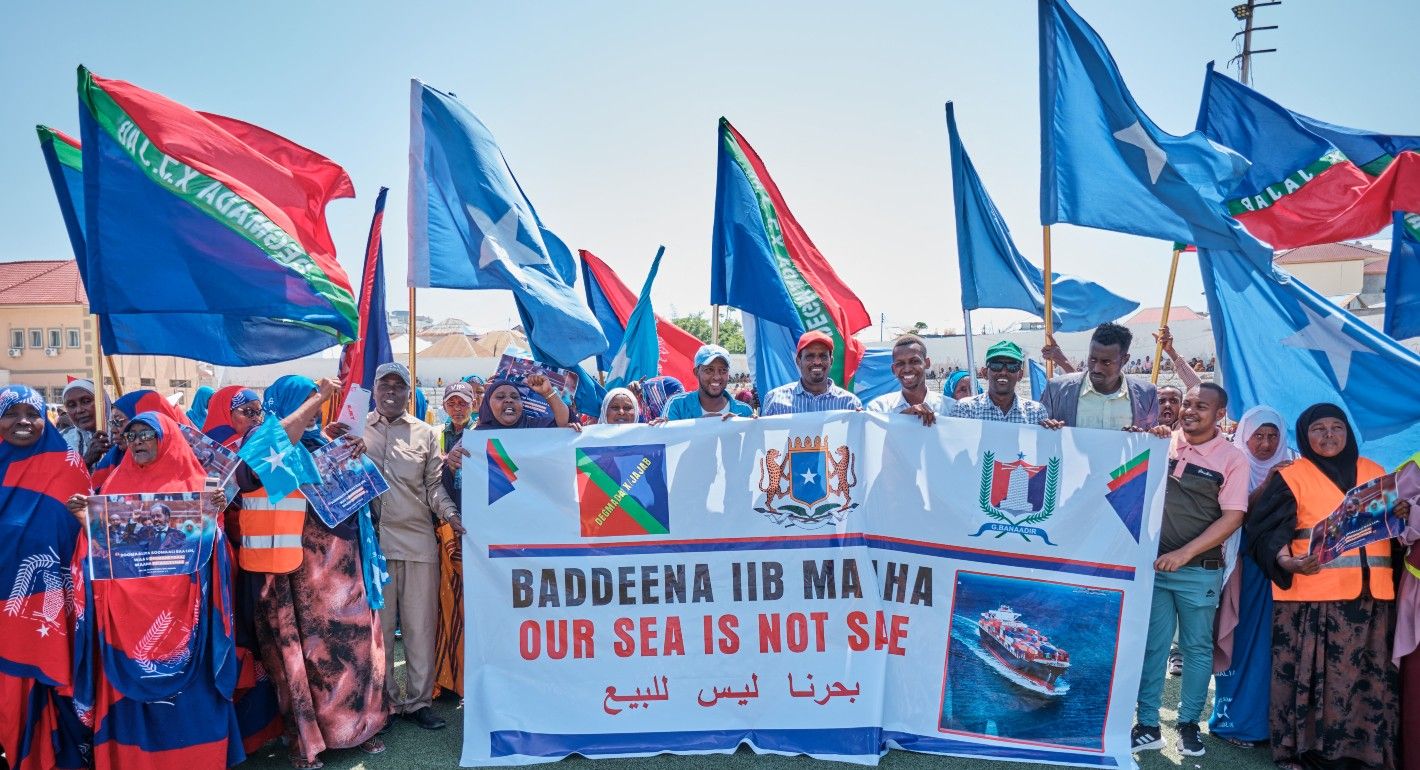
Facebook groups laying out the objectives of the march proliferated widely, along with a new list of twenty-eight grievances and demands. SMS blasts with logistical details went out in the lead-up to the protest. The plan was to march to and occupy the Place d’Bloques. Opposition parties agreed to assist by bringing water and food to the demonstrators once they occupied the Place. On April 25 as many as 5,000 youths took to the Place d’Bloques, which was blocked off by police who beat and arrested 15 youths and used tear gas to suppress the crowds. In the northern town of Zouerate a demonstrator was shot in the foot and taken to the hospital. Young men packed into cars and chased police shouting “Huriyya! Hurriya!” (Freedom! Freedom!).
Prospects
It is uncertain whether the protest movement will make serious gains in the coming months. The youth movement faces latent internal divisions that risk exposing it to co-optation by the regime. The ruling party (UPR), which controls a majority of the seats in parliament, announced plans to form a youth section. The protest movement is also relatively narrow in its composition, owing in part to its choice of communication techniques, with reduced participation from members of the lower classes whose support would be key in any truly mass demonstration in the capital. Expanding and deepening the network of organizers and protesters outside the major cities and into the medium-sized towns is another challenge for the protesters. Additionally, success could also pose trouble for Mauritania's protest movement.
At the present time the government is unlikely to increase the level of repression it has used against protesters in part because it fears provoking popular and international outrage. However, it has shown little interest in making significant concessions to the ongoing demonstrations. A larger uprising might cause the government to respond more harshly. As it stands the government has been put on the defensive, with small parties ending their alliance with the ruling party. Perhaps the most important result of the Arab Spring in Mauritania is an increasingly bold and defiant posture among student organizers and other youth demonstrators on campus and throughout the country, as this is likely to affect the tone and direction of politics significantly in the months ahead.
Khalid Lum is an independent writer and analyst based in Boston.