Egypt’s armed forces appear to be leading a revival of Egyptian nationalism since the ousting of Mohamed Morsi. The civic state with equal rights for all citizens, the respect for Egypt's security institutions, and the prominence of national security are central themes for the interim government. As with every such sentiment, this re-emerging nationalism only functions in opposition to an “other.” Due to recent political developments, the Muslim Brotherhood takes on the role of this other in the eyes of the current government and other pro-military institutions. This perception is also based on the alleged links between Morsi and the Syrian opposition as well as the Palestinian organization Hamas. Amplifying those links—and the alleged support of Syrian and Palestinian nationals for the Muslim Brotherhood—not only led to the de-nationalization of the Muslim Brotherhood and its supporters, but also created a strong anti-Syrian and anti-Palestinian sentiment in Egypt. This has resulted in a major change to the asylum policy regarding Syrian refugees, among other measures. Syrian and Palestinian refugees in Egypt have become a pawn in the government's fight against the Muslim Brotherhood.
While Syrians arriving in Egypt were not subject to visa restrictions and were allowed privileged rights, such as access to the public school and health system, they now need to apply for a visa prior to their arrival. Palestinians1 fleeing the Syrian conflict, however, never had the possibility of being registered as refugees; they face a protection gap in Egypt resulting from the exclusion from the 1951 Refugee Convention and the lack of a UNRWA mandate, and are therefore vulnerable to the arbitrariness of Egyptian state policies. Within the last four months, hundreds fleeing the conflict in Syria have been rejected at Cairo Airport, while others already residing in Egypt, face ongoing threat of deportation and detention in poor conditions.
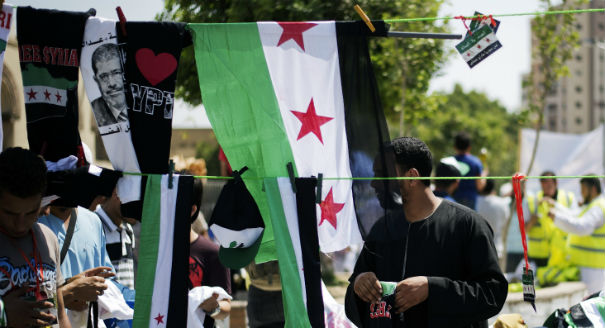
Such targeting of Syrian and Palestinian refugees points to political motivation by the Egyptian authorities—itself a product of the polarized political climate between the military and the Muslim Brotherhood. In September 2012, Morsi issued a presidential decree extending the protection and public services for Syrian refugees and, with that, gave them a privileged position within the Egyptian asylum system. The decree granted Syrian refugees, in contrast to other refugees in Egypt, the right to access the public education and healthcare systems. On June 15, 2013, Morsi suspended all diplomatic relations with the Syrian state under the regime of Bashar al-Assad, thus positioning himself as an ally of the Syrian opposition groups, such as the Syrian branch of the Muslim Brotherhood. The ties the Muslim Brotherhood shared with parts of the Syrian opposition, as well as its alleged links with Hamas, were subsequently employed to create a large-scale media campaign seeking to disconnect the Muslim Brotherhood from the Egyptian people.
The new immigration restrictions for Syrians, issued on July 8, came only a few days after Morsi’s ouster and the arrest of one Syrian citizen at the so-called “Anti-Coup” demonstrations in Nasr City in Cairo. What followed was a campaign fueled by the local media against Syrian and Palestinian refugees. On July 10, different local media channels publicly accused Syrians of supporting Morsi and joining the “Anti-Coup” demonstrations. Tawfik Okasha, a local media presenter, even called on the Egyptians to destroy the houses and shops of Syrians if they would not withdraw their support for Morsi and the Muslim Brotherhood within 48 hours.
Since the Muslim Brotherhood came to power in Egypt, rumors have also been growing that Hamas played a crucial role in Morsi's and other Muslim Brotherhood figures' 2011 prison break. Shortly before the ouster of Morsi, a court in Ismailia referred a case investigating the circumstances of the prison break to state prosecutors and accused him of collusion with Palestinian militants to attack Egyptian police and orchestrate the prison break. The current nationalist media discourse heavily builds on those allegations, portraying Morsi as a Hamas figure and not “the president of all Egyptians.”
The interim government has relied heavily on a militarized society and on the national pride and loyalty of the Egyptians. In the past four months, the government and other loyal institutions created the image of Syrians and Palestinians as being crucially involved in—and interfering with—Egypt's political situation by supporting Morsi and the Muslim Brotherhood. Portraying Morsi as a Hamas-led puppet, in order to de-nationalize the Muslim Brotherhood and its supporters, comes at the cost of Syrian and Palestinian refugees' need for protection.
The politicization of the presence of Syrian and Palestinian refugees in Egypt adds a further layer to the political polarization in the country. As the Muslim Brotherhood is portrayed as a foreign-led, “non-Egyptian” entity, Palestinian and Syrian refugees are, in turn, demonized and viewed as a national security threat. This national security discourse targeting the Muslim Brotherhood and their “foreign supporters” only deepens the divisions in Egypt.
Jasmin Fritzsche is a Cairo-based independent researcher focusing on refugee issues.
1. Descendants of male Palestinian refugees registered under the United Nations Relief and Work Agency for Palestine Refugees in the Near East (UNRWA) keep their refugee status, to preserve the right to return to their homelands. That means, in turn, Palestinian refugees fleeing a conflict in their country of asylum, such as the civil war in Syria, are still considered Palestinian refugees rather than refugees from the conflict area (e.g. Syrian refugees).↩