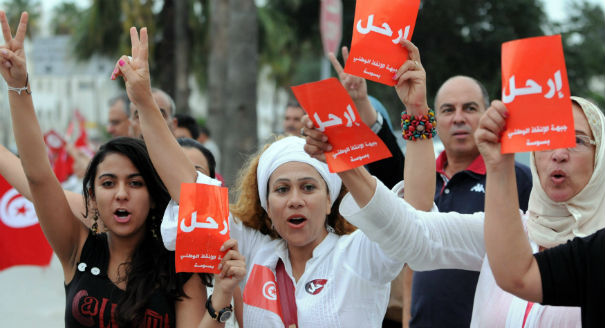
Last summer, Tunisians demonstrated in front of the National Constituent Assembly (NCA), calling for its immediate dissolution along with that of the government. Despite criticism from within the Congress for the Republic (CPR) and Ennahda, the leaderships of two of the three governing troika parties—Ennahda and Ettakatol—responded to the opposition's demands by stepping down. The two parties acknowledged the necessity of reinforcing the government’s electoral legitimacy with a supplemental, dialogue-based one. This process eventually led to the adoption of a new constitution in late January and the appointment of a consensual government led by Mehdi Jomaa. Despite curbing polarization in the country, the mediation efforts led by the Tunisian General Labor Union (UGTT)—in effect, appeasement negotiations between political elites—were seen by some Tunisians as a regression of the revolutionary tide that had swept in a new, democratically representative political order.
For the NCA and the troika parties in power who represent this new order, securing Tunisia's transition mainly meant finishing the constitution and setting up a sound body to oversee the next free and fair legislative elections, currently scheduled to take place before the end of the year. Achieving these goals was crucial, given that each of the NCA's steps forward on drafting the constitution and planning for elections represented an attempt to replace the old system.
Nevertheless, when the constitution-building process was stopped in its tracks after the assassination of member of parliament and leftist opposition leader Mohammed Brahmi last July, the crack in the NCA's legitimacy was too wide to prevent counterrevolutionaries from slipping in to take the lead. Once again, counterrevolutionaries used the discourse of “technocracy” and their old expertise in the former regime to influence Tunisian politics. The opposition, mainly the Salvation Front (an alliance between Nidaa Tounes and the extreme leftist Popular Front), demanded to shut down the NCA, bring down the government, and dismiss all officials appointed by the troika. This constituted a real threat to the transition and unveiled the alliance’s counterrevolutionary character.
The troika, using a bargain politics process, expressed its readiness to cede the government once the constitution and the electoral board are in place. The Salvation Front credits the success of removing the troika to the spontaneous street mobilization of the people. According to the Front, Tunisians are no longer able to stand the failure of the government to run the state, but Ennahda leader Rached Ghannouchi maintains that his party “could have insisted to stay in the government. We were elected by the people, we have the absolute majority in the NCA, and the only way to replace us would be through elections—but it would have led to bloodshed, like in other countries. But no, we said okay, we leave, and if the people have faith in us they will bring us back in the next elections, and we trust that they will.” By the same token, Ennahda spokesman Zied Ladhari asserted that the Troika “did not quit under coercion, as there was no military coup to bring us down, there was no revolution where millions called for our removal, and the opposition was unable to oust us through massive protests.”1
Replacing the Ennahda-led government with an entirely new administration, from a new prime minister to new heads of all the various ministries, was a key component of the National Dialogue process. However, it clearly strengthened the position of counter-revolutionary forces and figures from the former regime, who used this victory to discredit the entire post-revolution system and underscore the “uselessness” of the new elites running it. These Ben Ali era figures still play a role within state apparatuses and in leading political parties of the Salvation Front and the Destourian Movement. In Tunisian media, they plainly assert their sanctioned right to rule. With the wheels of transitional justice turning slowly, these old-regime-affiliated groups—which continued to control the main media outlets in the country after the revolution—used their strong positions in media, person-to-person networks, and traditional ties within bureaucratic structures (particularly the unreformed judiciary) to stage a comeback.
On the ground, the public is witnessing the acquittal of several ministers who served under Ben Ali and a host of corrupt public servants resuming duty after temporary dismissals. Conversely, leaders of the 2011 uprising, such as Imed Dghij and Yassine Ayari, are being dismissed by the opposition as “terrorists” or “mentally unstable.” These young men are being tried for their outspoken position against specific figures of the former regime, particularly within police forces, who have strong ties to both the Salvation Front and unreformed elements of the Interior Ministry. On March 28, Imed Dghij was sentenced to fourteen months for zealously criticizing (in a video he posted on social media) the “corrupt” judges and police officers present in the Union for Judges and in the Police Union. Dghij published his video in reaction to a statement issued by Tunis Police Officers Union where they promised to take “escalatory measures” against Prime Minister Mehdi Jomaa and Minister of Interior Lotfi Ben Jeddou if they do not respond to their demands and arrest Imed Dghij, whom they accused of threatening national security. Journalists, bloggers, and political activists holding similar views are discredited by the media and frequently harassed by the police. An example of this happened on February 28, when a demonstration of political activists denouncing the return of “Ben Ali’s repressive practices” was attacked in a manifest show of force by policemen.
Although alarming and indicative of counterrevolutionary resurgence, this reality does little to sway Ennahda’s leadership, which remains confident that the ongoing course of democratization will succeed despite such inglorious signs. Their confidence seems to derive from viewing the current status of transition through a broader paradigm. They see a political context increasingly defined by transparency and the creation of a range of democratic constitutional institutions, the very establishment of which will necessitate Ennahda’s participation. The Constitutional Court, the High Independent Authority for Elections, the Interim Chamber for the Judiciary (to be replaced by the High Council of Justice), the High Independent Authority for Audiovisual Communication, and the Human Rights Board are all installations that did not exist during Ben Ali’s autocratic era. They now aim to secure a new institutionalized democratic reality which, in Ennahda’s view, will likely coopt elements of the former regime.
Today political maneuvering in Tunisia is determined by the presence of two contending components: the democratic transition-building process upheld by the NCA and the old elites, among them business magnates and politically influential individuals who had been close to the centers of power in the Ben Ali and Bourguiba regimes. Neither side has been able to completely dominate the system, but the struggle continues. Tunisia’s current political climate reflects recent threats to the democratic transition, delicate counterbalancing on the part of political elites, and both satisfaction and dissatisfaction with what those government-affiliated elites have had to do to preserve the continuity of the democratic process. Tunisia must reenergize its transitional justice process and transparency efforts to prevent backroom bargaining and the subversion of accountability, which—if left unchecked—could spell the return of autocratic politics in Tunisia.
Omar Belhaj Salah is a Berlin-based independent Tunisian researcher.
1. Interview with the author. ?