A classroom that was destroyed as a result of clashes in Benghazi’s Banina neighborhood. Photo by Abdul Hakeam
Show More >
al-Yamany, October 23, 2015.
< Show less
One of the city’s schools, which was attacked last year because several fighters were based there. Only 60 schools
Show More >
out of 400 in Benghazi are in adequate condition to welcome students. Photo by Abdul Hakeam al-Yamany, October 23, 2015.
< Show less
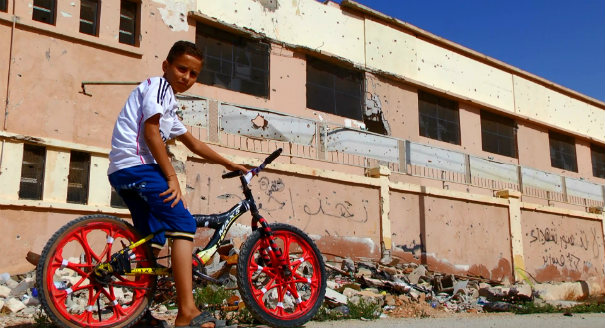
A boy on his bike stops in front of his school in Benghazi’s Banina neighborhood. Written on the wall (right) is the
Show More >
phrase, “Do not forget the martyrs of February 17 [the start of the Libyan Revolution].” Photo by Abdul Hakeam al-Yamany, October 23, 2015.
< Show less
A classroom in Benghazi’s Banina neighborhood, which remains unsafe because a number of rockets and missiles
Show More >
still fall from time to time. Photo by Abdul Hakeam al-Yamany, October 23, 2015.
< Show less
This classroom’s walls were struck by bullets and its windows smashed. Photo by Abdul Hakeam al-Yamany, October 23, 2015.
A teachers’ room in one of the schools that was destroyed. Photo by Abdul Hakeam al-Yamany, October 23, 2015.
A school library, whose wall collapsed as a result of clashes. Photo by Abdul Hakeam al-Yamany, October 23, 2015.
A group of classrooms showing the impact of clashes on their outer walls. Photo by Abdul Hakeam al-Yamany, October 23, 2015.
Part of a school wall that was exposed to rocket shelling. Residents in this neighborhood say that the school was
Show More >
targeted because snipers were hiding in it. Photo by Abdul Hakeam al-Yamany, October 23, 2015.
< Show less
Children in Benghazi’s Banina neighborhood sit in front of their destroyed homes. Banina neighborhood
faced
Show More >
large-scale destruction to buildings due to last year’s violent clashes. Photo by Abdul Hakeam al-Yamany, October 23, 2015.
< Show less
Children in Benghazi’s Banina neighborhood stand in front of their school, which was destroyed as a
result of
Show More >
the armed conflict. Some of the children make the V for victory sign. Photo by Abdul Hakeam al-Yamany, October 23, 2015.
< Show less
Children in Banina stand in their school’s courtyard in the same place where three of their friends were
killed after
Show More >
stepping on a landmine inside the school. Photo by Abdul Hakeam al-Yamany, October 23, 2015.
< Show less
Homes in Benghazi’s Laythi neighborhood that were damaged in clashes a year ago. Photo by Abdul Hakeam
Show More >
al-Yamany, October 23, 2015.
< Show less
This school in Benghazi was transformed into a shelter for displaced persons. More than 13,000 families in
Show More >
Benghazi were displaced as a result of the armed conflict. Photo by Abdul Hakeam al-Yamany, October 25, 2015.
< Show less
Clothes hang along the corridor in one of the schools where a group of displaced families are based. Photo by Abdul
Show More >
Hakeam al-Yamany, October 25, 2015.
< Show less
The family of these two girls was displaced from their region as a result of the clashes,
living now in one of Benghazi’s
Show More >
schools. Photo by Abdul Hakeam al-Yamany, October 25, 2015.
< Show less
A Libyan family works to turn a classroom into a shelter after they were displaced from their
homes. Photo by
Abdul
Show More >
Hakeam al-Yamany, October 25, 2015.
< Show less
A destroyed apartment building in the middle of Benghazi. Photo by Abdul Hakeam al-Yamany, October 23, 2015.
Al-Ageeb Street, in the center of Benghazi. The houses on this street were heavily damaged as a result of violent clashes.
Show More >
Photo by Abdul Hakeam al-Yamany, October 23, 2015.
< Show less
Over a year ago, on May 16, 2014, General Khalifa Haftar launched the so-called Operation Dignity against extremist militias in Benghazi. Since that time, the city has been engulfed in an armed battle that has ravaged its infrastructure, destroyed most of its institutions, and led to the displacement of entire neighborhoods of the city. The crisis has particularly affected the education sector in Benghazi. Only 60 of the 400 schools in the city escaped damage and are able to accept students.
Hassan al-Maghrabi, the official in charge of education in the Benghazi Crisis Committee formed by the Libyan government in the eastern part of the country, stressed that many of the schools that are in good enough condition to be used lie near the front lines of clashes and estimates that only about 50 percent of Benghazi’s students are able to go to school. “Despite this, we have set plans so that students can at least complete exams, and we have already succeeded in holding exams for the past academic year for grades one through eight. Parents have been happy that some aspects of schooling have returned, even if this only involved completing exams,” he said.
Most parents are afraid to send their children to the schools that remain open, fearing that they will be hit by the random shells that occasionally fall on the city. Maghrabi said, “The children and some parents always ask me about the danger of the situation and their fear that random shelling could hit the schools while students are there. I respond that these shells are indiscriminate—they could fall on their houses and not just the schools.” Mohammed al-Saaiti, a 10-year-old from the Banina neighborhood, which has largely been destroyed, said, “I want to go back to school, but my school was destroyed in the clashes. Many rockets and missiles fall on us from time to time.” Mohammed al-Barghathi, a 12-year-old from the same neighborhood, added, “My friends and I tried to clean our school multiple times so that it could be used for education, but the random shelling continues to fall on our region. Three of my friends died when they stepped on an unexploded shell hidden in the school yard.”
Meanwhile, the schools in safer neighborhoods have mostly been transformed into shelters for internally displaced persons who have left their homes in nearby areas of conflict. The Benghazi Crisis Committee is trying hard to develop solutions to displaced persons using the schools as temporary housing until the war ends in the city. Essam al-Hamali, the official in charge of social affairs in the Benghazi Crisis Committee, said, “We have 13,000 displaced families in Benghazi. We have temporarily placed them in schools located in relatively safe areas, because we have no other place to house them.” He added, “Due to the financial crisis faced by the government in eastern Libya, we cannot currently provide these families with money to rent homes. This crisis has been exacerbated due to the lack of support we obtain from all sides, whether international organizations or even local ones.”
The displaced, even though most are employed, are neither able to afford alternative housing nor can they return to their homes due to the ongoing violence. Salima al-Taira, a 56-year-old mother of four currently residing in one of the schools, said that over a year ago she and her family left the Bou Atni region in southern Benghazi due to the violent clashes occurring there. She added that the Libyan army evacuated many residential neighborhoods including hers, and she has not been able to return. According to her, the army is even discouraging families from returning to several residential neighborhoods, Bou Atni among them, where the Libyan army maintains active military camps. “A number of officials visited us in the school and said that we would return to our homes before this past Ramadan, but this did not happen,” she added.
With no political solution on the horizon, there is little indication as to when children can resume their schooling. In the past couple weeks, some locals have tryied to develop solutions to this crisis by airing educational lessons on public TV channels like Al-Wataniya. Other residents have turned to social media; the Benghazi Skype School, for example, uses Skype to connect students and teachers from home and distributes video lessons on YouTube. Yet this is only a stopgap measure, and most children in Benghazi do not have reliable access to electricity or the Internet to benefit from these initiatives.
Benghazi’s youth in the meantime are behind in their studies compared to other Libyan cities, and many families displaced from the city registered their children to study in other cities. But the majority of children instead stay at home listening to bombs drop around their neighborhoods or playing war games with friends in the streets. Together with the psychological toll of ongoing violence and inadequate public services, Benghazi’s lack of educational opportunities for children will likely only worsen the conflict.
This article was translated from Arabic.
Abdul Hakeam al-Yamany is a Libya-based journalist.