

Commentary
Despite its flop at the box office, the film raises important questions for the climate community to answer.
Leonardo Martinez-Diaz
{
  "authors": [],
  "type": "legacyinthemedia",
  "centerAffiliationAll": "dc",
  "centers": [
    "Carnegie Endowment for International Peace"
  ],
  "collections": [],
  "englishNewsletterAll": "menaTransitions",
  "nonEnglishNewsletterAll": "",
  "primaryCenter": "Carnegie Endowment for International Peace",
  "programAffiliation": "MEP",
  "programs": [
    "Middle East"
  ],
  "projects": [],
  "regions": [
    "North America",
    "United States",
    "East Asia"
  ],
  "topics": [
    "Political Reform",
    "Security",
    "Military"
  ]
}
Source: Getty
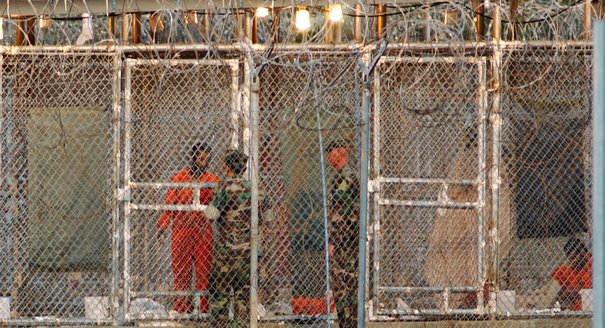
As the Obama administration contemplates what to do with the remaining Guantanamo detainees, Singapore's de-radicalization program, in which Islamic scholars build personal relationships with the detainees to correct their misreading of Islam, provides a valuable model.
Source: Washington Post

As the administration struggles over the fate of the 241 remaining detainees in its charge, it may want to look to an old Asian ally for a hand.
Meet Ustaz Ibrahim Kassim, one of Singapore's most respected Islamic scholars. His business card describes him as "Assistant Registrar of Muslim Marriages." But Kassim is engaged in a more important enterprise. He is part of his country's innovative program to fend off the threat of Islamic extremism. "We are not scared of [the terrorists]," says Kassim, an older gentleman with a face framed by a neatly trimmed white beard. "We know that history repeats itself, but these problems do not need to be passed on."
Kassim, along with nearly 40 other Islamic scholars, is part of a select group of religious leaders called the Religious Rehabilitation Group (RRG), which is trying to rehabilitate -- or, as its members say, "deprogram" -- Singapore's terrorist detainees. In 2001, Singapore's authorities had no idea that they had a terrorist problem. But after the Sept. 11 attacks, the government was tipped off that a cell of Jemaah Islamiyah, the Southeast Asian militant group with links to al-Qaeda, was planning attacks across the city-state. In raids in late 2001 and 2002, more than 30 members of the terrorist outfit were arrested; more arrests followed. So, while the United States was filling its detention center at Guantanamo with foreign fighters, Singapore began to house its own population of Muslim extremists in its jails.
Singapore's strict law-and-order government, which famously enforced a ban on chewing gum, may seem an unlikely candidate for believing terrorists could be reformed. But Singapore -- often referred to as "the little red dot" in Southeast Asia's Islamic sea -- is in a precarious position, and its government felt compelled to take action that would not only disrupt the terrorist group's operations, but also counter its ideological appeal. "We are what we are out of necessity," says Singapore's Foreign Minister George Yeo. "[Islamic extremism] is a long-term problem, and it's not going to go away in our lifetime. The only way you can combat it is to have an immune system."
Singaporean officials said they decided to use Islamic clerics because they were convinced that only religious leaders could "de-program" the detainees. "Once you have taken an oath of God, it will take another man of God to undo it," a senior security official told me.
After meeting several detainees and studying Jemaah Islamiyah's religious ideology, the Islamic scholars were disturbed to see how their faith had been distorted to recruit terrorist foot soldiers. During more than a thousand weekly hour-long sessions, the scholars worked to build personal relationships with the detainees. Some counselors said the process of de-radicalizing an extremist was similar to the one-on-one relationship that often exists between a terrorist recruiter and recruit.
The main battles were over the Koran. Islamic radicals, especially members of Jemaah Islamiyah, many of whom are born-again Muslims who adopted their extreme faith late in life, often quote from it to justify their actions. That was where a scholar's grasp of Islam came in, and it wasn't always a pleasant exchange. "They believe they have the right to kill. This is what they believe from years of indoctrination," says Ustaz Feisal Hassan, one of the counselors.
As with the rehabilitation of any criminal, there's always the possibility of backsliding. Two graduates of Saudi Arabia's rehabilitation program have reportedly taken leadership positions within al-Qaeda in Yemen. For this reason, the RRG also counsels the detainee's family to ensure that wrong lessons are not passed on to the next generation and to help wives, sons and daughters assimilate into the mainstream. Many families receive financial support from the government, and detainees have jobs waiting for them when they are released.
Sidney Jones, a longtime advocate for human rights in Southeast Asia now at the International Crisis Group, calls this aspect of the Singapore program a "stroke of genius."
"In some places, like Poso [in Indonesia], I have heard it is the wives who urge their husbands not to work with the police and to keep their resolve," says Jones. And unlike in many other countries with terrorist rehabilitation programs, such as Saudi Arabia and Yemen, the detainees in Singapore are required to continue their counseling after their release.
Today, 40 former terrorists, or roughly two-thirds of the detainees Singapore has arrested since 2001, have been rehabilitated and released. None appear to have returned to their violent past. For Singaporean authorities, the best dividend may be the trust they have gained from the city-state's own Muslim citizens. "Singapore is the one place in the world I know where relations between the government and the Muslim community are better after 9/11," says Alami Musa, the president of the Islamic Religious Council of Singapore.
Of course, the biggest question is how we can ever know if a radical is truly rehabilitated. A detainee in Singapore is not released until his case officer, a psychologist and the religious counselor signs off. Even then the decision goes to the prime minister's cabinet to give its approval. Political accountability rests at the top.
Members of the RRG have traveled to Iraq to brief U.S. military officers on their methods. At a meeting in Singapore earlier this year, Maj. Gen. Douglas Stone Jr., who used to run the U.S. military's detention system in Iraq, said that 15 percent of Iraqi militants would typically return to the fight once released. Since the U.S. military introduced its own rehabilitation program, inspired in part by Singapore's example, that figure has dropped to 1 to 2 percent.
As the Obama administration contemplates what to do with the detainees who remain in Guantanamo, perhaps they should consider talking with Ustaz Ibrahim Kassim. I have his business card.
This article originally appeared in the Washington Post.
Carnegie does not take institutional positions on public policy issues; the views represented herein are those of the author(s) and do not necessarily reflect the views of Carnegie, its staff, or its trustees.
Despite its flop at the box office, the film raises important questions for the climate community to answer.

Leonardo Martinez-Diaz

Russian strikes are weakening the economy sustaining Ukraine’s war effort. Closing the growing funding gap will require more European support and politically contentious reforms in Kyiv.

Balázs Jarábik

In an interview, Rozina Ali discusses her new book on the rise and manifestations of Islamophobia in the United States.

Michael Young

While the EU and European governments are embracing the much-lauded middle-power moment, this entails three difficult conundrums.

Richard Youngs

Ex-president Gurbanguly Berdimuhamedov remains interested in politics, but his son Serdar, Turkmenistan’s current president, is becoming increasingly independent and willing to break with his father’s legacy. If their covert rivalry goes too far, both risk losing power.

Galiya Ibragimova