

In The Media
David Rothkopf
{
  "authors": [
    "David Rothkopf"
  ],
  "type": "legacyinthemedia",
  "centerAffiliationAll": "",
  "centers": [
    "Carnegie Endowment for International Peace"
  ],
  "collections": [],
  "englishNewsletterAll": "",
  "nonEnglishNewsletterAll": "",
  "primaryCenter": "Carnegie Endowment for International Peace",
  "programAffiliation": "",
  "programs": [],
  "projects": [],
  "regions": [
    "North America",
    "United States"
  ],
  "topics": [
    "Economy"
  ]
}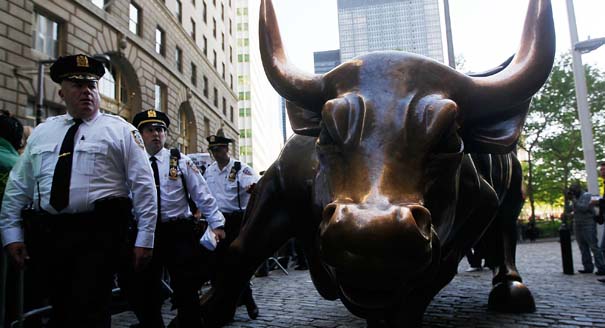
Source: Getty
Historically, the United States has placed a higher tax burden on its wealthiest citizens than it does currently. Such higher government revenues could help resolve the financial problems facing the country.
Source: Financial Times

For most of the past century America’s wealthiest have paid a vastly higher percentage of their income to taxes than they do now. They have also paid much higher rates during periods of national crisis, when America has felt it more natural to turn to them for support. In the period around the first world war this meant a top rate of 73 per cent. When we were climbing out of the Great Depression this hit 79 per cent, and at the peak of the second world war soared to 94 per cent.
Taxing the rich at higher rates, despite the cant that it drags down job creation and growth, has been a hallmark of America’s greatest expansions too, including the boom years after the second world war. The cuts in rates introduced by President George W. Bush, meanwhile, have also proved that reducing the burden on the richest brings no obvious benefits in terms of job growth, given that the decade since those cuts was the first in US history with no net job creation.
As Mr Buffett and others like him have often noted, today’s low rates for the rich are not just inconsistent with long-established US financial and social principles. They are also much lower than they at first appear, thanks to further tax breaks on capital gains, carried interest and other types of investments and flows of wealth that are enjoyed primarily by those in the upper brackets. Indeed, this is how we get to the phenomenon of Mr Buffett paying a lower tax rate than many of those in his office, as he himself has noted.
No, the real question is why it makes news when someone calls for a return to the status quo, from an experiment in regressive taxation that is depriving the government of resources it needs while further fuelling income inequality. The response shows just how fraught the coming period of reconciling forced austerity with equity is going to be.
America’s poor and middle class depend on government much more than the rich, and so stand to be hurt more by coming budget cuts. Given that America’s deficit is also likely to far exceed current official projections – because growth will be more anaemic than projected for several years to come – there is also no way cuts alone can produce the needed balancing of accounts.
Yet the muddle over how to tax those on higher incomes cuts both ways. The right trot out misguided ideas about a link between low taxes and growth. But some of the left also focus on taxing “millionaires and billionaires” to the exclusion of other steps to solve America’s economic problems. Yet even sharply increased taxes on those making more than $1m a year would produce perhaps $500-$600bn over the next decade – a small fraction of what is needed to bring America’s deficit into balance.
Of course such a move would help. Indeed it is a necessity, but it will not be enough. Instead substantial further additional new revenue sources, along with large spending cuts will be needed, especially if America’s current weak growth continues, and the country ultimately needs to provide further stimulus to boost job creation.
The best course of action would be for the US to move towards fairer taxes on the wealthy, while also joining virtually every other western nation in introducing a value added tax, or some other kind of consumption-related levy. A form of carbon tax would also help, especially if its revenues could supporting tax code simplification and infrastructure investment. And of course we must also undo the errors of both Mr Bush and, as of last December, President Barack Obama, and let the Bush tax cuts for the richest Americans expire.
Naturally you won’t hear much about any of these ideas during the political debate ahead. But you will see their influence in the intensity with which rich Americans who have only partly paid their way for decades denounce the inevitable and essential tax changes to come. Then, once the political campaign of 2012 is over, the real work will begin.
Originally published in the Financial Times, August 18, 2011.
Former Visiting Scholar
David Rothkopf was a visiting scholar at the Carnegie Endowment as well as the former CEO and editor in chief of the FP Group.
Recent Work
David Rothkopf
David Rothkopf
Carnegie does not take institutional positions on public policy issues; the views represented herein are those of the author(s) and do not necessarily reflect the views of Carnegie, its staff, or its trustees.

AI could hollow out jobs, reshape them gradually, create entirely new ones—or do all three at once. The case for starting to act now doesn’t depend on knowing which.

Teddy Tawil

In an interview, Jim Lamson discusses the ongoing regional conflict and sees an unclear picture when it comes to winners and losers.

Michael Young

Our new report offers a path forward for local officials and future policymakers.



Joe McCannon, Jenny Keroack, Lauren Jensen, …

Present and future policymakers seeking to address climate-related health challenges can draw lessons from the successes and failures of the Biden administration.
Joe McCannon, Jenny Keroack, Lauren Jensen, …

Powerful lobbyists and inertia led to Russia’s coal-mining sector missing an excellent opportunity to solve its structural problems.
Alexey Gusev