• Research
  • Emissary
  • About
  • Experts
Carnegie Global logoCarnegie lettermark logo
DemocracyIran
  • Donate
{
  "authors": [
    "Karim Sadjadpour"
  ],
  "type": "legacyinthemedia",
  "centerAffiliationAll": "dc",
  "centers": [
    "Carnegie Endowment for International Peace",
    "Malcolm H. Kerr Carnegie Middle East Center"
  ],
  "collections": [
    "Arab Awakening"
  ],
  "englishNewsletterAll": "menaTransitions",
  "nonEnglishNewsletterAll": "",
  "primaryCenter": "Carnegie Endowment for International Peace",
  "programAffiliation": "MEP",
  "programs": [
    "Middle East"
  ],
  "projects": [],
  "regions": [
    "Middle East",
    "Iran",
    "Syria",
    "Levant"
  ],
  "topics": [
    "Political Reform"
  ]
}
Source: Getty

In The Media

The Iranian Role in Syria

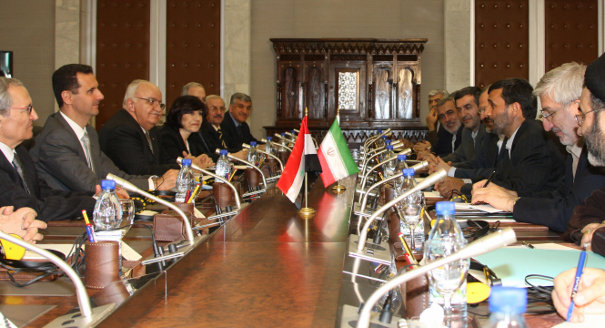
Syria is too important as an Iranian ally for Tehran to engage in a political transition process that would result in the ousting of the Assad regime.

Link Copied
By Karim Sadjadpour
Published on Aug 7, 2012
Program mobile hero image

Program

Middle East

The Middle East Program in Washington combines in-depth regional knowledge with incisive comparative analysis to provide deeply informed recommendations. With expertise in the Gulf, North Africa, Iran, and Israel/Palestine, we examine crosscutting themes of political, economic, and social change in both English and Arabic.

Learn More

Source: BBC

Speaking on the BBC, Carnegie's Karim Sadjadpour discussed Iran's role in the increasingly sectarian civil war in Syria. For Iran, Syria is its last remaining consistent ally in the international community, Sadjadpour. Thus, for Iran “the results of the Syrian conflict are a zero sum game; they stand to lose in a major way if the Assad regime falls,” he explained. Iran carries significant influence in Syria because of its financial support, its provisions of subsidized oil and arms, and the tactics and strategy it provides. Clearly, Sadjadpour added, the Iranian regime has shared its philosophy of never compromising with a domestic uprising with the Assad regime. Ultimately, the Iranians will continue to “publically call for reform and reconciliation while privately arming the Assad regime,” concluded Sadjadpour. The loss of a firm ally would be too devastating for the Iranian regime for it to plausibly engage in an international effort aimed at a political transition that would remove the Assad regime. 

About the Author

Karim Sadjadpour

Senior Fellow, Middle East Program

Karim Sadjadpour is a senior fellow at the Carnegie Endowment for International Peace, where he focuses on Iran and U.S. foreign policy toward the Middle East.

    Recent Work

  • Q&A
    Iran Wanted to Survive the War. Now What?

      Suzanne Maloney, Aaron David Miller, Karim Sadjadpour

  • Q&A
    What’s Keeping the Iranian Regime in Power—for Now

      Aaron David Miller, Karim Sadjadpour, Robin Wright

Karim Sadjadpour
Senior Fellow, Middle East Program
Karim Sadjadpour
Political ReformMiddle EastIranSyriaLevant

Carnegie does not take institutional positions on public policy issues; the views represented herein are those of the author(s) and do not necessarily reflect the views of Carnegie, its staff, or its trustees.
More Work from Carnegie Endowment for International Peace

  • Commentary
    Carnegie Politika
    Multiple Wars Are Ruining Central Asia’s Efforts to Diversify Its Trade Routes

    This year’s wars have made alternative routes to transit through Russia no less risky for Central Asian countries.

      Galiya Ibragimova

  • Three people standing outside a fancy building
    Commentary
    Emissary
    The Latest Iran Deal Ignores the Lessons of the Past

    By burying disagreements in imprecision, the new deal risks same fate as its predecessors.

      James M. Acton

  • Man sitting in a chair reading a newspaper with Trump's face above the fold
    Commentary
    Emissary
    Iran Wanted to Survive the War. Now What?

    The United States and Israel may have unwittingly revived the Islamic Republic’s “zombie regime.”

      Suzanne Maloney, Aaron David Miller, Karim Sadjadpour

  • Commentary
    Strategic Europe
    Taking the Pulse: Is European Diplomacy on Iran Outdated?

    When the U.S.-Iran memorandum of understanding was announced, the UK, France, Germany, and Italy declared their readiness to help demine the Strait of Hormuz and lift nuclear sanctions on Tehran. But does Europe need new tools to recover a diplomatic role?

      • Rym Momtaz

      Rym Momtaz, ed.

  • Commentary
    Diwan
    Lebanon Should Try to Place Hezbollah on the U.S.-Iran Table

    As talks begin between Washington and Tehran, Beirut has an opening to advance a regional plan for the party’s disarmament.

      Michael Young

Get more news and analysis from
Carnegie Endowment for International Peace
Carnegie global logo, stacked
1779 Massachusetts Avenue NWWashington, DC, 20036-2103Phone: 202 483 7600
  • Research
  • Emissary
  • About
  • Experts
  • Donate
  • Programs
  • Events
  • Blogs
  • Podcasts
  • Contact
  • Annual Reports
  • Careers
  • Privacy
  • For Media
  • Government Resources
Get more news and analysis from
Carnegie Endowment for International Peace
© 2026 Carnegie Endowment for International Peace. All rights reserved.