• Research
  • Emissary
  • About
  • Experts
Carnegie Global logoCarnegie lettermark logo
DemocracyIran
  • Donate
{
  "authors": [
    "Frederic Wehrey"
  ],
  "type": "legacyinthemedia",
  "centerAffiliationAll": "dc",
  "centers": [
    "Carnegie Endowment for International Peace"
  ],
  "collections": [
    "Arab Awakening"
  ],
  "englishNewsletterAll": "menaTransitions",
  "nonEnglishNewsletterAll": "",
  "primaryCenter": "Carnegie Endowment for International Peace",
  "programAffiliation": "MEP",
  "programs": [
    "Middle East"
  ],
  "projects": [],
  "regions": [
    "Middle East",
    "Syria"
  ],
  "topics": [
    "Political Reform",
    "Foreign Policy"
  ]
}
Source: Getty

In The Media

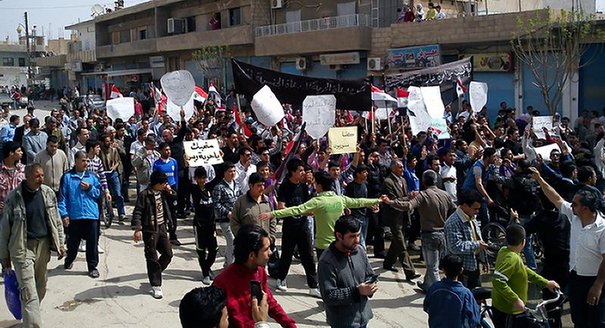
A No Fly Zone Over Syria?

Despite rising levels of violence in Syria, the United States should focus less on intervention and more on planning for the day after the fall of the regime.

Link Copied
By Frederic Wehrey
Published on Nov 13, 2012
Program mobile hero image

Program

Middle East

The Middle East Program in Washington combines in-depth regional knowledge with incisive comparative analysis to provide deeply informed recommendations. With expertise in the Gulf, North Africa, Iran, and Israel/Palestine, we examine crosscutting themes of political, economic, and social change in both English and Arabic.

Learn More

Source: FM4 ORF Austrian Radio

Speaking on FM4 ORF Austrian Radio, Carnegie's Frederic Wehrey explained that, with violence in Syria continuing to spiral to dramatic levels, a host of possible military actions are being considered. In particular, many are discussing implementing a no-fly zone. However, Wehrey noted, “no-fly zones are often the gateway drug to regime change. Once put in place it’s very difficult to say when you have achieved your goal, you become wedded to events on the ground and eventually become involved on the ground.” Aside from protecting innocent civilian,s a host of other considerations must be taken into account, he continued. In Syria, the possibility of any sort of American intervention—whether a no-fly zone or ground intervention—would undoubtedly rally jihadist elements, much as it did in Iraq. Wehrey stated that if he could advise on President Obama on how the U.S. should operate moving forward, he would stress “less of a focus on intervention and more planning for the day after the fall of the regime.”

About the Author

Frederic Wehrey

Senior Fellow, Middle East Program

Frederic Wehrey is a senior fellow in the Middle East Program at the Carnegie Endowment for International Peace, where his research focuses on governance, conflict, and security in Libya, North Africa, and the Persian Gulf.

    Recent Work

  • Article
    Parallel Climate Reckonings: Colonial Water Legacies and Indigenous Adaptation, from Morocco to the American West

      Frederic Wehrey, Charles H. Johnson

  • Commentary
    The Iran War Is a Stress Test for Gulf States

      Frederic Wehrey, Charles H. Johnson

Frederic Wehrey
Senior Fellow, Middle East Program
Frederic Wehrey
Political ReformForeign PolicyMiddle EastSyria

Carnegie does not take institutional positions on public policy issues; the views represented herein are those of the author(s) and do not necessarily reflect the views of Carnegie, its staff, or its trustees.

More Work from Carnegie Endowment for International Peace

  • Satellite in space
    Commentary
    Emissary
    The U.S. Has Weapons in Space. Now What?

    The acknowledgment has sparked fears of a new arms race with China and Russia.

      • Chris  O'Meara ​​​​

      Chris O’Meara

  • Blue Water Bridge with Flags of USA and Canada
    Paper
    What Canada Knows About American Power

    Smaller powers cannot go it alone, but Canadian history shows that integration with the United States will not always be benign.

      Paul Samson

  • Commentary
    Strategic Europe
    Taking the Pulse: Can the EU Stare Down China on Trade?

    The European Commissioner for Trade is headed to China. But after President Xi’s bridge-building visit to Washington, can a more isolated EU overcome Beijing’s stranglehold on critical raw materials? Who will blink first?

      • Rym Momtaz

      Rym Momtaz, ed.

  • Trump holding a glass of champagne up in a toast, with a table of guests in the foreground
    Commentary
    Emissary
    Trump Had the Chance to Address U.S.-China AI Safety. He Threw Xi a Party Instead.

    The summit may be remembered as a fatal blunder, when Washington, Beijing, and the AI industry collectively chose ceremony over action.
      • Jeffrey Prescott

      Jeffrey Prescott

  • Article
    Separable, not Separate: Governing Europe’s Collective Defense

    European NATO countries are wrestling with the possibility of U.S. disengagement from the alliance. With the continent’s security increasingly uncertain, governments must restore the credibility of their collective defense.


      Hans-Dieter Lucas, Adam Thomson, Pierre Vimont

Get more news and analysis from
Carnegie Endowment for International Peace
Carnegie global logo, stacked
1779 Massachusetts Avenue NWWashington, DC, 20036-2103Phone: 202 483 7600
  • Research
  • Emissary
  • About
  • Experts
  • Donate
  • Programs
  • Events
  • Blogs
  • Podcasts
  • Contact
  • Annual Reports
  • Careers
  • Privacy
  • For Media
  • Government Resources
Get more news and analysis from
Carnegie Endowment for International Peace
© 2026 Carnegie Endowment for International Peace. All rights reserved.