

Research
- +10
Rosa Balfour, Frances Z. Brown, Yasmine Farouk, …
{
  "authors": [
    "Moisés Naím"
  ],
  "type": "legacyinthemedia",
  "centerAffiliationAll": "",
  "centers": [
    "Carnegie Endowment for International Peace"
  ],
  "collections": [],
  "englishNewsletterAll": "",
  "nonEnglishNewsletterAll": "",
  "primaryCenter": "Carnegie Endowment for International Peace",
  "programAffiliation": "",
  "programs": [],
  "projects": [],
  "regions": [
    "North America",
    "United States"
  ],
  "topics": [
    "Economy",
    "Trade"
  ]
}
Source: Getty
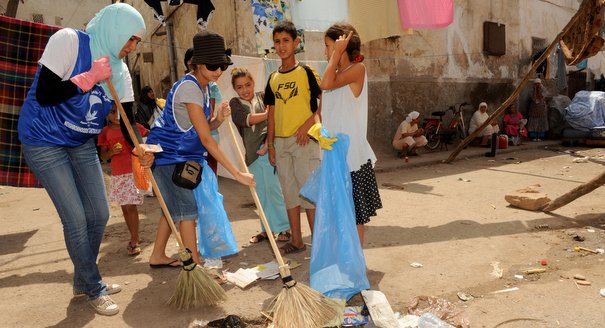
Containing—or reversing—economic inequality and unemployment will require a protracted and highly targeted effort, one similar to the campaign launched by the adoption of the Millennium Declaration.
Source: Atlantic
It was easy to miss the miracle that occurred in New York in the fall of 2000. The miracle was one of the reasons why, over the ensuing decade, humanity experienced the fastest decline in poverty in history.
On September 8, 2000, at the headquarters of the United Nations in New York, 189 heads of state signed a lofty set of promises that they called the Millennium Declaration. In it, they committed “To halve, by the year 2015, the proportion of the world’s people whose income is less than one dollar a day and the proportion of people who suffer from hunger and, by the same date, to halve the proportion of people who are unable to reach or to afford safe drinking water. To ensure that, by the same date, children everywhere, boys and girls alike, will be able to complete a full course of primary schooling and that girls and boys will have equal access to all levels of education.” They also promised to reduce maternal mortality by three quarters and under-five child mortality by two thirds, while also reversing the spread of HIV/AIDS, malaria, and other major diseases.Most people who heard the news at the time yawned and moved on. And why not? Politicians have taught us not to take their promises too seriously, especially when, like the Millennium Declaration, they are proffered at that annual tournament of mendacity and hypocrisy called the UN General Assembly. Inevitably, the Declaration quickly disappeared from the public’s view as more attention-grabbing news filled the headlines: the Palestinian Intifada, Saddam Hussein’s refusal to accept UN inspections, Hillary Clinton’s ascent into the Senate, and the Supreme Court’s decision to recognize George W. Bush as the 43rd president of the United States.
Yet since that September, 13 years ago, there are 500 million fewer people living in conditions of extreme poverty, while malaria-related deaths have dropped by 25 percent and infant mortality has fallen by 30 percent. Two hundred million inhabitants of the poorest neighborhoods in the world have gotten access to water, sewage systems, and better homes.
This progress was a result of many factors—high rates of economic growth, especially in Asia, more employment options and better salaries, increased public spending on healthcare, and more effective social policies. Countries like China and India becoming more deeply integrated in the global economy through trade and investment also contributed to the enormous reduction in poverty levels. In China for example, extreme poverty rates dropped from 60 percent in 1990 to 12 percent in 2010.
Poverty alleviation may have been propelled by a variety of forces, but the widespread adoption of the Millennium Declaration was a surprising catalyst of this unprecedented progress in the living standards of the poor. It was surprising because, rather than vague promises and generic statements of governmental intention, the Declaration’s goals were concrete, measurable, and time-bound. It defined eight goals, 21 specific objectives, and 60 indicators to track progress toward the goals. Moreover, it was a very public commitment with an expiration date: the year 2015. These factors created healthy competition among governments. In some countries, progress—or lack thereof—toward attaining the Millennium Development Goals became part of the national political debate.
Not surprisingly, the results have been uneven. Brazil, for example, achieved many of its goals, while progress in countries like Benin and Niger has been far less notable. The greatest shock, however, has been the unexpected success of the goals in the face of insurmountable odds. Not only was the Millennium Declaration aggressively ambitious, but its progress has continued in spite of the disastrous world economic crisis that burst forth in 2008. And some of the goals—such as halving the number of people without access to drinkable water and the number of people living in extreme poverty—were achieved five years before the target date. Others will not be met by 2015, and some targets saw no advancements whatsoever: We have yet to make a substantial dent in carbon-dioxide emissions. Work must still be done to attain these goals, and surely other goals will have to be added to any post-2015 campaign.
To that effect, UN Secretary General Ban Ki-moon named a panel of "eminent persons" to assess the Millennium Declaration, consult broadly, and outline a post-2015 agenda. Their report sets forth a roadmap for the effort going forward. I asked Homi Kharas, a respected development expert who coordinated the work of this group for over a year, what surprised him most during the endeavor. “How much the interdependence between poor and rich countries has intensified. It has always existed, but it is now deeper and more important than ever,” he replied.
We already knew that some policies of rich countries—trade barriers or weapons exports, for example—hurt poor ones. And we also knew that there are many problems—global warming and illegal migration flows, for instance—that rich and poor countries must face together. According to Kharas, the list of problems in these categories has grown larger and more complex.
But the real revelation is that there is a new and important category: problems where rich countries can learn from the experience of poorer ones. Indeed, some issues, once typical of less developed countries, are now also plaguing the most advanced ones. Economic inequality is perhaps the most notable example. Living with high levels of inequality has been the norm in many poor countries, but now it is increasingly widespread in the U.S. and Europe. In the United States, the gap between the richest 1 percent and the rest of the population is now the widest it’s been since the 1920s, and Europe is also seeing its income distribution worsen. We’re seeing these trends in unemployment as well. The high rates of unemployment suffered by the hardest-hit European countries mirror those found in lower-income countries, where chronic unemployment is common. Youth unemployment is now particularly acute in both rich and poor countries.
These trends are alarming. And it is obvious that containing—or reversing— them will require a protracted and highly targeted effort, one similar to the campaign launched by the adoption of the Millennium Declaration. In 2015, we will need another miracle like the one that took place in 2000. But this time, it must also encompass the world’s richest countries.

Distinguished Fellow
Moisés Naím is a distinguished fellow at the Carnegie Endowment for International Peace, a best-selling author, and an internationally syndicated columnist.
Recent Work



Rosa Balfour, Frances Z. Brown, Yasmine Farouk, …
Moisés Naím
Carnegie does not take institutional positions on public policy issues; the views represented herein are those of the author(s) and do not necessarily reflect the views of Carnegie, its staff, or its trustees.

AI could hollow out jobs, reshape them gradually, create entirely new ones—or do all three at once. The case for starting to act now doesn’t depend on knowing which.

Teddy Tawil

In an interview, Jim Lamson discusses the ongoing regional conflict and sees an unclear picture when it comes to winners and losers.

Michael Young

Our new report offers a path forward for local officials and future policymakers.



Joe McCannon, Jenny Keroack, Lauren Jensen, …
Present and future policymakers seeking to address climate-related health challenges can draw lessons from the successes and failures of the Biden administration.
Joe McCannon, Jenny Keroack, Lauren Jensen, …

Powerful lobbyists and inertia led to Russia’s coal-mining sector missing an excellent opportunity to solve its structural problems.
Alexey Gusev