

Paper
George Perkovich
{
  "authors": [
    "George Perkovich"
  ],
  "type": "legacyinthemedia",
  "centerAffiliationAll": "dc",
  "centers": [
    "Carnegie Endowment for International Peace",
    "Malcolm H. Kerr Carnegie Middle East Center"
  ],
  "collections": [],
  "englishNewsletterAll": "ctw",
  "nonEnglishNewsletterAll": "",
  "primaryCenter": "Malcolm H. Kerr Carnegie Middle East Center",
  "programAffiliation": "NPP",
  "programs": [
    "Nuclear Policy"
  ],
  "projects": [],
  "regions": [
    "North America",
    "United States",
    "East Asia",
    "South Korea"
  ],
  "topics": [
    "Security",
    "Nuclear Policy",
    "Arms Control"
  ]
}
Source: Getty
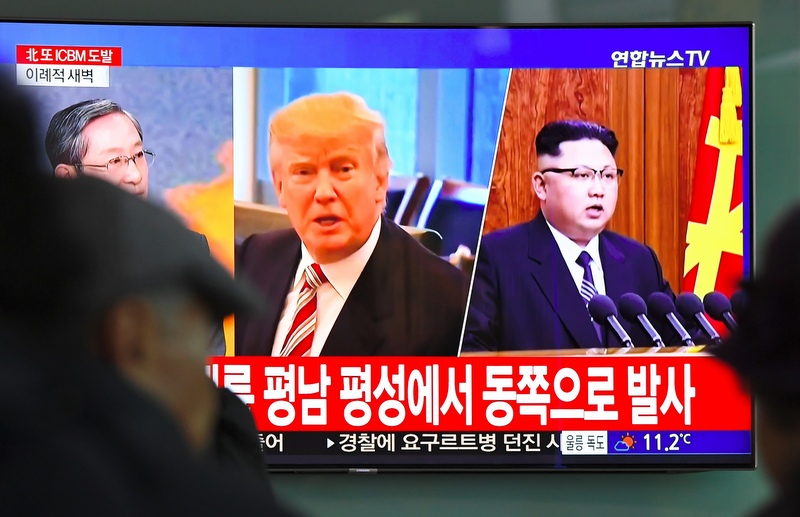
Although Senate Democrats and others are calling for complete dismantlement and removal of nuclear and chemical weapons from North Korea, the North Koreans have entirely different expectations. Political leaders in the United States should clarify what progress looks like, rather than attempting to negotiate a perfect deal.
Senate Democratic leaders on Monday tried to set unrealistically high expectations for a nuclear agreement to be negotiated by President Trump and North Korean leader Kim Jong Un. It is easy to call for “the dismantlement and removal of all nuclear, chemical, and biological weapons from North Korea,” and withholding “sanctions relief for anything other than this,” as the seven senators did. But posing perfect outcomes will impede efforts to persuade North Korean leaders that the Congress will provide the cooperation necessary to fulfill the terms of an agreement that actually can be negotiated in the real world.
Of course, the North Koreans have their own unacceptable winning model of a deal: one like President George W. Bush gave India in 2005. This deal accepted that India would retain nuclear weapons with no restrictions, and offered sanctions relief in exchange for India’s splitting its civilian nuclear program from its weapon program, and adhering to nonproliferation rules. Negotiations will lead nowhere except back to crisis unless and until all parties involved accept that winner-take-all is not an option.
I first became aware of North Korea’s attachment to the India model at a conference with two of their officials after the country’s first nuclear weapon test in 2006. I had asserted that the United States would never accept North Korea’s possession of nuclear weapons. During a break, the two men approached and reminded me that this was the United States position on India’s nuclear program over decades. Eventually, the United States defined success down, bent nonproliferation rules it shaped despite vociferous international opposition, and welcomed India in from the cold. I tried to explain the significant differences between the two cases, not least that India never made a legally binding commitment to not develop a nuclear weapons program and North Korea did. One of the diplomats interrupted me politely and said: “You miss the point. The United States made the nonproliferation rules. When you decided you wanted to change them for India, you did. If you want to change relations with our country, you will change your rules.”
Since 2006, North Koreans have hewed to a strategy to achieve a similar deal. They would press on to acquire a nuclear arsenal robust enough to make the U.S. and others accept its reality and recognize that the only near-term option before them is to limit the scope of the program, not eliminate it. Everything the DPRK has done since then has followed this strategy.
Yet, North Korea will soon discover this strategy’s limits, too. While it would be “catastrophic” for the United States to forcibly disarm the DPRK, as Defense Secretary James Mattis has acknowledged, no one – not the United States or China or South Korea – thinks North Korea deserves an India deal. If war is to be avoided, therefore, victory must be defined more realistically for all parties.
The essence of a workable deal in the near and medium term will require a comprehensive, verifiable cap on all of the key activities and capabilities that North Korea would need in order to export nuclear weapons or use them effectively to commit an aggression. A cap would encompass nuclear warheads, fissile material production, missile and rocket testing and production, restrictions on locations of capabilities and military exercises, with corresponding transparency and monitoring provisions. The probability of detecting at least one violation of these limits is high. This would violate the whole agreement.
In return for the tight, comprehensive and verifiable cap on its nuclear arsenal, the DPRK would for now get to keep the weapons it has already tested to leverage the United States and others to fulfill commitments they would make to normalize political relations, remove sanctions, and facilitate economic development. The ultimate goal, to be encoded in an agreement, would be to phase in the reciprocal conditions necessary for the complete verifiable elimination of North Korea’s nuclear capabilities and a durable modus vivendi between the DPRK, its neighbors, and the United States.
The very idea of such a settlement with the DPRK is extremely difficult to abide. Immediate disarmament – a lopsided win -- is vastly preferable. But, if that cannot be achieved at a price that South Koreans, Chinese, and the American public can accept, then something like a comprehensive, verifiable cap on North Korea’s most dangerous activities and capabilities would make everyone more secure than the alternatives of war or resumed expansion of North Korea’s arsenal.
It behooves political leaders and opinion shapers in the United States and around the world to clarify now that something less than the perfect deal would nonetheless be recognized as a major win for everyone. Whatever people feel about Trump and Kim, the stakes on the Korean Peninsula are so enormous that all should be ready to herald the achievement of even imperfect progress in reducing the risks of further nuclear proliferation and war there.

Japan Chair for a World Without Nuclear Weapons, Senior Fellow
George Perkovich is the Japan Chair for a World Without Nuclear Weapons and a senior fellow in the Carnegie Endowment for International Peace’s Nuclear Policy Program. He works primarily on nuclear deterrence, nonproliferation, and disarmament issues.
Recent Work
George Perkovich
George Perkovich
Carnegie does not take institutional positions on public policy issues; the views represented herein are those of the author(s) and do not necessarily reflect the views of Carnegie, its staff, or its trustees.

While the EU and European governments are embracing the much-lauded middle-power moment, this entails three difficult conundrums.

Richard Youngs

Europe is facing rising populism internally as well as external pressures from Russia, China, Turkey, and the United States.

Dimitar Bechev

The acknowledgment has sparked fears of a new arms race with China and Russia.

Chris O’Meara

Smaller powers cannot go it alone, but Canadian history shows that integration with the United States will not always be benign.
Paul Samson
The summit may be remembered as a fatal blunder, when Washington, Beijing, and the AI industry collectively chose ceremony over action.

Jeffrey Prescott