

Q&A
- +1
Amr Hamzawy, Andrew Leber, Eric Lob, …
{
  "authors": [
    "Marwan Muasher"
  ],
  "type": "commentary",
  "blog": "Emissary",
  "centerAffiliationAll": "dc",
  "centers": [
    "Carnegie Endowment for International Peace"
  ],
  "englishNewsletterAll": "menaTransitions",
  "nonEnglishNewsletterAll": "",
  "primaryCenter": "Carnegie Endowment for International Peace",
  "programAffiliation": "MEP",
  "programs": [
    "Middle East"
  ],
  "projects": [],
  "regions": [
    "Israel",
    "Palestine"
  ],
  "topics": [
    "Foreign Policy",
    "Democracy"
  ]
}
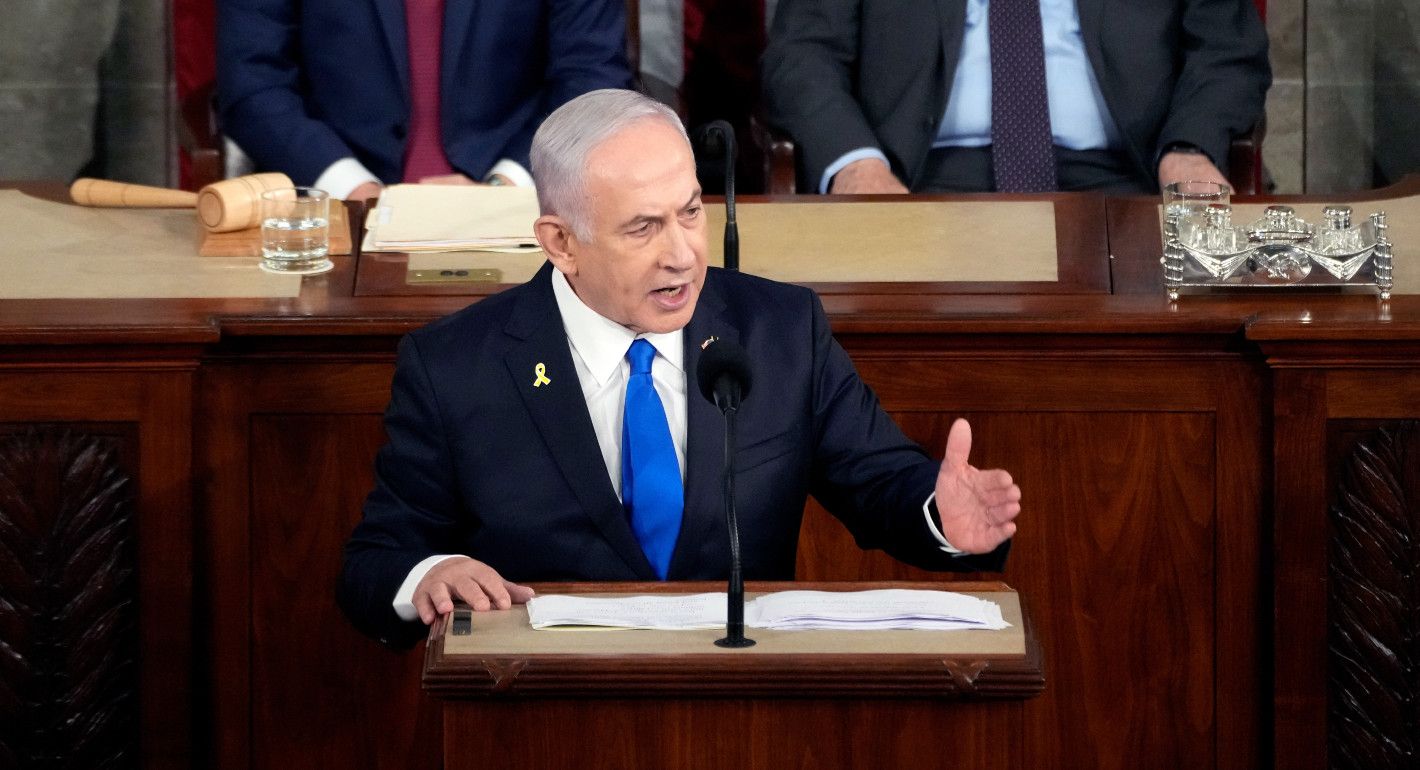
Netanyahu addresses Congress in Washington on July 24. (Photo by Kent Nishimura/Getty Images)
Foreign leaders typically use their addresses to lay out visions for the future or offer hope for peace. The Israeli leader did neither.
On Wednesday, Israeli Prime Minister Benjamin Netanyahu addressed the U.S. Congress in a speech that was divisive both inside and outside the Capitol even before he began. In an unprecedented move, about half the Democratic members of both houses did not attend. Anticipated Democratic presidential nominee Kamala Harris, who would typically preside over the session as vice president, also did not attend, citing a scheduling conflict.
Perhaps the best summary of Netanyahu’s speech came from Haaretz commentator Noa Landau: “Netanyahu didn’t go to Washington to end the Gaza War. He went to get the means to prolong it.” In his speech, the Israeli leader intended to rally Congress behind expediting arms shipments to “finish the job faster,” referring to delayed arms shipments by the United States to Israel for fear they might be used against Palestinian civilians. He argued that Israel’s war against Hamas is really America’s war, as well as a bigger war against Iran, further implying that he was waging it on behalf of the United States.
Though speaking to U.S. lawmakers, Netanyahu was also targeting his domestic audience, hoping that a show of strength before Congress might convince the Israeli public that he should remain prime minister. It is doubtful that he changed a lot of minds in the United States or in Israel, where polls show two-thirds of Israelis think he should leave office. The applause he received from a largely Republican audience did not reflect his standing at home or around the world.
Netanyahu’s speech did not attempt to accept even partial responsibility for his government’s failure to prevent the October 7 attack. Typical of his record, it is always other people’s fault. He blamed not just Hamas and Iran but also the International Criminal Court and the presidents of major U.S. universities. He called protesters “idiots.” He stopped short of criticizing the members of Congress who did not attend his speech, but he also did not allude at all to Israeli intelligence mistakes or to the fact that his government has rejected any offers of hope to the Palestinians. He did not use the word “ceasefire.” If the Israeli public was looking for him to behave like a respectable leader, or present any hope for the return of hostages, they were likely disappointed.
Netanyahu claimed that civilian deaths in Rafah were “practically none”—a statement that is not only a lie but also defies the daily reporting of women and children killed, the destruction of most buildings in Gaza, and the systematic blocking of direly needed aid. He displayed no empathy for the almost 40,000 Palestinians killed in Gaza.
But the most glaring shortfall in his speech was the absence of a political vision—not only for ending the war but also for ending the decades-long conflict. Previous foreign leaders have used their invitations to speak in front of Congress as opportunities to lay out their visions for the future of their countries, to look beyond their current challenges, and to offer hope for peace rather than more war. Not in this case. Netanyahu offered no political horizon for the conflict beyond an imaginary group of Palestinians he approves of to rule Gaza. He hardly mentioned “Palestinians” in the speech at all. Rather than speak about coexistence, a two-state solution, or any hope for ending the conflict, he only discussed a vision that amounted to no more than a security alliance with some Arab countries that ignores the core issues: a fifty-seven-year-long occupation and the Palestinians’ right to self-determination, living side by side with Israel.
The warm reception Netanyahu received from the partisan crowd appears increasingly out of touch with public opinion, both inside and outside the United States, which has become more critical of a never-ending occupation and the constant violation of Palestinian human rights. Without a political horizon, that warmth will be short-lived. Netanyahu will not only go home to a public that wants him out, but he will also go down in history as someone who consciously resisted a political settlement that would have brought peace to his people. Those who cheered him in Congress should consider the consequences of the lack of a political solution—not only for the future of the Arab-Israeli conflict but also for Israel’s dream of a democratic, Jewish state.
Nancy Pelosi, the former House speaker and a longtime supporter of Israel, likely spoke for many when she described Netanyahu’s address as “by far the worst presentation of any foreign dignitary invited and honored with the privilege of addressing the Congress of the United States.” But the stakes are much higher than a lackluster speech. Netanyahu, once again, failed to meet the moment.
Invalid video URL

Vice President for Studies
Marwan Muasher is vice president for studies at Carnegie, where he oversees research in Washington and Beirut on the Middle East. Muasher served as foreign minister (2002–2004) and deputy prime minister (2004–2005) of Jordan, and his career has spanned the areas of diplomacy, development, civil society, and communications.
Recent Work



Amr Hamzawy, Andrew Leber, Eric Lob, …
Marwan Muasher
Carnegie does not take institutional positions on public policy issues; the views represented herein are those of the author(s) and do not necessarily reflect the views of Carnegie, its staff, or its trustees.

Despite public disputes over trade and immigration, the strategic partnership’s foundations remain sturdy.

Sameer Lalwani
Fatima El Mansouri is the country’s first female prime minister. She’s also a privileged insider in a largely ceremonial position.

Sarah Yerkes

The acknowledgment has sparked fears of a new arms race with China and Russia.

Chris O’Meara
The summit may be remembered as a fatal blunder, when Washington, Beijing, and the AI industry collectively chose ceremony over action.

Jeffrey Prescott

The real test may come after the leaders leave the room.



Sheena Chestnut Greitens, Oriana Skylar Mastro, Yukon Huang, …