

Research
- +5
Herbert Crowther, Darcie Draudt-Véjares, Walter James, …
{
  "authors": [
    "Darcie Draudt-Véjares"
  ],
  "type": "commentary",
  "blog": "Emissary",
  "centerAffiliationAll": "dc",
  "centers": [
    "Carnegie Endowment for International Peace"
  ],
  "collections": [
    "Dynamic Governance Risks in Asia",
    "Korea: Emerging Player"
  ],
  "englishNewsletterAll": "asia",
  "nonEnglishNewsletterAll": "",
  "primaryCenter": "Carnegie Endowment for International Peace",
  "programAffiliation": "AP",
  "programs": [
    "Asia"
  ],
  "projects": [],
  "regions": [
    "South Korea"
  ],
  "topics": [
    "Domestic Politics",
    "Democracy",
    "Military"
  ]
}
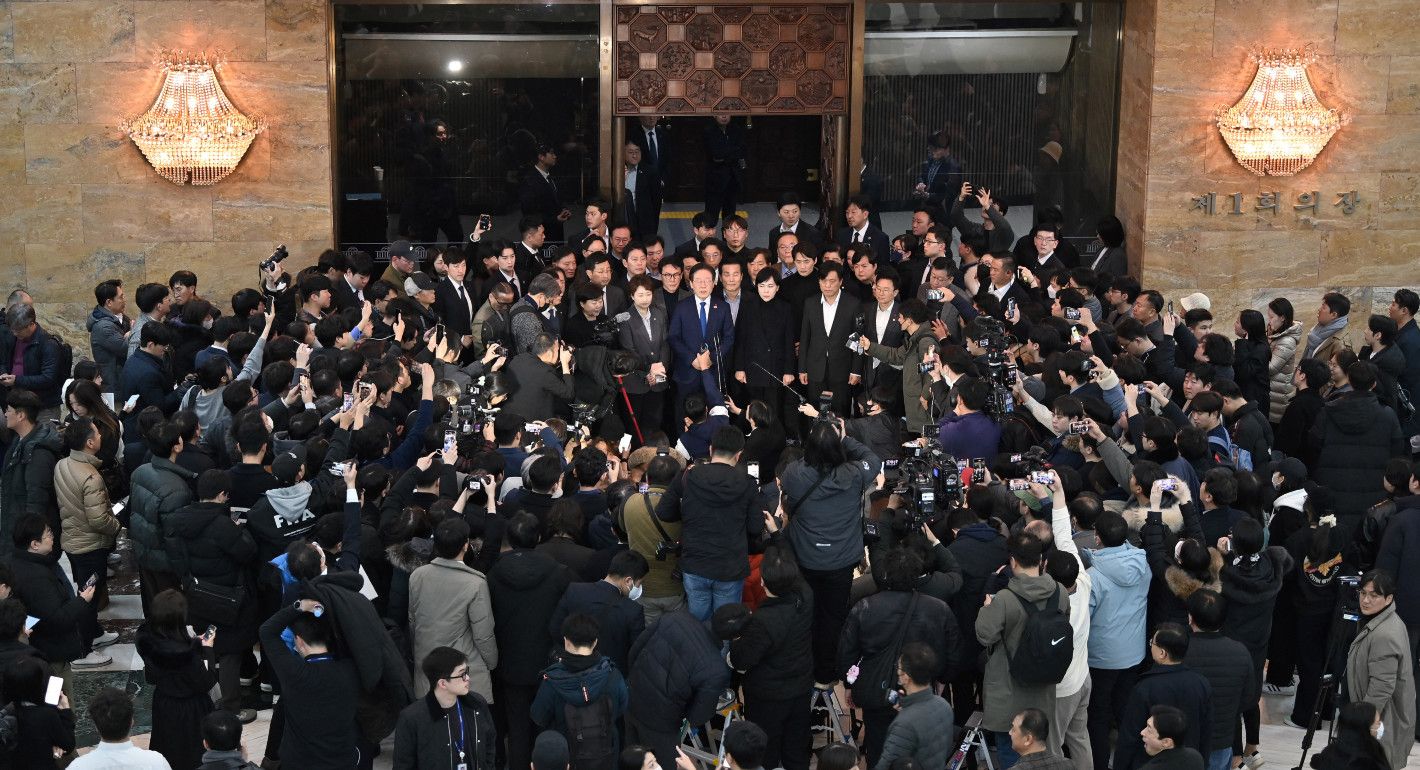
Lee Jae-myung, the main opposition Democratic Party leader, speaks to the media at the National Assembly in Seoul on December 4, after the president declared martial law. (Photo by Jung Yeon-je/AFP via Getty Images)
The president’s martial law declaration was swiftly denounced, but the constitutional crisis isn’t over yet.
The South Korean president’s imposition of martial law and the National Assembly’s rapid vote to demand an end to the decree have left the country with a slew of puzzling questions about the president’s political calculus and the country’s future.
Late Tuesday evening, South Korean President Yoon Suk-yeol stunned his country and the world with an attempt to impose martial law. In his announcement, Yoon cited budget gridlock, the impeachment of government officials, and the “trampling of the constitutional order” as his motivations, and said that the opposition-led “National Assembly has become a den of criminals and is attempting to paralyze the nation’s judicial administration.” Following the decree, Army General Park An-soo assumed command. He issued a proclamation imposing immediate and sweeping restrictions on political parties, public demonstrations, and labor organizing—the very foundations of Korean democratic activism. The decree even placed all media under military control.
Political leaders across the spectrum swiftly denounced the move. In an emergency late-night session, with military surrounding the building and protesters amassing outside, all 190 present members of the 300-seat National Assembly voted to block the decree. The rejection requires the president to end martial law but does not specify a time frame for doing so. National Assembly Chairman Woo Won-sik declared the decree “invalid” and added that “The people should . . . rest easy. The National Assembly will defend democracy with the people.”
Invalid video URL
Yoon’s miscalculation reveals the depth of his administration’s crisis and desperation to deal with political turmoil within his own party. The president, who assumed power in 2022, has approval ratings hovering in the twenties and mounting opposition not only from the Democratic Party, which has a commanding majority in the legislature, but also from rivalries within his own People Power Party, including frictions with chair Han Dong-hoon. His administration has also faced a number of scandals and inquiries, ranging from allegations of bribery to conflicts of interest, into cabinet officials and his wife. This attempt to override democratic institutions suggests either desperate overreach or grievous undemocratic impulses.
The parallels to Korea’s era of military dictatorship—from 1961 to 1987—are striking. The regimes of Park Chung-hee and Chun Doo-hwan maintained power through martial law, suppressing the exact civil liberties Yoon attempted to restrict. The democracy movement’s victory in 1987 came through massive protests and civil resistance, establishing civilian control that’s now deeply embedded in Korean political culture. Yoon’s allegations of North Korea sympathizers within the opposition—another reason he cited for his decree—also resurrects the justification of martial law used by the military dictatorship in the mid-twentieth century: war with the North, and an unsubstantiated fear of spies within the South.
But the past three decades have shown Koreans won’t tolerate democratic backsliding. The 2016-17 candlelight demonstrations that peacefully removed President Park Geun-hye showcased this civic engagement. Korean civil society, from student groups to religious organizations, maintains robust networks that can rapidly mobilize against perceived threats to democracy. As of publication, street protests continue in Seoul, with demonstrators calling for the president’s arrest.
Given the swift response from politicians and civil society, this crisis may ultimately strengthen Korean democracy by reaffirming civilian control and demonstrating institutional resilience. But the coming days could be turbulent, and critical questions remain about how the military leadership and Yoon’s cabinet will respond to the National Assembly’s rejection.
Update: Shortly after publication, Yoon lifted the martial law order.
The latest from Carnegie scholars on the world’s most pressing challenges, delivered to your inbox.
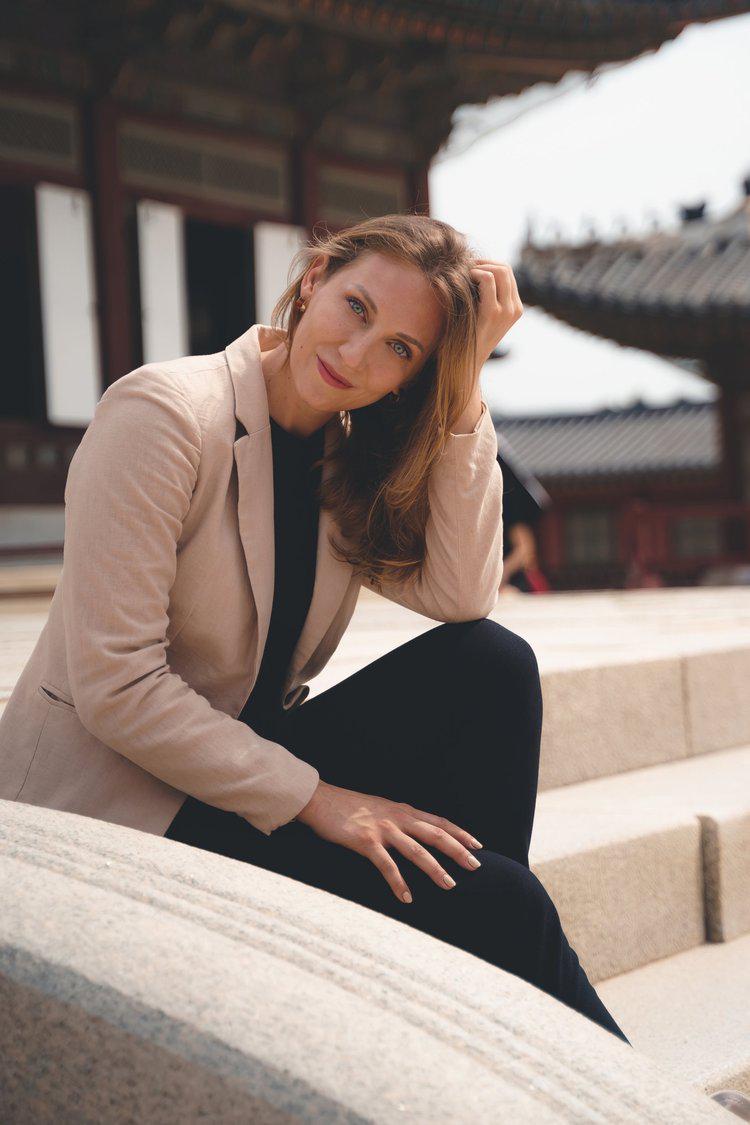
Fellow, Asia Program
Darcie Draudt-Véjares is a fellow for Korea studies in the Asia Program at the Carnegie Endowment for International Peace. Her research focuses on South Korean political economy, governance, and foreign policy, particularly the intersection of economics, technology, and geopolitics.
Recent Work

Herbert Crowther, Darcie Draudt-Véjares, Walter James, …
Darcie Draudt-Véjares
Carnegie does not take institutional positions on public policy issues; the views represented herein are those of the author(s) and do not necessarily reflect the views of Carnegie, its staff, or its trustees.

Despite public disputes over trade and immigration, the strategic partnership’s foundations remain sturdy.

Sameer Lalwani

It signals a new era of tech diffusion and warfare.

Steve Feldstein
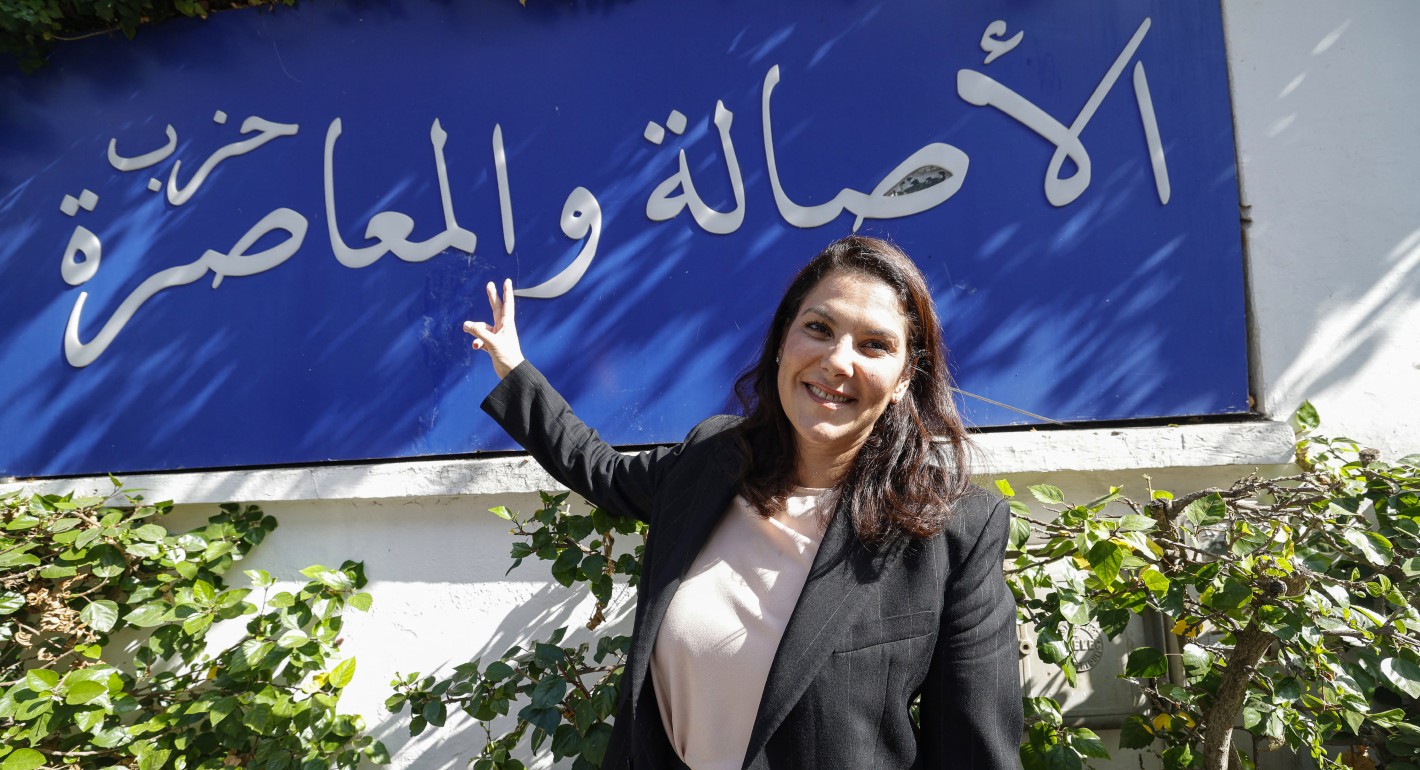
Fatima El Mansouri is the country’s first female prime minister. She’s also a privileged insider in a largely ceremonial position.

Sarah Yerkes

The Horn of Africa countries are among those facing a new security calculus.


Andrew Leber, Lesley Anne Warner
Why governance of rapidly evolving technology will be distributed and complex.


Stewart Patrick, Scott Singer