

Research
Trump 2.0 has unsettled India’s external environment—but has not overturned its foreign policy strategy, which continues to rely on diversification, hedging, and calibrated partnerships across a fractured order.
{
  "authors": [
    "Sameer  Lalwani"
  ],
  "type": "commentary",
  "blog": "Emissary",
  "centerAffiliationAll": "dc",
  "centers": [
    "Carnegie Endowment for International Peace"
  ],
  "englishNewsletterAll": "ctw",
  "nonEnglishNewsletterAll": "",
  "programAffiliation": "SAP",
  "programs": [
    "South Asia"
  ],
  "regions": [
    "South Asia",
    "India",
    "United States",
    "China"
  ],
  "topics": [
    "Technology",
    "Foreign Policy",
    "Domestic Politics",
    "Military",
    "Security",
    "Economy"
  ]
}
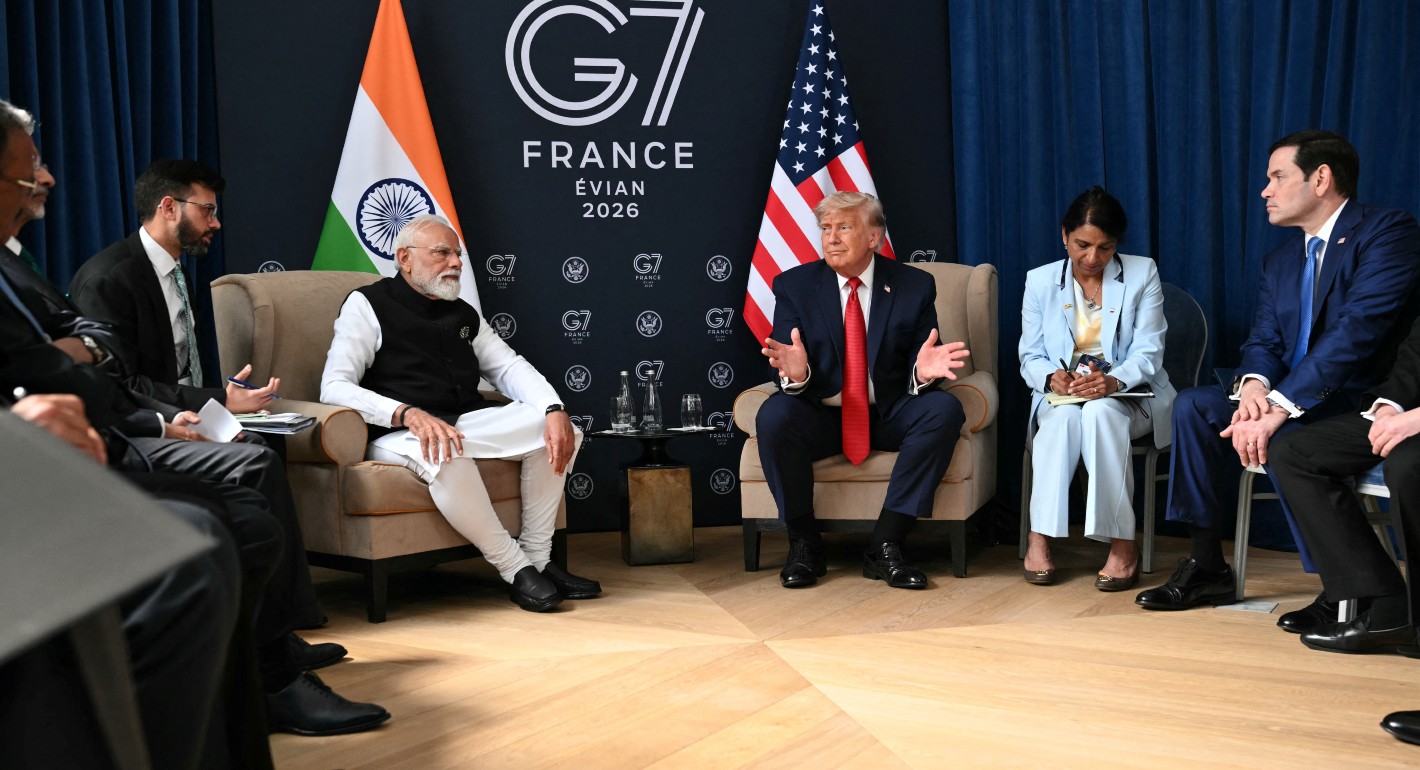
Modi, Trump, and Rubio speak at the G7 summit in Evian, France, on June 17, 2026. (Photo by Mandel Ngan/AFP via Getty Images)
Despite public disputes over trade and immigration, the strategic partnership’s foundations remain sturdy.
As U.S. Secretary of State Marco Rubio heads to India, the U.S.-India relationship appears to many to be facing another cycle of volatility. Trade negotiations have plateaued, disagreements over Russia have intensified, public criticisms have sharpened, and public opinion of the United States has hit a record low in India. Washington’s weaponization of trade and its handling of regional crises have revived doubts about American reliability, while New Delhi’s intransigence on a trade deal, sustained embrace of Russia, and renewed engagement with China have revived India skepticism for some in Washington.
However, beneath the public disputes, the two countries continue to deepen functional cooperation on defense-industrial relations, space, AI infrastructure, and maritime operational security. Despite the downturn, the partnership retains the ability to work together on critically important issues.
This contradiction may have a simple explanation. Failures are public, politically salient, and often immediately apparent, but successes are often hidden from view, highly technical, or take years to materialize. Consequently, perceptions of the political relationship have deteriorated faster than its strategic foundations.
This period of turbulence largely began over trade, and the two governments remain divided over market access, tariffs, and India’s purchases of Russian oil. These economic disputes reflect a deeper geopolitical divergence: Washington (and Brussels) increasingly regard Moscow as an active threat to the European security order, and the latest round of U.S. sanctions legislation has caught New Delhi in the crossfire. In contrast, India views Russia through the lenses of energy security, legacy arms dependence, and strategic flexibility, and it bristles at the West’s censure, which it sees as hypocritical.
Significant shifts in U.S. legal immigration policy have also stressed the relationship. The crackdown by President Donald Trump’s administration on Indian technology firms days before a White House delegation travels to New Delhi to revive technology partnerships—under the TRUST Initiative—raises questions of policy coherence.
The past year of U.S. foreign policy has also strained the relationship. Indian officials have criticized renewed U.S. engagement with Pakistan as lacking empathy for India’s counterterrorism challenges, and the war with Iran has created severe economic pressures on India, forcing New Delhi to revert to higher levels of Russian oil imports. Furthermore, the United States’ courtship of China has revived Indian fears of a so-called G2 bipolar world that could constrain India’s rise.
Such disagreements affect public expectations about how each country might behave in a future crisis. Once confidence begins to decline, every dispute risks becoming evidence of a larger betrayal.
Focusing on politically salient tensions obscures the steady, often overlooked advances that constitute a major strategic upgrade for the two sides.
Despite the sound and fury of new tariffs, U.S.-India trade grew by almost 12 percent in 2025 to a new peak of nearly $240 billion, with the United States remaining India’s top export destination.
Technology cooperation has also been quietly growing. Take the NISAR satellite, which collects data on changes in Earth’s land, ice, water, and vegetation. Its launch in 2025 was the culmination of a decade of collaboration between two complex bureaucracies—NASA and the ISRO—that successfully overcame regulatory hurdles and political transitions to deploy cutting-edge radars to space.
Another example is AI. Major U.S. technology companies pledged nearly $68 billion in AI infrastructure investments in India last year. The opening of semiconductor corporation Micron’s first assembly and test facility in India on February 28 served as a landmark fulfillment of a 2023 commitment, but it was drowned out by the launch of U.S. Operation Epic Fury against Iran. A few weeks ago, Applied Materials and Lam Research announced their own investments in India’s semiconductor ecosystem.
The defense relationship has proved especially durable. This year, the United States and India are on pace for a record number of joint exercises, including one that involved multiple days of combined air assault operations and Indian and U.S. troops working together at a uniquely granular level just 30 miles from the India-China border. The new ten-year framework for the U.S.-India Major Defense Partnership calls for closer coordination across advanced domains, expanded information-sharing, more complex exercises, and deeper defense-industrial ties.
The maritime dimension is particularly consequential. For all the hand-wringing in Washington about the Indian Army’s dependence on Russian arms, the Indian Navy has acquired an array of interoperable U.S. platforms for maritime reconnaissance: P-8 maritime patrol aircraft, MH-60R anti-submarine warfare helicopters, and MQ-9B high-altitude, long-endurance surveillance drones. All are designed to enhance India’s burden-sharing in the Indian Ocean while complementing U.S. naval strategy in the broader Indo-Pacific—including a new Quad initiative for Indo-Pacific Maritime Surveillance Collaboration. Behind closed doors, Indian officials routinely talk about joint tracking of Chinese submarines. There is also far too little appreciation of India’s growing role in the U.S.-led Combined Maritime Forces—the first time India has joined a military coalitional effort outside the UN framework.
Some of the most consequential achievements—especially in India’s advanced undersea and space domains—remain invisible amid the din of political disputes. For instance, American capital, technology, labs, and accelerators have supported India’s space, semiconductor, and digital ecosystems. However, these connections remain confined to private relationships between firms and, even when publicized, are rarely presented as broader evidence of strategic interdependence.
In other instances, cooperation is deliberately concealed. During India’s 2020 border crisis with China, Washington played a significant role in expediting equipment, gear for extreme cold weather, and intelligence support, but India requested that this all be kept quiet. Beyond indirect assistance, when India leased contractor-owned, contractor-operated MQ-9B Predator drones to surveil its maritime approaches and border with China, it likely relied on former U.S. military pilots to operate those drones on behalf of the Indian Navy from an Indian military base. A couple of years later, U.S. intelligence support likely helped the Indian Army interdict a Chinese army gray-zone probe, but this was never acknowledged.
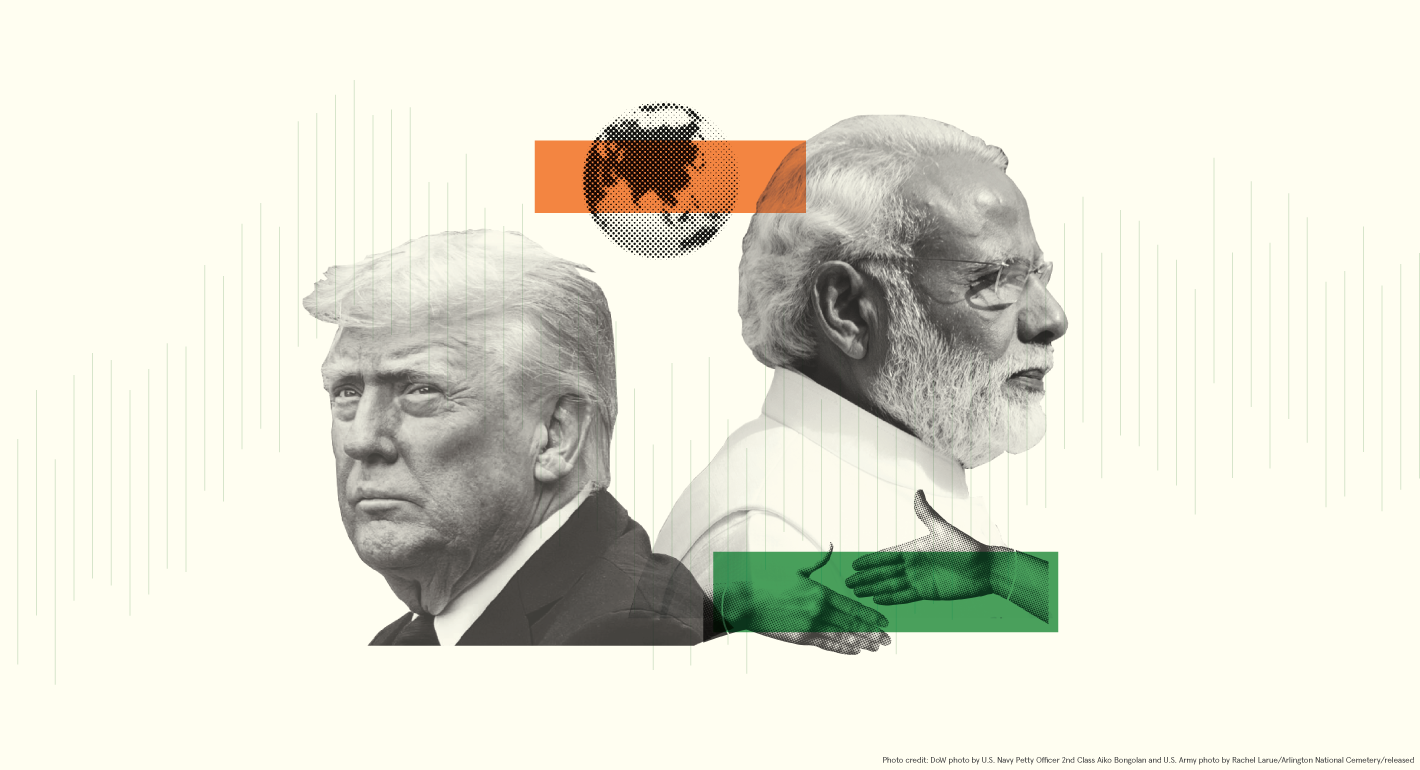
Trump 2.0 has unsettled India’s external environment—but has not overturned its foreign policy strategy, which continues to rely on diversification, hedging, and calibrated partnerships across a fractured order.
These episodes suggest Washington can be reliable in a serious security crisis, but that information has gone largely unobserved by the Indian public and many within the Indian government. Indian leadership has concealed these facts to manage escalation, and Washington has respected New Delhi’s preference for discretion, even though the secrecy meant a missed opportunity to deepen trust.
The United States is also guilty of passing up opportunities to spotlight strategic breakthroughs. For example, the full details of the 2025 U.S.-India Major Defense Partnership framework have yet to be made public. This secrecy has consequences: Investors hold back on big bets, export controllers act with excess caution, and lawmakers discount the trade-offs when they choose to enact sanctions, solidifying a strategic ceiling for the relationship.
Long delays between commitments and delivery compound the visibility problem. Political leaders seek clear results on marquee defense or technology projects within an electoral term, while bureaucracies may take years to turn announcements into contracts and capabilities.
Some of this is the normal lag that occurs when two governments reconcile different acquisition systems, export controls, and technology expectations. India took four years to implement the Indo-Pacific Partnership for Maritime Domain Awareness after its announcement in 2022. Some of the MQ-9B Predator drones cleared for sale in 2017 during Trump’s first administration were not contracted until the end of former president Joe Biden’s administration and will be delivered to India around the time the next U.S. administration takes office in 2029. Such lags are hardly unique to the U.S.-India relationship: India’s BrahMos missile joint venture with Russia took more than ten years from initial agreement to induction of the missile, and nearly thirty years later, India has still not fully indigenized the missile.
These delays are also partially the fault of the rigid Indian defense acquisition process. The recently announced Javelin anti-tank guided missile purchase and co-production memorandum of understanding come after more than a decade of on-again, off-again discussions constrained by export controls. The landmark 2023 American offer to co-produce General Electric jet engines for Indian fighter aircraft on Indian soil faces yearslong delays due to issues with Indian state-owned enterprises. Slow implementation should not be mistaken for the absence of progress, but it can no longer be excused in light of the pace of the adversarial China challenge.
The current downturn in bilateral ties is also shaped by selective institutional memory. American policymakers criticize India’s dependence on Russian weapons such as the S-400 air defense system while overlooking how earlier U.S. restrictions on the purchase of Israeli air defense systems helped push New Delhi in Moscow’s direction. Furthermore, the United States neglects to mention its part in encouraging India to buy Russian oil to stabilize the market in 2022 (and potentially in 2026).
India has its own blind spots. Many in the Indian defense community forget how U.S. research and development infrastructure has supported Indian indigenous technology development for decades. Beyond the U.S. jet engines, India’s first indigenous fighter aircraft (and its digital fly-by-wire system) relied on a U.S. F-16 testbed in the 1990s, and its development of a fifth-generation fighter relies on U.S. wind tunnels. This history does not erase today’s disagreements, but durable partnerships require an honest accounting of how past decisions shape contemporary relationships. Since civil-nuclear deal legislation ushered in the strategic realignment in the relationship twenty years ago, India has neglected the role of the U.S. Congress as an institutional partner.
The U.S.-India relationship cycles between bouts of optimism and disappointment. Despite the political disputes that attract headlines, this relationship still trends upward, so each upswing reaches a greater level of cooperation than the last.
Today, in addition to interpersonal ties, commercial interests, and geopolitical imperatives, the two countries possess a dense network of defense-industrial partnerships, technology co-investments, routine military exercises and intelligence exchanges, and multiagency dialogues. These networks ensure some resilience and enable the tending of the diplomatic “garden” that is necessary to renew trust and sustain the pipeline of joint efforts, even if it is difficult to launch new collaborative initiatives.
To build broader support for the relationship among key constituencies, both governments should disclose more about the mutual benefits of cooperation without betraying critical secrets. Speeches, fact sheets, legislative testimony, and even social media feeds can render the partnership more legible to the average citizen, market players, and bureaucratic enablers. Indian policymakers should reengage with the U.S. Congress to embed bilateral initiatives in legislation that would institutionalize defense-industrial cooperation through durable legal authorities and fiscal appropriations. Finally, political leaders can highlight private-sector deals as wins for the broader bilateral relationship and frame investments in semiconductors, cloud infrastructure, commercial space, and defense supply chains as shared strategic efforts.
The current downturn in U.S.-India relations is serious, but it is occurring within a partnership that has become broader, more operational, and more materially and strategically valuable to both sides. Restoring confidence does not require overhauling the relationship. It requires revealing, institutionalizing, and accelerating the one that already exists.
Understand the world with the latest from our scholars around the world.

Senior Fellow, South Asia Program
Sameer Lalwani is a senior fellow in the South Asia Program at the Carnegie Endowment for International Peace. He is also a research affiliate with the MIT Security Studies Program and a contributing editor to War on the Rocks.
Carnegie does not take institutional positions on public policy issues; the views represented herein are those of the author(s) and do not necessarily reflect the views of Carnegie, its staff, or its trustees.

Xi, Putin, and other regional leaders are back-slapping in Bishkek, but the SCO has yet to answer the most serious questions about continental Asia's economic future.

Evan A. Feigenbaum

As “unprecedented” temperatures become routine, the country is failing its energy transition stress test.

Kayly Ober
New data from the 2026 Indian American Attitudes Survey show that Democratic support has not fully rebounded from 2020.



Sumitra Badrinathan, Devesh Kapur, Andy Robaina, …
Washington and New Delhi should be proud of their putative deal. But international politics isn’t the domain of unicorns and leprechauns, and collateral damage can’t simply be wished away.
Evan A. Feigenbaum

This year’s selections span biography, history, and political economy—but they share a common thread.

Milan Vaishnav