

Commentary
It should address the shortcomings of previous crisis communication efforts and adapt to the demands of frontier AI.
Lucy Luo
{
  "authors": [
    "Gustavo Romero",
    "Stewart Patrick"
  ],
  "type": "commentary",
  "blog": "Emissary",
  "centerAffiliationAll": "dc",
  "centers": [
    "Carnegie Endowment for International Peace"
  ],
  "collections": [
    "The Post-American World"
  ],
  "englishNewsletterAll": "ctw",
  "nonEnglishNewsletterAll": "",
  "primaryCenter": "Carnegie Endowment for International Peace",
  "programAffiliation": "GOI",
  "programs": [
    "Global Order and Institutions"
  ],
  "projects": [],
  "regions": [
    "United States"
  ],
  "topics": [
    "Foreign Policy",
    "Global Governance",
    "Domestic Politics"
  ]
}
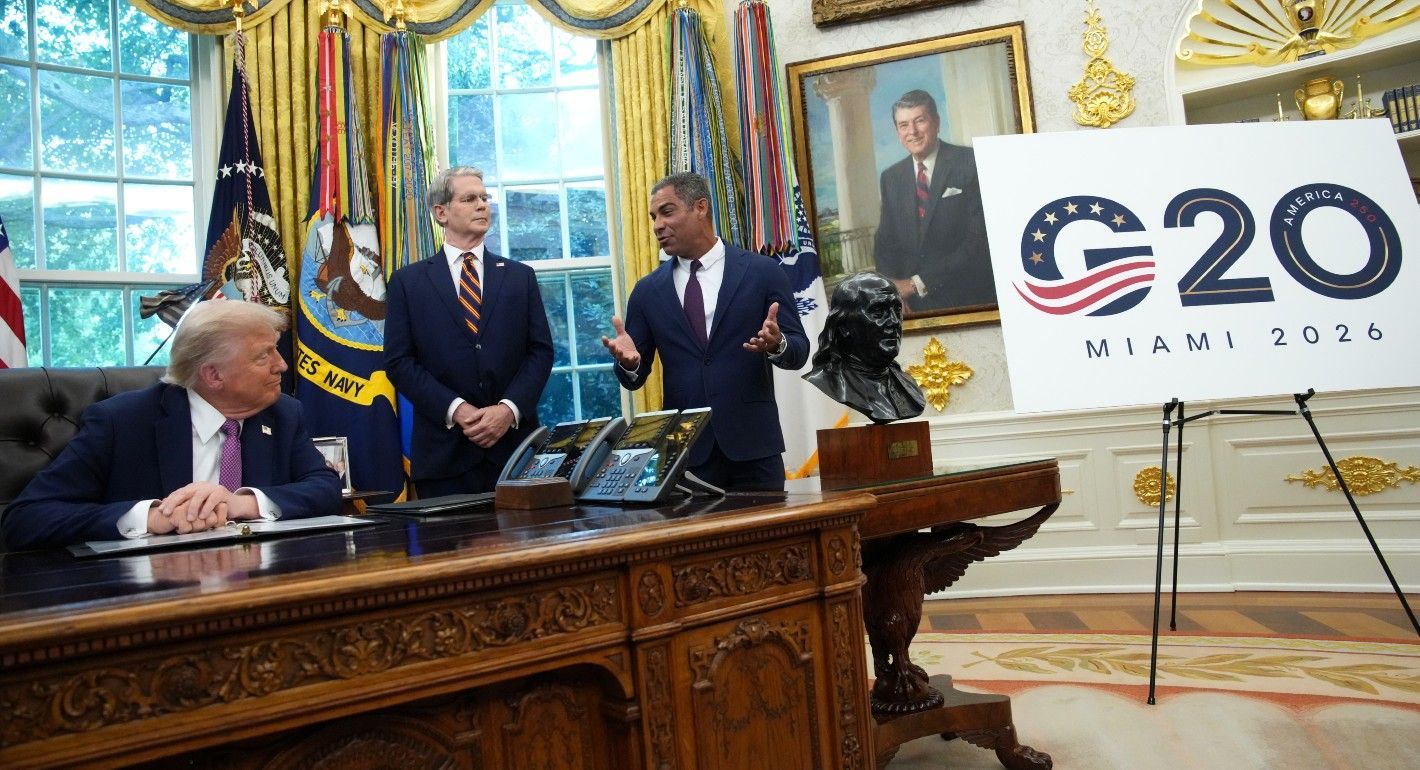
Trump announcing plans to host the 2026 G20 summit in Miami. (Photo by Kevin Dietsch/Getty Images)
For four years, the G20’s emerging economies used the rotating presidency to set an unprecedented agenda. With the United States now at the helm, that’s about to dramatically change.
On December 1, the United States assumed the rotating presidency of the Group of 20 (G20). This transition follows an unprecedented sequence of four consecutive Global South–led chairs (Indonesia, India, Brazil, and South Africa), during which the forum’s agenda, as well as membership, evolved and expanded. It also completed the forum’s first full hosting cycle: Since the G20 was elevated from a modest yearly gathering of finance ministers to leader-level summits in response to the global financial crisis in 2007–2008, every member has chaired it at least once. Now, for the first time since 2009, the G20 presidency returns to the United States.
This transition will not be merely procedural. It represents a substantive and normative shift from a more expansive, inclusive, development-centered G20 toward a narrower, more nationalized vision. President Donald Trump’s administration has already signaled its desire to pursue a back-to-basics agenda, which will sharply curtail much of what has been accomplished over the past four years. Such a shift raises fundamental questions about the G20’s purpose, legitimacy, and effectiveness at a moment when multilateralism itself is increasingly under strain.
This transition is an apt moment to take stock of the G20’s trajectory and its significance for global economic governance. Like Ebenezer Scrooge in Charles Dickens’s A Christmas Carol, the forum will have to confront the ghosts of its legacy and past ambitions, the realities of its current limitations amid geopolitical contestation, and the uncertain contours of its future role. Whether it emerges leaner but intact or diminished by fragmentation and distrust will be a telling reflection of what kind of multilateral cooperation still has purchase in a more divided world.
The past four years of Global South leadership constituted a distinct phase in the G20’s evolution. Never before had more than two emerging economies chaired the forum in uninterrupted succession, and that continuation mattered. Concerns long sidelined—particularly those of emerging markets and developing economies—were elevated and normalized within the G20. In addition, these presidencies were remarkably congruous with one another, providing a degree of continuity to the G20’s work. The summits in Bali, New Delhi, Rio de Janeiro, and Johannesburg shared several themes.
First was a sustained push for greater inclusion and representation. India’s 2023 presidency marked a watershed by securing permanent G20 membership for the African Union, significantly broadening the forum’s representation and increasing its coverage of the world’s population from 65 percent to 80 percent. The G20’s thematic areas of focus and external stakeholder engagement have likewise grown. By South Africa’s 2025 presidency, the organization had twenty-two working groups, three task forces, and thirteen engagement groups on topics such as labor and science.
Second, debt distress and reform of the international financial architecture moved to the center of the G20 agenda. Across the Global South, debt servicing costs have soared, capital remains expensive, and fiscal space has narrowed sharply. During their G20 presidencies, Indonesia and India emphasized strengthening multilateral development banks and accelerating progress toward the Sustainable Development Goals, while Brazil prioritized reforming the international financial institutions. South Africa elevated sovereign debt restructuring and development finance, underscoring the inadequacy of existing mechanisms and the destabilizing effects of drawn-out, opaque debt workouts.
Third, the four Global South hosts all highlighted climate change, framing it as a development challenge rather than a siloed environmental concern. They often emphasized adaptation, energy access, and climate finance, arguing that transitions must be equitable if they are to be politically and economically viable. This framing differed markedly from earlier G20 approaches that treated climate more as a regulatory or emissions-management issue.
Finally, these chairs brought inequality, social protection, and hunger into the G20’s core deliberations. Brazil’s 2024 presidency launched the Global Alliance Against Hunger and Poverty, while South Africa commissioned a report on the global emergency of economic inequality and anchored its agenda around the theme of “Solidarity, Equality, and Sustainability.” Leaders’ declarations acknowledged the role of universal social protection systems and, at least rhetorically, the economic risks posed by widening disparities.
At the same time, the G20’s functioning was increasingly complicated by geopolitical gridlock, which made it harder for members to reach consensus on key issues, much less agree to concrete and measurable commitments to major policy changes. Russia’s full-scale invasion of Ukraine in 2022 and the intensifying U.S.-China rivalry turned the forum into what observers have described as a microcosm of growing global rifts.
These divisions were on full display during Indonesia’s 2022 presidency, when G7 member states pressured then president Joko Widodo to exclude Russia from the summit. Widodo successfully resisted these efforts and, through intense diplomatic maneuvering, ultimately secured a consensus leaders’ declaration—a result that surprised and impressed many. The Bali declaration, however, did little to conceal fundamental differences over Russian aggression. Although it noted that “most members strongly condemned the war,” it included the caveat that “other views and different assessments” also existed.
As a result, critiques of the G20 as a mere “talk shop” are not totally unfounded. But they also misconstrue the forum’s actual purpose: The G20 is not an implementing body. It exists to promote and catalyze consensus among governments of twenty of the world’s largest economies, preparing positions that members then pursue through either national policy adoption or via more formal institutions such as the International Monetary Fund (IMF), World Bank, and United Nations. Its informality—once a source of agility in the days of the global financial crisis—also limits its capacity to deliver binding outcomes absent the right conditions for cooperation.
In this sense, the G20 operates less as an engine of execution than as a bellwether of broader geopolitical trends. Nowhere was that clearer than in Johannesburg last month.
The G20’s first leaders’ summit on African soil was both fragile and revealing. The November 2025 gathering in Johannesburg was defined by the complete absence of the United States, which opted to not send a national delegation at all—the first time any G20 member had taken such a step. Trump loudly boycotted the meeting, citing unsubstantiated and discredited claims of South African government complicity in the persecution of the country’s white Afrikaner minority and rejecting the host’s emphasis on themes that U.S. Secretary of State Marco Rubio labeled as “anti-American” and code for “DEI and climate change.”
In the lead-up to the summit, U.S. officials reportedly sought to undermine consensus in many of the preparatory meetings and working groups by refusing to negotiate and objecting to language referencing the “energy transition,” “equity,” or “universal healthcare.” Behind the scenes, Trump also applied significant pressure on South Africa and other members not to sign off on the adoption of a final summit declaration without the United States. He failed.
In a striking break from diplomatic tradition—and in defiance of U.S. wishes—South African President Cyril Ramaphosa secured the adoption of a 122-point leaders’ declaration at the outset of the summit. Covering issues from debt relief and climate finance to inequality and critical mineral supply chains, the declaration was endorsed by all G20 members except for the United States and Argentina, which attended the summit but in solidarity with Washington did not officially endorse the final declaration.
French President Emmanuel Macron, though regretful of the Americans’ absence, insisted that “it should not block us. Our duty is to be present, engage, and work all together because we have so many challenges.” South African Foreign Minister Ronald Lamola said that “the G20 should send a clear message that the world can move on with or without the U.S.”
Johannesburg revealed a forum under strain but not yet broken. Many members remain invested in multilateral cooperation, even amid U.S. retrenchment. And the G20 continues to matter because there is no alternative forum that annually convenes systemically important advanced and emerging economies at the leaders’ level. The body is also far more representative than either the G7 or the UN Security Council. Still, dismissing the absence of the world’s largest economy from the November summit—and what this may imply for the G20’s resilience, reach, and role in years ahead—would be foolish.
In its early years, the G20 acted as an extraordinarily effective crisis committee. During the global financial crisis, it moved quickly to stabilize markets, injecting unprecedented liquidity worth over $4 trillion, rejecting trade barriers, implementing financial regulation, establishing the Financial Stability Board, and empowering the IMF and other international financial institutions to help rescue a global financial system in free fall.
Since then, the G20 has struggled to function as a steering committee of the global economy. Its size and heterogeneity make decisive action difficult in periods of geopolitical discord, and these dysfunctions have become all the more common in recent years. As Macron observed in Johannesburg, the G20 may indeed be “coming to the end of a cycle.”
The Trump administration has already signaled that its presidency will pursue a markedly leaner agenda framed around economic growth, deregulation, energy security, and technology, and which will surely curtail the G20’s work in areas including climate, inequality, and development. In practice, this is likely to mean fewer working groups, fewer ministerial meetings, and sharply reduced interaction with civil society and most engagement groups.
Some cutbacks in the G20’s expansive agenda are not inherently misguided. The G20 was created as a lean forum, and if its recent results (or lack thereof) serve as evidence, expansion has strained the body’s coherence. But the degree and manner of contraction matter.
Trump’s first term brought testing times for the G20, which was often forced to operate effectively as the G19+1 on some issues—particularly climate change, after the United States announced its withdrawal from the Paris Agreement in 2017. A reprise of that era—with an America skeptical of multilateralism but still broadly participating in it, and observant of at least certain elements of traditional American internationalism—would be the best-case scenario for the 2026 G20.
That seems implausible, however, as the United States will actually host the process this time. Rather than working around other governments’ preferences, the administration will have freedom to exert its own and set the tone. The most likely outcome is that 2026 will be a disruptive year for the G20—one characterized by transactional diplomacy, recurrent threats of tariffs, and disregard for institutional continuity or diplomatic convention.
There is also a risk of excessive nationalization of the agenda. Although all G20 chairs imprint their own priorities, a leaner agenda—one that is focused and purposeful—is different than a thinner one that simply abandons shared commitments and leaves multilateral cooperation thematically and substantively shallow. A U.S.-centric G20 that completely discards institutional memory and ideational momentum risks losing the G20’s sense of common enterprise. Entire issue areas—from the climate crisis and presently unfolding energy transition to international finance and corporate taxation—may simply vanish from formal discussions.
In this regard, the new U.S. G20 presidency has gotten off to an inauspicious start. On the very day that the United States obtained G20.org from South Africa, the Trump administration wiped the website clean of all previous documents, replaced by a single page with the G20 Miami 2026 logo, a photo of Trump wearing a USA baseball cap, and the words “THE BEST IS YET TO COME.” Separately, Trump announced that South Africa would be barred from next year’s G20 summit and would be replaced by Poland.
Despite this symbolism of a definitive break, the coming year may still witness some continuity and convergence with the forum’s recent past, particularly where interests quietly align beneath all the rhetoric.
Sovereign debt restructuring remains a shared concern of both Washington and the recent Global South hosts. U.S. Treasury Secretary Scott Bessent has repeatedly called for debt relief processes that are faster, clearer, and more effective.
Critical minerals are a possible area for a loose alignment of interests. South Africa spotlighted the issue through a development and industrial policy lens, emphasizing that resource-rich countries should be supported in expanding domestic refining, processing, and manufacturing so that more value is retained locally rather than exported as raw ore. The Trump administration, by contrast, has approached critical minerals primarily through the prism of supply chain security and strategic competition with China, favoring diversification away from Beijing-controlled chokepoints. Although the two parties’ rhetoric and intermediate policy goals differ, the ultimate destination—a diversified and developed global critical minerals ecosystem—might serve as common ground for creative solutions. That said, Washington may simply opt to pursue these objectives through bilateral deals rather than through the G20, particularly given China’s membership in the forum.
Other initiatives will likely also migrate outside the G20 altogether. Issue-based coalitions and minilateral efforts may fill gaps where consensus proves impossible. Following the unveiling of a G20-commissioned report on global economic inequality at the Johannesburg summit, the leaders of South Africa, Brazil, and Spain pushed for a new international panel, modeled after the UN Intergovernmental Panel on Climate Change, to provide data and policy analysis for governments on what they describe as an “inequality emergency.” Similarly, on the sidelines of the G20 summit, the leaders of India, Brazil, and South Africa met to reinvigorate the IBSA Dialogue Forum, a trilateral partnership created in 2003 to foster South-South cooperation and drive social and economic progress.
Most concerning for the immediate integrity of the G20 is the Trump administration’s effort to sideline South Africa from G20 processes, such as excluding it from the summit in Miami. Such actions risk creating a dangerous precedent, upending established conventions and permitting punitive discretion by the host government. If exclusion becomes normalized, trust will evaporate—and retaliation would be inevitable as the presidency rotates. For now, Pretoria has declined to escalate and has indicated it will likely lay low and wait for the next rotation of the G20 into British hands in 2027. Whether that restraint holds—and how other G20 members might react to this twist—remains an open question.
Ultimately, the America First G20 will test whether the forum can survive not just ideological disagreement but also an open challenge to long-standing norms of continuity, inclusion, and collective purpose. Even a leaner, more transactional G20 could still deliver results where interests align—but only if contraction does not give way to fragmentation, and back-to-basics reform does not become a pretext for abandonment.
The latest from Carnegie scholars on the world’s most pressing challenges, delivered to your inbox.
Gustavo Romero
Former James C. Gaither Junior Fellow, Global Order and Institutions Program
Gustavo Romero was a James C. Gaither Junior Fellow in the Carnegie Global Order and Institutions Program.

Senior Fellow and Director, Global Order and Institutions Program
Stewart Patrick is a senior fellow and director of the Global Order and Institutions Program at the Carnegie Endowment for International Peace. His primary areas of research focus are the shifting foundations of world order, the future of American internationalism, and the requirements for effective multilateral cooperation on transnational challenges.
Carnegie does not take institutional positions on public policy issues; the views represented herein are those of the author(s) and do not necessarily reflect the views of Carnegie, its staff, or its trustees.
It should address the shortcomings of previous crisis communication efforts and adapt to the demands of frontier AI.

Lucy Luo
Washington’s decision to support some UN functions while letting others wither is pulling the organization apart at the seams.
Stewart Patrick, Theodore Zaritsky
AI capabilities are moving fast. Most institutions—including governments—can’t keep up.


Anton Leicht, Scott Singer

The books, podcasts, and films that explain the world it made.

Andrew Leber
U.S. trading partners in Asia are closely watching the dispute for signs of how it may affect their own interests.
Barbara Weisel