

Commentary
Evan A. Feigenbaum
{
  "authors": [
    "Evan A. Feigenbaum"
  ],
  "type": "commentary",
  "blog": "Emissary",
  "centerAffiliationAll": "dc",
  "centers": [
    "Carnegie Endowment for International Peace"
  ],
  "englishNewsletterAll": "ctw",
  "nonEnglishNewsletterAll": "",
  "programAffiliation": "SAP",
  "programs": [
    "South Asia"
  ],
  "regions": [
    "United States",
    "India"
  ],
  "topics": [
    "Economy",
    "Trade",
    "Foreign Policy",
    "Domestic Politics"
  ]
}
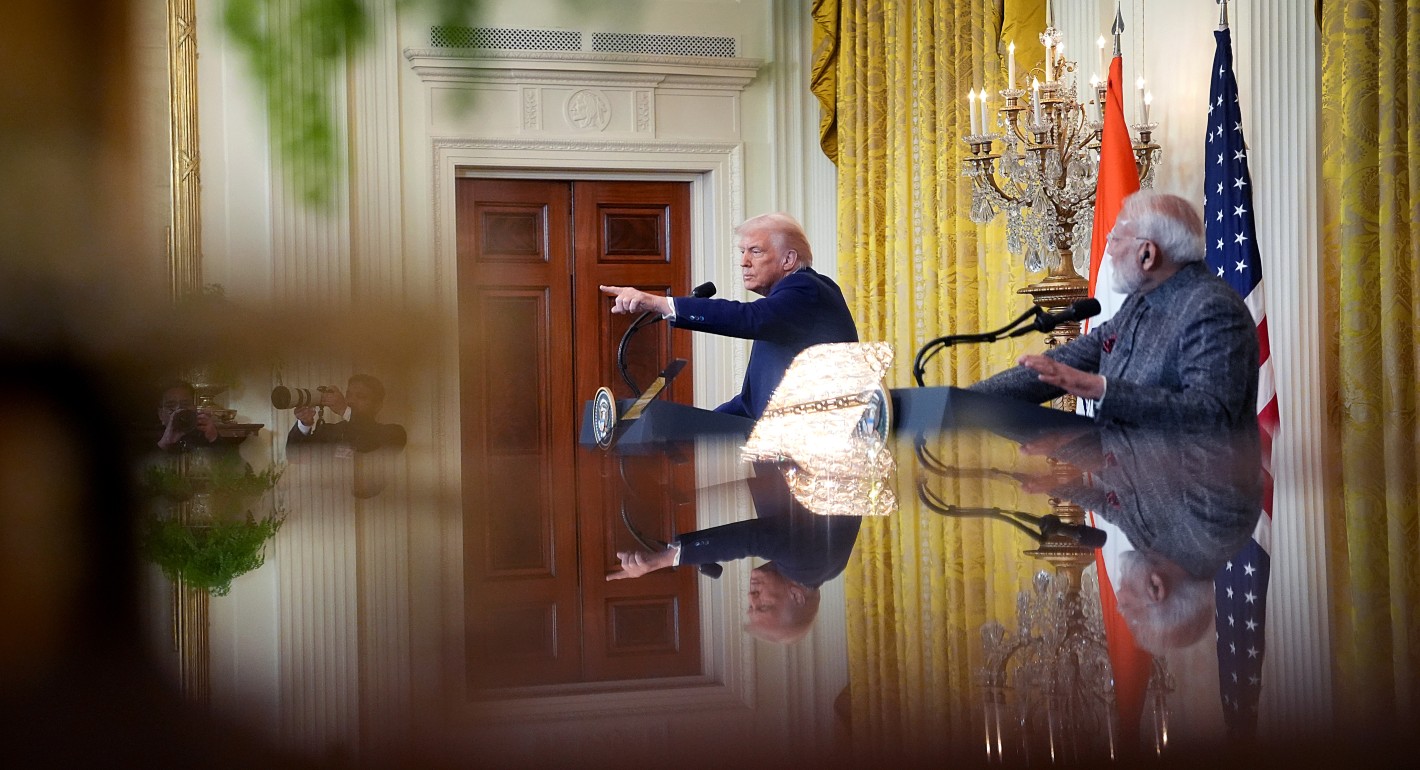
Trump and Modi at the White House on February 13, 2025. (Photo by Andrew Harnik/Getty Images)
Washington and New Delhi should be proud of their putative deal. But international politics isn’t the domain of unicorns and leprechauns, and collateral damage can’t simply be wished away.
On Monday, after six months of rancor and wrangling, the United States and India at last announced an initial agreement on a trade deal. The agreement came just one week after India and the European Union sealed a formal free trade agreement that had been under negotiation for well over a decade.
The contrast is important in two respects.
First, the EU’s deal is a genuine trade agreement, while Washington’s, in keeping with the pattern of negotiations under President Donald Trump, is a trade “deal”—with all the flexibility and potential for reversal that the latter implies. Bluntly put, the United States hasn’t done true bilateral or plurilateral agreements since what feels like the Jurassic period, so we should temper our enthusiasm by recognizing that one of these things is not like the other.
Second, the American deal is still thin on details, many of which will need to be further negotiated. According to Trump, the deal includes a cut from 50 percent to 18 percent tariff rate on Indian exports, an agreement from India to purchase $500 billion in U.S. goods and services over time, and what the White House spokesperson Karoline Leavitt has now characterized as an explicit promise from India to stop purchasing Russian oil.
My advice? Everyone needs to take a deep breath.
The situation between Washington and New Delhi was utterly unsustainable, which is why a deal was inevitable. (In fact, I was surprised it didn't happen sooner.) If you care deeply about U.S.-India relations and are invested in them, then having the floor fall out—as it did—is bad news. This is the opposite, and we should celebrate it.
Since his arrival in January, U.S. Ambassador to India Sergio Gor has managed to reset the tone. Prior American ambassadors, such as Robert Blackwill and David Mulford, have fostered momentum by identifying just a few key priorities early in their tenures and then pushing both systems hard to move the ball downfield. Gor seems to have recognized that a U.S. tariff rate for India that was the highest in the world (alongside Brazil’s) was both unsustainable and an insuperable obstacle to progress in any other area. Smartly, he focused on removing it.
The resulting headline is that the deal cuts tariffs on India’s exports to 18 percent. That’s better than the 50 percent—a 25 percent base tariff coupled to an additional 25 percent penalty tied to India’s Russian oil purchases—but the tariff rate never should have been that high in the first place, and everyone had better hope it stays here.
Trump loves tariffs, full stop. He has used or threatened them for much more than just trade disputes, and they are now the one-size-fits-all solution to any and every issue that seizes his attention: because he seeks a crackdown on fentanyl flows, because he doesn't like a given country’s foreign policy choices, because he doesn’t like how a U.S. company has been treated, because he’d like to roll back other countries’ domestic regulatory regimes, because he thinks countries should buy American only, because he wants them to ditch supply chain relationships with third countries, because he doesn’t want anyone to do deals with the very countries that he himself is doing deals with, and even when others dare to object to his interest in annexing a piece of territory.
In short, tariff “deals” have foundered because he changes his mind or layers on new issues. Don’t believe me? Go talk to some South Koreans. Then ask a few Canadians. Both countries thought they had made deals, only to discover that the terms of such deals are subject to fresh threats and perpetual renegotiation.
But 18 percent is a smooth landing for India, because if American tariffs are going to be a fact of life, then relative advantage over competitors is what matters. India now has a lower tariff rate than ASEAN countries—most of them are stuck at 19 percent, with Vietnam at 20 percent and with additional penalties for transshipment of Chinese goods—and it’s competitively good for Indian exporters. (It is perversely entertaining that 18 percent is now considered an awesomely “low” tariff rate, but this is nonetheless a boon to India.)
That said, while relative tariff rates matter, tariffs aren’t the only factor in determining trade and investment decisions. It is questionable whether a 1 percent or 2 percent tariff differential conveys such overwhelming competitive advantage that it overcomes other factors working in favor of Southeast Asian competitors that are better integrated into regional supply chains and have stronger fundamentals in their favor as foreign direct investment, export, and manufacturing hubs. The straight line many are drawing from small differentials in tariff rates to the totality of what makes an exporter attractive elides much about Vietnam’s comparative advantage and especially what made China so attractive. There is more to the China ecosystem, for example, than just cost.
We also shouldn’t sleep on China. Beijing has no realistic chance of reducing tariff rates to prior levels, but it doesn't need to. It just needs to get close enough to the ASEAN and India tariff rates to shape the medium-term calculations of manufacturers and complicate all the “China plus X” talk of the past decade. And that outcome hardly seems inconceivable since we are heading for at least two—and maybe more, per Treasury Secretary Scott Bessent—U.S.-China leaders meetings this year. Plus, Trump clearly craves a deal with Beijing.
Analysts would be wise to ignore some of the numbers in the deal, or at least treat them as aspirational. How is India going to buy $500 billion of anything from the United States anytime soon? U.S. goods exports to India in 2024 were $41.5 billion. U.S. services exports to India in 2024 were $41.8 billion. So a 500 percent increase—from $83 billion to $500 billion—seems like, well, kind of a stretch. But U.S.-India trade has undershot its potential forever, so ambition is good.
I also have a hard time believing the government of India will make any Russian oil-related commitment explicit. After all, India has deep historical and sentimental ties to Russia that it will not simply ditch under American pressure. Maintaining the symbolic hedge that it can purchase Russian oil if it so chooses speaks both to Indian foreign policy autonomy and to its ability to resist American coercion, both of which are important factors in India’s domestic politics.
Initial signs suggest that New Delhi had already been incrementally reducing its imports of Russian crude, even in the absence of a deal with Washington. But publicly rebuking Russia—as Bessent and others in the administration repeatedly have—was always a nonstarter for Prime Minister Narendra Modi, who can ill afford to humiliate one of India’s most important defense partners. And Trump’s frequent suggestions that Venezuelan oil is the answer to the world’s crude import needs strains credulity when that country’s industry needs to be modernized, to the tune of tens or hundreds of billions of dollars in capital expenditure.
Most importantly, those who care about U.S.-India relations—have worked hard on them and have spent years struggling for them against domestic political pressure—should be happier than they were a few months ago. But let’s not talk as if the past six months never happened or somehow just went “poof” in a magical puff of fairy dust and smoke. International politics and domestic politics are not populated by unicorns and leprechauns, so there really is such a thing as collateral damage.
The biggest bipartisan achievement on both sides since the 2000s had been a depoliticized relationship. Because of all that has happened in recent months, this relationship has become politicized again. A lot of people put in a lot of work over recent decades to ensure that third-country relationships to which either side objected did not bleed back into U.S.-India relations: namely, India’s relationships with Iran, Myanmar, and Russia, to which Washington often objected, and America’s relations with China and Pakistan, to which India often objected. So the American decision to impose a 25 percent oil penalty tied to third-country choices set a bad precedent that will linger, even if it is now rolled back in this new tariff deal. This is the perverse foreign policy impact of the administration’s recent choices. It was obvious from the get-go that imposing an unprecedented 25 percent “Russian oil tariff” was a fool’s errand, since the United States had no realistic chance of persuading India to jettison its relations with Moscow wholesale.
Last August, I wrote about three fundamental facts in foreign policy: (1) domestic politics nearly always trumps foreign policy, (2) foreign policy arguments almost never prevail unless they are anchored by a strong domestic political foundation, and (3) trust is much easier to lose than to build. I hope the domestic politics around the relationship now get stronger for both India and the United States but fear that the ceiling of trust has been lowered very considerably. Washington and New Delhi are in a better place than they’ve been since August. Both leaders should take the win, and Gor and his counterparts should be commended. But it’s still worthwhile to take a deep breath, check the euphoria at the door, and see where we go from here.

Vice President for Studies
Evan A. Feigenbaum is vice president for studies at the Carnegie Endowment for International Peace, where he oversees work at its offices in Washington, New Delhi, and Singapore on a dynamic region encompassing both East Asia and South Asia. He served twice as Deputy Assistant Secretary of State and advised two Secretaries of State and a former Treasury Secretary on Asia.
Recent Work
Evan A. Feigenbaum
Evan A. Feigenbaum
Carnegie does not take institutional positions on public policy issues; the views represented herein are those of the author(s) and do not necessarily reflect the views of Carnegie, its staff, or its trustees.
Why Pakistan, Saudi Arabia, and Turkey are joining forces on regional security.


Alper Coşkun, Amr Hamzawy

Despite public disputes over trade and immigration, the strategic partnership’s foundations remain sturdy.

Sameer Lalwani

It signals a new era of tech diffusion and warfare.

Steve Feldstein

Despite its flop at the box office, the film raises important questions for the climate community to answer.

Leonardo Martinez-Diaz

Fatima El Mansouri is the country’s first female prime minister. She’s also a privileged insider in a largely ceremonial position.

Sarah Yerkes