

Paper
A new U.S. approach should prioritize protecting the rights and human security of Palestinians and Israelis over maintaining a peace process and attempting short-term fixes.
{
  "authors": [
    "Zaha Hassan"
  ],
  "type": "commentary",
  "blog": "Emissary",
  "centerAffiliationAll": "",
  "centers": [
    "Carnegie Endowment for International Peace"
  ],
  "englishNewsletterAll": "",
  "nonEnglishNewsletterAll": "",
  "primaryCenter": "Carnegie Endowment for International Peace",
  "programAffiliation": "",
  "programs": [
    "Middle East"
  ],
  "projects": [],
  "regions": [
    "Israel",
    "Palestine",
    "United States",
    "Middle East"
  ],
  "topics": [
    "Global Governance",
    "Foreign Policy"
  ]
}
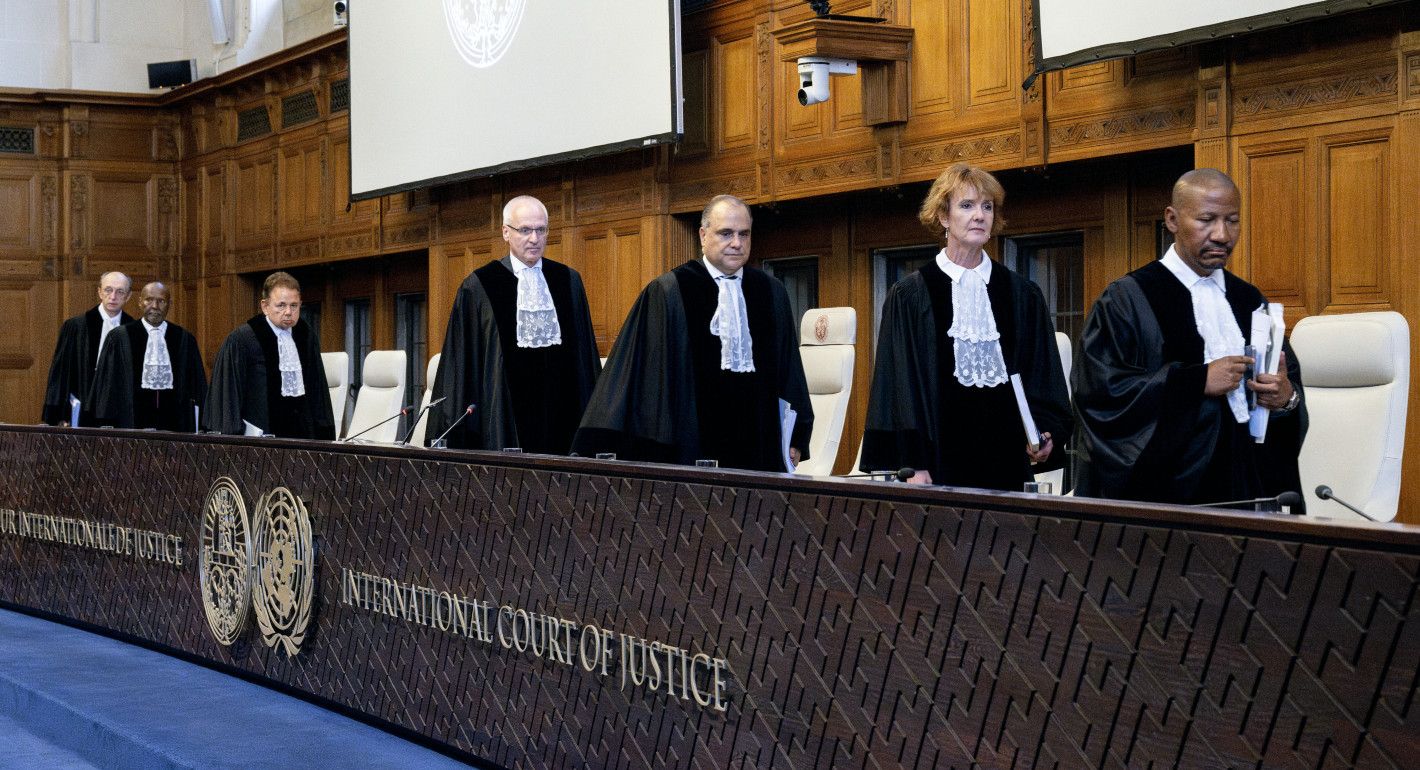
ICJ judges depart the courtroom on July 19.
Its opinion, though nonbinding, shattered the entire framework for U.S. engagement on Israel-Palestine peace.
Last week, the International Court of Justice (ICJ), the judicial arm of the UN, issued an advisory opinion that upended the prevailing wisdom in Washington on Israeli-Palestinian peacemaking.
According to the court, Israel’s prolonged occupation over Palestinians living in Gaza and the West Bank—including East Jerusalem—and its settlement enterprise are illegal under international law and constitute apartheid. Ending the occupation does not require a bilateral agreement guaranteeing Israel’s security and Palestinian concessions on territory, borders, the status of Palestinian refugees, and Jerusalem. Rather, the court stated, Israel must immediately withdraw its troops, evacuate all 750,000 Israeli settlers from the West Bank, and pay Palestinians reparations. The court added that the UN, international organizations, and other states must do everything in their power to compel Israel to adhere to the ruling, including through sanctions.
The court’s opinion has not received a warm reception in Washington, where international law has little currency in discussions concerning Israel and Palestine. It will certainly complicate cooperation between U.S. allies in Europe and states forming part of the so-called global majority, where international norms figure more prominently in formulating foreign policy toward Israel and Palestine.
The United States, however, ought to take this opportunity to recalibrate its approach to center the human security and rights of both Palestinians and Israelis. Israel-Palestine peace has been elusive over the past three decades, not due to a lack of creative solutions to the final status issues but because key stakeholders, particularly the United States, lack the willingness to create costs and consequences for Israel while they simultaneously press Palestinians to make more and more concessions. U.S. policymakers must utilize the tools available to disincentivize continued occupation and comply with the ICJ ruling, allowing the United States to work cooperatively with allies and the global majority, rather than at odds with them.
The court’s nonbinding opinion—which stems from a December 2022 request from the UN General Assembly—is a statement of international law from the world’s most eminent jurists. It represents a paradigm shift in how the question of Palestine and the existing relationship between Israel and the Palestinian people has been framed, particularly by the United States and its allies.
For decades, the U.S. position effectively has given Israel control over when or whether its military occupation over Palestinians will end. According to the U.S. legal brief and oral argument to the ICJ, the “land for peace” framework requires that Israel’s security needs be met before the occupation can end. Once that is achieved and memorialized in a bilateral agreement, a two-state solution becomes possible. Thus, the United States asserted that responding to the legal questions the General Assembly posed risked “disrupting [the framework’s] balance.”
The ICJ rejected that argument. It found that Israel is obligated to end its illegal military occupation without Palestinian concessions or agreement. The court referenced the Fourth Geneva Convention provision establishing that agreements made between an occupying power and an occupied population are invalid. This legal principle is also common sense: agreements made under duress can never be consensual. The ICJ ruling shatters the entire framework for U.S. engagement on Israel-Palestine peace.
But the court (and anyone following it) should not be under any illusion about whether Israel will voluntarily comply with the sweeping and historic ruling. In fact, only days before, the vast majority of the Knesset voted to oppose Palestinian sovereignty and the two-state solution, calling it an existential threat to Israel’s security. The Knesset legislation drew support from almost the entire Israeli political spectrum, from the far right to the more moderate party led by Benny Gantz. (Center-left politician Yair Lapid left the hall to avoid voting.)
Like Israel, the United States is showing no signs that it plans to reverse its position. When asked about the ruling, the State Department spokesperson dismissed “votes in international bodies that don’t do anything” and said that such “unilateral actions” are harmful to negotiations for a Palestinian state.
As unlikely as it is that the United States will engage with the ICJ decision and recalibrate the U.S.-Israel bilateral relationship, especially in the midst of an election year, it is important for policymakers to review it and consider the implications of ignoring it.
Dismissing an ICJ decision, even if it is advisory in nature, is not a good look for an international player angling to restore respect for international legitimacy. Of course, votes in multilateral bodies and legal mechanisms matter. The United States understands this; otherwise, it wouldn’t bother filing legal briefs before the world court or using its veto power to block resolutions in the Security Council. Certainly, such a position does not bode well for U.S. credibility and leadership among the global majority.
Though statements about the legal consequences of Israel’s enduring occupation alone cannot change the reality on the ground, they can and should inspire international action. And what the United States decides to do—or not do—with the ICJ ruling will play a decisive role in whether the Middle East is embroiled in recurring conflict, human rights violations, and apartheid for the indefinite future or whether a different outcome is possible.
Some of the steps that the United States ought to take, which my co-authors and I outlined in a 2021 paper, include prioritizing the rights and security of people, centering international law as the point of departure for conflict resolution, deploying the levers of U.S. policy to encourage both Israelis and Palestinians to comply with international law toward a just and durable political solution, and working cooperatively with multilateral organizations and mechanisms for that purpose.

A new U.S. approach should prioritize protecting the rights and human security of Palestinians and Israelis over maintaining a peace process and attempting short-term fixes.
In addition, Washington should take a whole-of-government approach to ensure that its policies comport with the ICJ decision. It must respect distinctions between Israel and the occupied Palestinian territory in domestic law and policy, and it must not recognize Israel’s annexation of Palestinian land, including in East Jerusalem. The Biden administration’s decision reaffirming the State Department’s legal opinion that Israeli settlements are illegitimate is an important step in this direction. Biden’s executive order—as well as U.S. sanctions on Israeli settlers, entities responsible for attacks against Palestinians in the West Bank, and those preventing humanitarian assistance from entering Gaza—also show how U.S. policy can be given practical effect.
However, more can be done to fully comply with the ICJ decision. Washington should support a ceasefire in Gaza in which effective measures to provide humanitarian assistance and prevent starvation are not linked to negotiations. Offensive weapons transfers used to maintain Israel’s occupation and commit human rights violations should also be suspended. It should deny U.S. tax-exempt status to charities supporting Israeli settlements or funding the violence in the West Bank, relocate the U.S. embassy back to Tel Aviv from Jerusalem, and disallow consumer products made in settlements from being labeled “made in Israel.” It should also exclude Israeli settlements from the benefits of U.S.-Israel bilateral agreements. At the international level, the United States should support Palestinian elections and democratic governance throughout the occupied territories, and it should work with the UN General Assembly to implement the ICJ decision and adopt consensus positions in the Security Council to advance peace and security for both Israelis and Palestinians.
Reorienting U.S. policy in this way may seem like a monumental, if not unlikely, task, given the politics associated with such a change. Building domestic support and seeing real impact and change on the ground will take time. But U.S. policymakers are long overdue to reassess failed frameworks for peace that placed a premium on maintaining a status quo that keeps Palestinians under military occupation and perpetuates violence and insecurity. After the ICJ decision, ending the occupation is no longer an Israeli choice. According to the court, it is an international obligation.
Understand the world with the latest from our scholars around the world.
Carnegie does not take institutional positions on public policy issues; the views represented herein are those of the author(s) and do not necessarily reflect the views of Carnegie, its staff, or its trustees.
When democracies and autocracies are seen as interchangeable targets, the language of democracy becomes hollow, and the incentives for democratic governance erode.

Sarah Yerkes, Amr Hamzawy

From Sudan to Ukraine, UAVs have upended warfighting tactics and become one of the most destructive weapons of conflict.


Jon Bateman, Steve Feldstein
And how they can respond.

Sophia Besch, Steve Feldstein, Stewart Patrick, …
They cannot return to the comforts of asymmetric reliance, dressed up as partnership.
Sophia Besch
Carnegie scholars examine the crucial elements of a document that’s radically different than its predecessors.



James M. Acton, Saskia Brechenmacher, Cecily Brewer, …