

Article
Benjamin Feldman, Jennifer McCoy
{
  "authors": [
    "Jennifer McCoy"
  ],
  "type": "commentary",
  "blog": "Emissary",
  "centerAffiliationAll": "dc",
  "centers": [
    "Carnegie Endowment for International Peace"
  ],
  "collections": [
    "Global Democracy"
  ],
  "englishNewsletterAll": "democracy",
  "nonEnglishNewsletterAll": "",
  "programAffiliation": "DCG",
  "programs": [
    "Democracy, Conflict, and Governance"
  ],
  "regions": [
    "Venezuela",
    "United States"
  ],
  "topics": [
    "Democracy",
    "Foreign Policy",
    "Domestic Politics",
    "Economy"
  ]
}
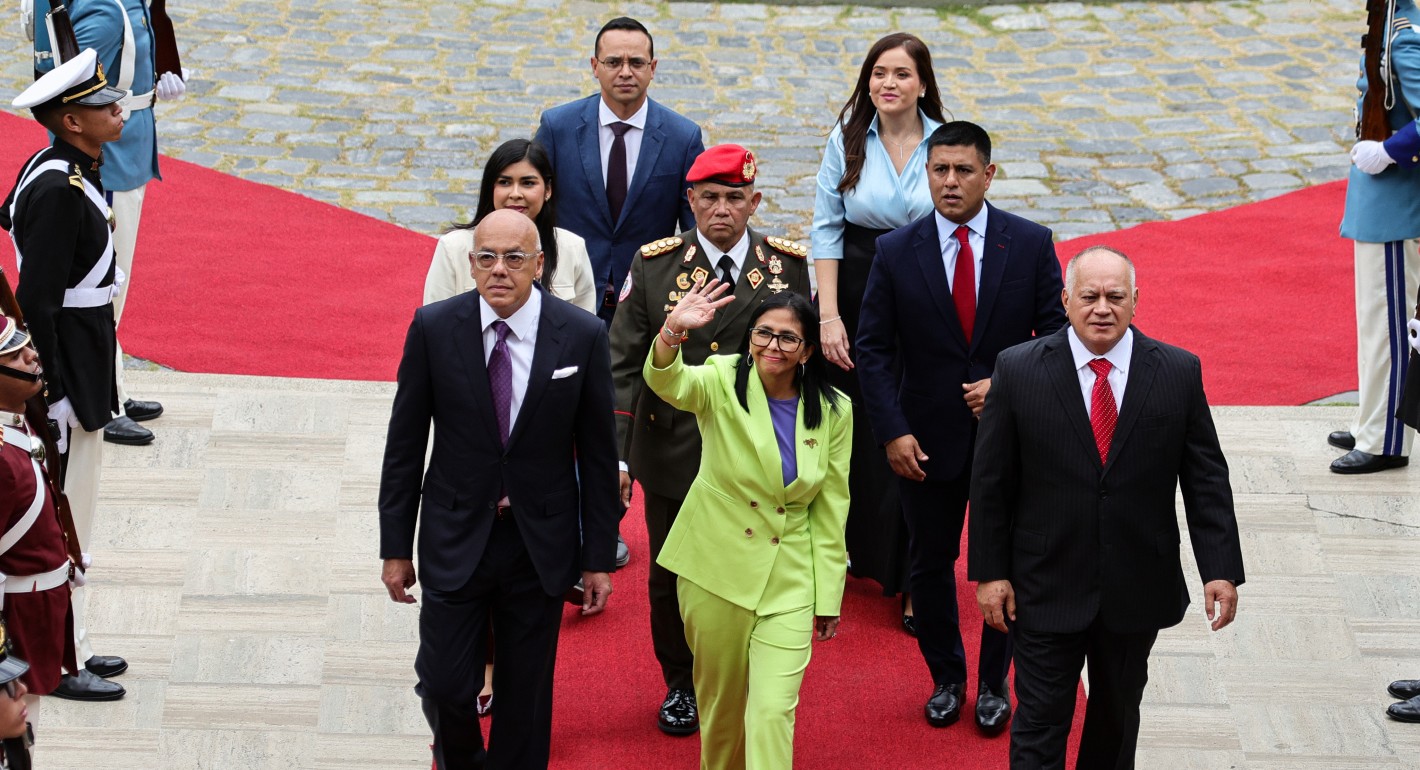
Rodríguez and other government officials arrive at Palacio Federal Legislativo on January 15, 2026 in Caracas. (Photo by Jesus Vargas/Getty Images)
Venezuelans deserve to participate in collective decisionmaking and determine their own futures.
The U.S. nighttime military raid on January 3 to capture and extract Venezuelan leader Nicolás Maduro was a dramatic end to his thirteen-year reign. It also opened the door to multiple pathways to move Venezuela out of the political repression and economic misery that Maduro and his mafia state have inflicted on the country.
For now at least, President Donald Trump’s administration has chosen a path that prioritizes economic and political stability. It is working closely with the existing regime (minus Maduro), especially interim president Delcy Rodríguez, who served as Maduro’s vice president. Immediately after the raid, Trump explained his thinking: Opposition leader María Corina Machado did not enjoy sufficient support within the country to guarantee stability (which was certainly true in terms of support among the government and security forces, though she did have widespread popular support). He emphasized the U.S. interest in Venezuelan oil and strategic minerals, a shift from his earlier focus on stopping drug shipments to the United States.
Although Trump has expressed little (if any) interest in pushing for a democratic transition, Secretary of State Marco Rubio, long a champion of regime change in Cuba and Venezuela, provided an outline of a broader three-step plan when he briefed Congress following the raid: stability, recovery, and eventual political transition—but provided no timeline. Indeed, establishing human rights protections, restoring democratic institutions, and creating political space leading to credible elections are necessary to give Venezuelans a meaningful role in defining their own future and to create a new foundation of the rule of law that helps make new investments in the country more attractive. What would it take for such political change to occur?
The motives for the United States and Rodríguez to continue to work together are strong and thus far work against a political opening. Trump wants to recover what he views as “our oil” based on 2007 expropriations of some U.S. oil companies, and even the historic role of U.S. companies in developing the Venezuelan industry going back to the 1920s. He believes the United States is in a solid position to pressure the Venezuelan regime to open the economy to U.S. investment, increase oil supply, and potentially lower prices for U.S. consumers. On her side, Rodríguez sees the advantage for her own political survival to playing ball with Washington on the economic front. And she already knows the oil sector and the players—she worked since the first Trump administration to open it to foreign investors but was thwarted by U.S. sanctions.
At the same time, high-level officials in the Venezuelan government and their allies fear retribution by the United States, a future Venezuelan government, or the International Criminal Court if they lose power. They will not contemplate surrendering power in a future election or giving up arms without strong guarantees against punishment, a guaranteed future political life, and possibly the ability to retain ill-gotten riches.
But there are benefits for both governments of a political opening that could change their political calculus. American oil executives made it clear to Trump in their January 9 meeting that they need legal certainty, security, and infrastructure before they invest $100 billion to jumpstart Venezuelan oil production, as he requested. This means reestablishing the rule of law, asserting control of armed gangs, and stabilizing the country and the economy sufficiently to rebuild needed services and infrastructure. Accomplishing these would of course tremendously benefit the Venezuelan people as well.
For the current Venezuelan regime, economic recovery through a partnership with the United States can provide a form of performance legitimacy to bolster its popular support without having to rely solely on repression and fear. Economic recovery and reduction of repression could also set the regime up to potentially even be competitive in a future (fair) election. Rule of law and an independent judiciary will help protect the regime and its supporters from revenge and persecution, should it lose power. An independent election authority would provide assurances of future political participation. But it will need heavy pressure from the United States to move in this direction.
What would a path toward a political opening look like? Venezuelans need and deserve to participate in collective decisionmaking and determine their own futures, as any free society requires. A political opening should enable society to imagine a collective future together. It requires first to establish physical safety, minimum conditions for survival and thriving, and basic freedoms of speech, dissent, and association as well as due process.
Some immediate actions would need to be taken by the current government to create initial momentum toward a genuine opening. First, it should release the remaining political prisoners without conditions. As of January 26, the Venezuelan human rights nongovernmental organization Foro Penal had verified the release of 266 political prisoners since January 8, though hundreds remain detained. Next, it should repeal laws that criminalize dissent and free speech and restrict the operation of nongovernmental organizations. This would allow all Venezuelans to participate in rebuilding their country. The regime should also return control of the intervened political parties to their original members, legalize outlawed parties, and remove disqualifications of opposition politicians.
Finally, it should remove any orders for the armed gangs known as colectivos, as well as official forces, to intimidate citizens through road checkpoints, random stops to search cellphones, detention, beatings, or extortion. Developing a plan to disarm the colectivos and illicit gangs is also essential for improving safety throughout the country.
On the U.S. side, a near-term priority is to address the severe humanitarian crisis and restore public services and economic stability, which will require international cooperation and debt restructuring. Most immediately, the Trump administration needs to ensure that the oil revenues it is acquiring from the sale of Venezuelan oil are handled transparently and used to benefit Venezuelans. But a plan for political opening needs to accompany economic opening and stability.
Beyond these initial steps, reinstituting the rule of law and democracy will require some form of shared power, ideally starting soon. Badly needed reforms—including reconstituting an independent judiciary and public entities such as the Central Bank and National Electoral Council—can only be credibly implemented by incorporating opposition figures and nonpartisan experts in the government or by shifting to a technocratic interim government.
Two vexing issues that can impede a meaningful political opening loom large: how to address the current regime’s fears of persecution while also holding accountable those accused of the most serious human rights crimes? And when and how to hold new elections? At least fifteen former and current top Venezuelan officials face U.S. indictments for narco-terrorism or drug trafficking, including Interior Minister Diosdado Cabello and Defense Minister Vladimir Padrino. Many others are suspected of violations of human rights, as well as economic crimes and extreme corruption. For the most serious crimes, new models of restorative justice can offer a route through the first dilemma. These models can offer truth, guarantees of non-repetition, and reparations for victims, as well as provide for conditional amnesties and tax amnesties.
The question of elections is also thorny. The 2024 presidential election was widely seen as being stolen by Maduro, and the lower-level elections in 2025 were largely boycotted by opposition parties. Any transitional timetable will need to advance new elections, starting with the presidency and National Assembly, and take into consideration the need to reestablish independent judicial and electoral authorities. This is likely to take some time—longer than the six months provided in the constitution to replace an absent president. But the process of institutional recovery must begin now, parallel with the planned economic recovery. It needs to give a voice and role to diverse Venezuelan experts, civil society, and politicians in joint decisionmaking mechanisms, with assistance from international monitors.
Regardless of one’s assessment of how the United States and Venezuela came to be in this position, the United States is the single actor today with the means and the credibility to jumpstart the political opening. By pressing the Rodríguez government to begin the process of political opening by reestablishing the rule of law, accountable governance, and democratic institutions, the United States will help make the country more attractive for investment. Including more Venezuelan voices in this process will increase the credibility and legitimacy of the economic and political reforms for the entire population, and thereby also improve prospects for stability. By facilitating a restorative justice approach to address the serious human rights crimes, the United States can help cut through the Gordian knot that has held back a solution to the Venezuelan tragedy far too long.
Nonresident Scholar, Democracy, Conflict, and Governance Program
Jennifer McCoy is a nonresident scholar in the Democracy, Conflict, and Governance Program, where she focuses on political polarization and democratic resilience in the U.S. and around the world.
Recent Work
Benjamin Feldman, Jennifer McCoy
Sarah Yerkes, Jennifer McCoy, Paul Stronski, …
Carnegie does not take institutional positions on public policy issues; the views represented herein are those of the author(s) and do not necessarily reflect the views of Carnegie, its staff, or its trustees.

In the latest Five-Year Plan, the Chinese president cements the shift to an innovation-driven economy over a consumption-driven one.

Damien Ma
A conflict launched in the name of American security is producing the opposite effect.
Sarah Yerkes
Restoring competence and trust to the anemic, neglected disaster recovery agency is a matter of national security.

Sarah Labowitz, Debbra Goh
Although the IAA often differs from the IRA, European policymakers can still take note of the U.S. act’s shortcomings.

Milo McBride
Going to war was the U.S. president’s decision, for which he alone is responsible.

Daniel C. Kurtzer, Aaron David Miller