Source: Global Times
Ukrainian President Viktor Yanukovych's decision on November 21 to not sign the Association Agreement or part of the Deep and Comprehensive Free Trade Agreement with the EU has provoked a political crisis in Ukraine, and has raised tensions between the EU and Russia.
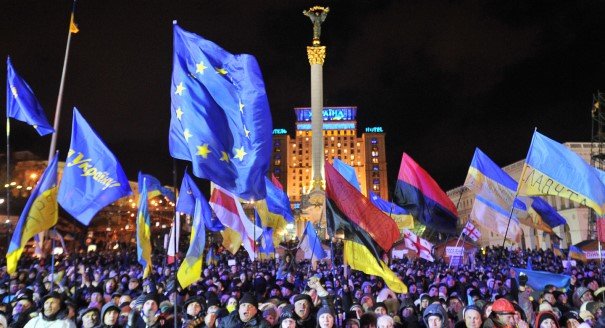
The escalating protests in Kiev, demanding the president's resignation, have drawn parallels with the Orange Revolution of a decade ago. The rhetoric used by European and Russian politicians toward each other reminds some of the Cold War days between the Soviet Union and the West.
What are the roots of the crisis, where is it headed, and what might its implications be for Ukraine itself and Russian-EU relations?
The summit of the EU's Eastern Partnership initiative held in Vilnius in late November has turned out to be a disappointment for the EU. Ukraine, the biggest partner by far, has refused the EU's offer to sign the agreement even without any preconditions.
True, two other countries, Moldova and Georgia, whose combined population is a fifth of Ukraine's, did sign, but this is small consolation to the Union. The EU had been overconfident about its soft power and both unwilling and unable to play by the rules of the region, where money rules the day. Brussels' soft power simply could not compete with Moscow's hard alternative.
Uninvited at Vilnius, Russia did much to influence its result. President Vladimir Putin told Yanukovych how much Ukraine would lose after signing the Association Agreement with the EU. Moscow's threat to withdraw the trade privileges which Ukraine still enjoys, and to demand that Kiev pays its debt to Russian banks, if exercised, would mean a massive slump in the Ukrainian economy and the default of its government.
In such a scenario, Yanukovych would be swept away from power, and possibly replace his archenemy former prime minister Yuliya Tymoshenko in jail. Desperate, the Ukrainian leader turned to Europe for help, but heard instead that the EU was not going to bail Ukraine out.
Yanukovych's failure to associate Ukraine with the EU angered his political opponents and those Ukrainians who see the EU as the only path toward development, prosperity, and the rule of law.
Kiev has again confirmed its fame as the workshop of revolutions in Eastern Europe. The country's elite is split on whether to move west and risk losing power and property or stay put in the middle as before. As to the public at large, its larger part is pro-European, while a significant minority is concerned about the economic consequences of "Europeization."
The spectacular sight of hundreds of thousands of people in Kiev's main square will not overshadow the hard fact that, whatever happens politically, Ukraine's economic situation is bleak, and will get even more difficult in the short term.
The EU will display "solidarity with the people of Ukraine," and send its spare politicians to Kiev, but will offer no money.
Moscow will keep the pressure on the Ukrainian leadership by making clear that Kiev cannot afford a break with the Russian market.
The US, which had basically delegated Eastern Europe, including Ukraine, to the EU, will criticize these Russian hardball tactics, but is unlikely to become involved in a serious way: The region is not a priority for the Obama administration.
It may look like a geopolitical battle, Cold War-style, but in reality the choice is Ukraine's. There are hard lessons to be learned.
A country is truly independent only when it can pay its own bills. Modernizing one's economy and becoming internationally competitive requires a strong political will from elites and solid support from a population willing to go through "blood, sweat and tears" to achieve a better future.
National unity requires a basic contract between the elites and the public in which each side keeps its part of the deal.
The Ukrainian crisis, however, may become a European one. The situation is getting tenser, and, for each party, backing down is becoming less and less realistic. If it comes to a showdown in Kiev, the implications will be serious for all major outside players, including the EU, Russia and the US.
As they root for their teams, they will be best advised not to rush to the field. The battle in Ukraine should not be allowed to become a battle for Ukraine.
This article originally appeared in Global Times.