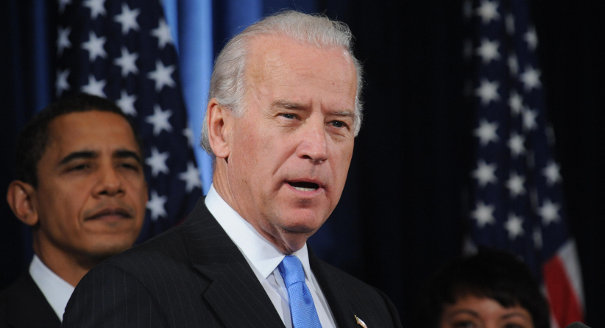
Forget Dick Cheney: Joe Biden is the most influential vice president in American history. He is poised for a role in the Obama administration’s second term that seems sure to make Cheney look like a shrinking violet, and Al Gore look like little more than a spear-carrier for Bill Clinton.
Consider this: The veep has thus far taken the point role in the two most important initiatives of this year for the Obama administration: the fiscal cliff battle and gun control. He is perhaps the president’s single most influential foreign policy advisor. Obama’s incoming national security team is Biden’s favorite players from his days as chairman of the Senate Foreign Relations Committee. John Kerry and Chuck Hagel are seen as far closer to him than to the president. Tom Donilon, the president’s national security advisor, is also seen as close to the vice president, which should come as a surprise to no one since his wife, Catherine Russell, is the vice president’s current chief of staff. Biden’s previous chief of staff, Ron Klain, is one of two men considered likely to replace Jack Lew as Obama’s chief of staff. Biden’s top national security advisor, Tony Blinken, is seen as heading for a promotion (if moving away from this particular vice president could be seen as a step up), either stepping in for U.S. U.N. ambassador Susan Rice should she someday become national security advisor or moving over to a top job in Kerry’s State Department.
In terms of day-to-day foreign policy decision-making, Biden is a regular at the morning meeting at which the president, Donilon, outgoing White House counterterrorism chief John Brennan, Donilon deputy Denis McDonough, and Blinken review the latest intelligence and make the big decisions that are passed along to the other arms of the administration to execute. Obama consults Biden regularly, and is known to respect his opinion greatly. This was sometimes a bone of contention for officials like Bob Gates and Hillary Clinton, who often sought a tougher line on key issues than the generally more dovish team led by Biden. But those officials are gone or leaving now.
The goofy Uncle Veep persona that follows Biden around like a stray dog, largely thanks to his garrulousness and occasional slips of the tongue, could not be farther from the reality of the role this seasoned Washington insider is playing. Washington is a town in which relationships are currency, and given the fact that the president is both relatively new to the city and not exactly a social animal, it is Biden’s ties that are often critical to helping the White House advance its goals. This was never clearer than at the turn of the New Year, when it took Biden’s personal intervention with Senate Minority Leader Mitch McConnell to broker the deal that saved America—for a while at least—from going over the fiscal cliff.
While the role Biden is playing may come as a surprise to outsiders, it is not the one for which he has been preparing his whole life. I vividly remember a story told to me by my former boss, the late Rep. Steve Solarz, who, upon arriving in Congress in 1978, discovered he was also allowed on the floor of the Senate. So he walked over one night and discovered, pacing the floor and orating remarks into the Congressional Record, young Senator Joe Biden. The chamber was empty save for a tired-looking gentleman sitting at the chair, but Biden was gesticulating and emoting as though he were speaking to a stadium. At that moment, Solarz used to say, it was clear to him that this was a guy who was planning on a run to the top.
Insiders say that Biden, who would be 74 come the 2016 election, is intent on succeeding Obama in the Oval Office. Further, there are clearly some around Obama who see him as a more desirable choice than Clinton. Indeed, there are rumblings that the old Obama-Clinton divide—never far beneath the surface—may widen again as a White House camp dominated by Biden tees things up for the next presidential season.
Unlike Cheney, however, who wore his influence like the Star Wars character he evoked wore his helmet and cape, Biden remains one of the few Washington figures who can actually be described as beloved by many. It might seem that it is his humor or his million-dollar smile that have earned him that affection. But in reality, to those on the inside in this administration it has been his loyalty, his tirelessness in pursuit of some very tough goals, his willingness to speak candidly to the president, and his special combination of experience and intelligence that have put him in this unique role.
No one saw it coming. Except, of course, the people who have been paying attention to his steady (or is it relentless?) ascent for the past three and a half decades.
Carnegie does not take institutional positions on public policy issues; the views represented herein are those of the author(s) and do not necessarily reflect the views of Carnegie, its staff, or its trustees.
More Work from Carnegie Endowment for International Peace
In return for a trade deal and the release of political prisoners, the United States has lifted sanctions on Belarus, breaking the previous Western policy consensus. Should Europeans follow suit, using their leverage to extract concessions from Lukashenko, or continue to isolate a key Kremlin ally?
The supposed threats from China and Russia pose far less of a danger to both Greenland and the Arctic than the prospect of an unscrupulous takeover of the island.