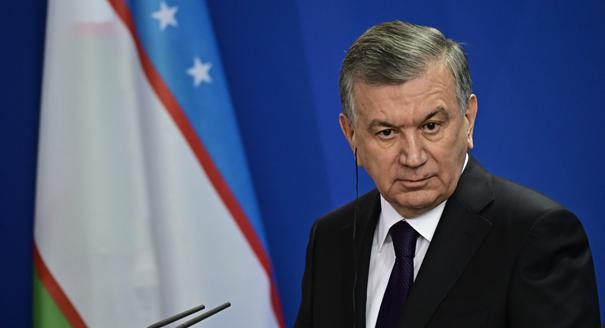
In four years, Uzbek President Shavkat Mirziyoyev has managed to establish a reputation both at home and abroad as a reformer. Upon coming to power in September 2016, he announced sweeping changes and did everything he could to distance himself from the harsh regime of his late predecessor, Islam Karimov. His first steps met with almost universal support, but over time, enthusiasm has waned as some of the reforms turned out to be superficial. Next year, Mirziyoyev must run for reelection and make an important choice: whether to continue with his half-hearted liberalization without touching the foundations of the regime, or to embark on the more vigorous reforms that Uzbek society expects from him.
When Mirziyoyev took charge of Uzbekistan following the death of Karimov, the public was skeptical of his promises of reform. Having served as Karimov’s prime minister for thirteen years, he didn’t look much like a fearless reformer. Yet the new president immediately embarked on a raft of changes.
Mirziyoyev began by tackling the issues for which Karimov had come under the strongest criticism: the economy, public policy, and international relations. Most political prisoners from the Karimov era were released from Uzbekistan’s prisons, and the authorities closed the Jaslyk prison, which was notorious for the use of torture. These steps were welcomed by the West.
Tashkent has started rebuilding its relationships with its neighbors, and has resumed talks with Kyrgyzstan and Tajikistan on the demarcation of borders and the use of water from shared rivers, among other issues. Uzbekistan has also resurrected a regional dialogue for which the heads of the five Central Asian nations convened in 2018 and 2019.
At the same time, Mirziyoyev began to convince the world that investing in the Uzbek economy is now safe and rewarding. The government has standardized exchange rates, given the green light for foreign currency transactions, reformed the banking sector, and removed many of the administrative barriers for foreign investors.
There has even been progress on a previously taboo subject: the Andijan massacre of 2005. The country’s leadership still does not admit that Andijan was not an attempt by Islamist extremists to seize power, but a peaceful protest, and denies that the demonstration was brutally crushed. But public discussion of this highly sensitive issue has begun: Deputy Prosecutor General Svetlana Artykova has admitted that the security forces opened fire on peaceful protesters, though she said it was not a deliberate act, but resulted from a communications breakdown.
Mirziyoyev has made considerable effort to surround himself with a loyal new team, replacing all of Karimov’s ministers and agency heads, with the exception of the foreign minister. The state is now run by young technocrats, as well as those who had fallen out of favor with Karimov.
The image of the Uzbek official has started to change. Instead of being cloistered away in impregnable offices, they are active on social media, are not afraid to talk about problems, and give interviews, including to foreign media.
Now officials talk to the public, and even attend the scene when there is a problem. Last year, for example, when hundreds of people blocked a highway in the city of Urgench over the failure to pay out compensation for demolished homes, Prime Minister Abdulla Aripov went to talk to protesters: something impossible to imagine under Karimov. Mirziyoyev himself has visited areas hit by natural disasters.
There are still problems recruiting staff, however. Just as under Karimov, it’s almost impossible to enter the state service without the right connections. The few who do manage to break through are kept down by the older generation of officials. Many Karimov-era veterans may have officially lost their positions, but they have retained their influence as presidential advisors, for example. In addition, only national bodies have so far been reformed, while local administrations remain untouched.
Another area of transformation under Mirziyoyev is the media. Journalists are now permitted to cover real political events, and access to some foreign websites has been unblocked. Agencies have been set up to protect journalists, headed by the president’s eldest daughter Saida Mirziyoyeva and his own former press secretary Komil Allamjonov.
Cautious criticism of the authorities has become possible in the Uzbek media, and human rights violations, corruption, and official negligence are no longer taboo subjects, even for regional journalists. Facebook and Telegram have become the main platforms for discussion, and popular bloggers have emerged.
Uzbekistan’s media still has some way to go, however. In the 2019 World Press Freedom Index, the country may have left the black zone, but it remains in the group of countries with the worst conditions for journalists. In addition, taboos remain: no one dares to write about the president’s family, the security services, or corruption at the very top.
Yet even the limited media freedom is forcing the authorities to change their behavior, as evidenced during the coronavirus pandemic. Not so long ago, the Uzbek authorities would most likely have revealed nothing about the situation in the country, but that’s no longer possible, since local media and bloggers would have reported on it anyway.
Mirziyoyev himself describes what is happening in Uzbekistan as a change “in the leadership style of the last twenty-five years.” “Style” is precisely the right word here, since the foundations of the regime built by Karimov remain largely untouched. Power is still concentrated in the hands of a few, political parties aren’t focused on a genuine political fight, and social freedoms are restricted. Excessive emphasis on the PR effect of the reforms only increases people’s mistrust in the latest promises.
Four years is enough time for the initial enthusiasm for the reforms to have died down, especially where the economy is concerned. On the one hand, the authorities have reformed important sectors such as taxes and privatization. But on the other hand, the dominant philosophy in economic policy remains strict protectionism; subsidies and incentives for local monopolies continue to stifle any competition; and the privatization process is not transparent. Just as before, the Uzbek economy works for a small circle of lobbyists, no matter how hard a few prominent officials have tried to change that.
Meanwhile, Uzbekistan’s vast state apparatus continues to grow, as the government tries to solve problems by creating new ministries and bodies to deal with them, resulting in the emergence of unintelligible structures with vague functions.
Now new problems are adding to the unresolved old ones. Officials are more worried about meeting their KPIs (key performance indicators) in their reports than they are about the situation on the ground. Protected by government decrees, figures close to the authorities are putting pressure on private businesses, and the new authorities’ lack of experience in public office has resulted in a constant stream of scandals. On top of all this are the economic and social problems caused by the pandemic.
Uzbekistan is due to hold a presidential election next year, and no one doubts that Mirziyoyev will be reelected for a second term. Since the constitution currently bars presidents from serving more than two consecutive terms, he is fast approaching the middle of his tenure.
Mirziyoyev has already solved the most toxic issues for which Karimov was condemned. Now he must tackle the problems that have arisen on his own watch. With every year, it will be harder and harder to pass off symbolic concessions as genuine reforms.
The country’s leadership is facing a difficult choice: to transition from stylistic transformations to structural reforms, or keep trying to preserve the status quo. Achieving the latter won’t be as easy as it once was: even Mirziyoyev’s half-hearted liberalization has already made Uzbek society far more demanding.