The transfer of the two red sea islands of Tiran and Sanafir from Egypt to Saudi Arabia sparked a long legal battle between the regime and critics within the establishment, led by former presidential candidate Khaled Ali. The regime seems to have won the battle, as Abdel Wahab Abdel Razeq, the president of the Supreme Constitutional Court, ruled on June 21 to annul all previous legal rulings pertaining to the transfer of the islands. In addition, on June 24, President Abdel Fattah el-Sisi ratified the treaty to transfer the islands after it was approved by the parliament on June 14.
Although the legal battle was settled in favor of the regime, it has shown that the judiciary—though largely coopted by the regime—still has significant pockets of opposition capable of resisting the regime under certain circumstances. Furthermore, for the first time, the legal process exposed Sisi to criticism from within the military establishment, causing unprecedented friction among elites. Though this win appears to have consolidated the regime’s power, it is a Pyrrhic victory that undermines its own nationalist narrative of protecting the homeland and creates an issue around which heterogeneous forces of the opposition can rally.
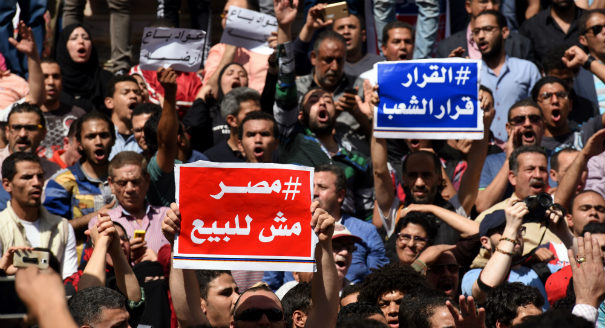
The island transfer to Saudi Arabia was announced during King Salman’s visit to Cairo in April 2016, together with a series of large investments, including a land bridge connecting the two countries. The transfer triggered the first mass protests against Sisi’s presidency and the military regime since Sisi came to power in 2013. Although the government has launched arrest campaigns and instituted harsh punishments against protesters to deter further public mobilization, the issue remains a rallying cry for the opposition and a cause of public discontent. In June 2016, the Court of Administrative Justice (CAJ) issued a “final” ruling nullifying the treaty with Saudi Arabia. Sisi’s government responded to the CAJ ruling by appealing the case in front of the Cairo Court of Urgent Matters, which approved the transfer of the islands in September 2016. However, in January 2017, the Supreme Administrative Court (SAC) issued a decision rejecting the appeal and upholding the CAJ’s nullification of the transfer. The contradictory court rulings allowed the regime to move the case to the Supreme Constitutional Court (SCC) as the final arbitrator. The SCC ruled in favor of the regime on June 21, allowing the transfer and ending the legal battle.
Prior to the ruling, the regime simultaneously pushed the parliament (which is thoroughly controlled by Sisi) to ratify the treaty, hoping to sidestep the mounting legal challenges to the transfer of the islands. In a heated session on June 14, the Egyptian parliament approved the transfer. Speaker of Parliament Ali Abdul Aal even went so far as to declare that the court rulings were not binding to the parliament.
But despite these two victories, there was significant resistance from within the state apparatus, and the issue exposed intra-elite friction. The disagreements reflect the regime’s struggle to control the judiciary fully, specifically the State Council: the system of courts (including the CAJ and the SAC) responsible for adjudicating disputes between administrative bodies and between the general populace and the state. Moreover, when the regime referred the SAC’s ruling to the Supreme Constitutional Court to halt its implementation, the court’s commissioners issued a preliminary report ahead of the final ruling recommending it uphold the SAC’s January verdict, showing resistance at the Supreme Constitutional Court even though it ultimately ruled in favor of the regime.
While Sisi’s regime struggled to bring the State Council fully under control, parliament issued a new law on April 26 (swiftly approved by the Sisi) that changed the selection process for heads of judicial bodies. Before, the process had been based on seniority, and the president simply ratified the appointments, whereas now each judicial body proposes three names, allowing the president to make the selection from among them. This was widely seen as a move to punish Yehia Dakroury, the judge responsible for the CAJ court order in June 2016, who was due to take over as the head of the State Council. In defiance of this new law, on May 13 the State Council nominated Dakroury as its sole candidate for council chief, rather than the three candidates as stipulated. Sisi did not confirm Dakroury’s nomination, and is instead expected to appoint Ahmed Abul Azm, a strong supporter of Sisi on the State Council. Even so, the council’s move shows that even though the judiciary is closely allied with the regime, it still has a measure of independence that it is willing to assert in certain circumstances.
The legal process also exposed disagreements within the military establishment over the issue. Ahmed Shafik, a retired air force general who ran against Mohamed Morsi for president in 2012 and briefly served as prime minister in 2011, reappeared in public to openly criticize the transfer of the islands on Dream TV Egypt’s talk show “10 PM.” Other prominent establishment figures have been critical on social media, including Sami Anan and Magdy Hatata (former Chiefs of the General Staff of the Armed Forces, serving from 2005 to 2012 and from 1995 to 2001, respectively), both of whom hold possible presidential ambitions. Sami Anan went so far as to hint that it was treasonous to even say the islands were not Egyptian.
The friction among the establishment elites has also extended to parliament—despite its loyalty to the security apparatus and to Sisi himself. The 25-30 Coalition, an alliance of independent MPs that has been largely supportive of the regime, voiced considerable opposition to the treaty during the heated debate on June 14, undermining parliament’s hallmark show of unity with the regime. Even though the treaty was approved by majority, 119 members signed an open letter to Sisi asking him to delay the ratification of the treaty until the Supreme Constitutional Court issued its verdict. Wafd Party MP Mohamed Fouad resigned over the vote, and other MPs—including many among the 25-30 Coalition—have also threatened to resign. Even if they do not follow through on this threat, they have already shown unprecedented willingness to criticize the regime.
The intra-elite friction revealed by the legal battle over the two islands—particularly if popular anger over the ruling is sustained—could weaken Sisi, potentially opening the path for challengers to emerge. Mass mobilization remains a distinct possibility due to the sensitivity of the issue and the clear violation it represents of the regime’s own nationalist narrative.
Maged Mandour is a political analyst and writes the “Chronicles of the Arab Revolt” column for Open Democracy. Follow him on Twitter @MagedMandour.