Obama Shouldn't Put Too Much Hope in a Kremlin-Led Thaw
Pushing the "reset button" on U.S.-Russia relations will be impossible if a dramatic curtailment of Russian state resources produces harder political crackdowns, economic nationalism, and isolationism.
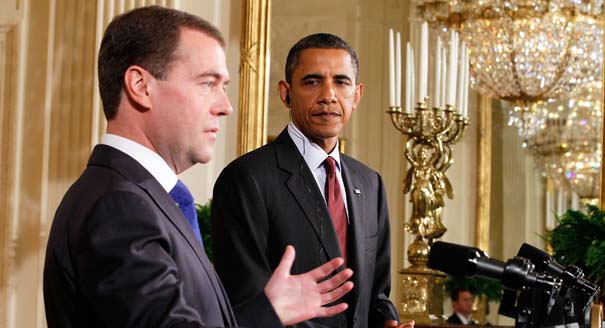
Obama Shouldn't Put Too Much Hope in a Kremlin-LedThe emergence of a Kremlin leader, President Dmitri Medvedev, without a KGB background, combined with the economic crisis, has inspired talk that when Barack Obama visits Moscow, America's president will be seeing a country on the verge of a new political thaw, a revived perestroika. However, pushing the "reset button" on US-Russia relations may be harder than Obama and his team imagined.
Russian (or Soviet) leaders opt for perestroika or a thaw only when forced to do so by dire conditions that threaten the regime's survival. An atmosphere of mortal fear, mutual suspicion, and hatred among the communist elite was the catalyst for Nikita Khrushchev's post-Stalin thaw. For Mikhail Gorbachev in the 1980s, the catalyst for his perestroika was the USSR's growing economic paralysis.
For both men, the goal of clinging to power was a top priority. Changing the system and easing their grip on power was a risky move that could undermine their authority. But the risks of inertia seemed to be even higher. In the end, having opted for change, both were forced to leave their posts prematurely, against their will.
As he revived centralized Kremlin control over Russian politics and public affairs, Vladimir Putin has been concerned primarily with minimizing challenges to state power, which he concentrated in his own hands. To this end, he stripped the political system of competition, emasculated state institutions, marginalized the opposition, and basically eliminated public participation. His power-building project was facilitated by high oil prices, but came at the cost of a steady deterioration in the quality of governance and abandonment of the goal of modernization.
With policymaking fully nontransparent and reduced to a very closed circle, and implementation delegated to an unaccountable bureaucracy, the inevitable result of Putin's political model was pervasive corruption. The desire to avoid public discontent and ensure social stability led to a suspension of reform.
Instead of creating incentives that would unleash public energies, the government pushed citizens further and further away from politics and policymaking, thereby deepening social apathy and atomization. Moreover, the opportunity provided by the oil boom was wasted. Indeed, today Russia risks lagging even further behind the developed countries. Its economy remains undiversified and uncompetitive, and its contribution to global technological progress is minuscule.
Worse still, economic growth based on exports of natural resources has proved unsustainable. When oil prices were high and growing, the government could compensate for poor performance by throwing money at problems. Today, with oil prices dramatically reduced, this largesse is no longer available, and economic experts agree that the growth potential of Russia's petro-economy has been exhausted.
Despite all this, the situation is not sufficiently dire to push Russia's leaders to open at least some channels of genuine public participation and yield any of their power. The price of oil, at around $70 a barrel, may be half of what it was a year ago, but up from around $40 earlier this year. Nor does the Russian economy's contraction and the expected deepening of poverty (the World Bank's report released in late June was grimmer about Russia than its previous report) presage an immediate catastrophe. And, unlike the situation during the late 1980s and 1990s, Russia is not indebted to foreign banks or international organizations, though it plans to resume foreign borrowing next year.
So the government will prefer to muddle through the crisis, rather than risk any decisive reform. The goal of clinging to power remains the priority, and risk-aversion the main guideline.
The ruling elite is known to be torn by disputes and rivalries. Just recently, two of Putin's deputies gave interviews to two Western media outlets offering what sounded like starkly opposite visions for Russia's development. But such disputes never spill over into the broad public sphere; members of the elite are primarily concerned about social and political stability and would not stir the public by seeking support for an alternative policy course.
These delaying tactics are enabled by a lack of pressure from below. Russians may be concerned by growing unemployment and reduced incomes, but this is not manifesting itself in any drive to organize or try to effect political change. The public below, just like the leaders above, cherish political stability; the popularity ratings of both Prime Minister Putin and President Dmitri Medvedev remain above 70 percent.
Disgruntlement over the increasingly authoritarian governance may be common among business circles, elements of the neutered political opposition, liberal intellectuals, and even part of the bureaucracy. But these forces are too timid and fragmented, with no drive for political action.
The current government's tactic of muddling through without changing the political system or the structure of the economy is fraught with the risk of gradual decline. To the Kremlin's rulers, this may seem an acceptable cost for retaining power, but postponing reform will only aggravate Russia's countless problems. Besides, muddling through may prove unaffordable even in the short run, if oil prices decline again.
A dramatic curtailment of state resources may eventually push the government toward modernization, but it might also produce an uglier shift-toward harder political crackdown, economic nationalism and an essentially isolationist course. This would be catastrophic for Russia, to say nothing of how it would affect relations with the US.
Former Scholar in Residence, Society and Regions Program, Editor in Chief, Pro et Contra, Moscow Center
Lipman was the editor in chief of the Pro et Contra journal, published by the Carnegie Moscow Center. She was also the expert of the Carnegie Moscow Center’s Society and Regions Program.
Carnegie does not take institutional positions on public policy issues; the views represented herein are those of the author(s) and do not necessarily reflect the views of Carnegie, its staff, or its trustees.
Funding Ukraine remains a priority for European leaders. As Russia’s war of aggression heads into another winter, two feasible options to mobilize support for Kyiv should be fast-tracked.
A notable degree of participative democracy has firmly arrived in Europe. But to have more far-reaching impact, democratic deliberation needs to move into a radically new phase.
Much has been said of the changes Brussels is trying to make to the EU enlargement process. Here’s why gradual integration might—or might not—be the answer.