

Commentary
Dmitri Trenin
{
  "authors": [
    "Dmitri Trenin"
  ],
  "type": "legacyinthemedia",
  "centerAffiliationAll": "dc",
  "centers": [
    "Carnegie Endowment for International Peace",
    "Carnegie Europe",
    "Carnegie Russia Eurasia Center"
  ],
  "collections": [],
  "englishNewsletterAll": "ctw",
  "nonEnglishNewsletterAll": "",
  "primaryCenter": "Carnegie Russia Eurasia Center",
  "programAffiliation": "NPP",
  "programs": [
    "Nuclear Policy"
  ],
  "projects": [],
  "regions": [
    "North America",
    "South Asia",
    "Central Asia",
    "Caucasus",
    "Eastern Europe",
    "Western Europe",
    "Asia",
    "Russia",
    "Europe"
  ],
  "topics": [
    "Political Reform",
    "Climate Change",
    "Security",
    "Military",
    "Foreign Policy",
    "Nuclear Policy",
    "Nuclear Energy"
  ]
}
Source: Getty
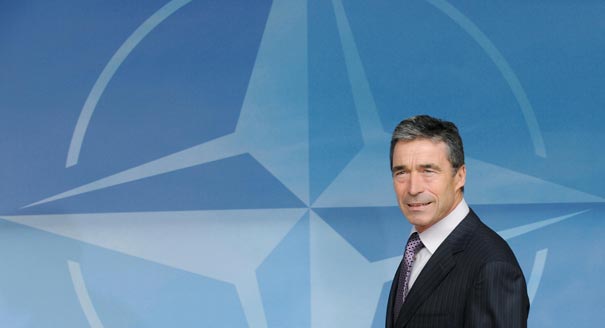
When Anders Fogh Rasmussen, NATO's secretary-general, addresses an audience at Carnegie Europe on Friday, 18th September, he will speak about the possibility of a new dialogue between two former foes – NATO and Russia. Dmitri Trenin suggests that these discussions could initially take place through the NATO-Russia Council of 2002, but in time, that they might spawn a new framework altogether.
Source: The European Voice

And a new beginning is needed. The Berlin Wall may have fallen two decades ago and NATO may be fighting in Afghanistan; but east of Berlin – in Moscow and Minsk, Tallinn and Tbilisi – NATO continues to be perceived as an alliance focused on Russia. While the organisation has evolved, alongside the EU, into a principal pillar of European security, it has never managed to incorporate former Soviet lands, or Russia itself, into a European security framework. This has consequences for Russia's neighbours. The war in the Caucasus last year, which produced considerable tensions in the Crimea, illustrates the potential severity of the problem.
So how can the US and its allies engage Russia and create a new European security community, including both NATO members and non-members? Russian President Dmitry Medvedev's proposal to this end is useful if only as a de facto invitation to ongoing dialogue. NATO must seize this opportunity and respond with ideas of its own.
There are no simple ways to integrate Russia into a pan-European security framework. Russian membership in NATO, sought in the 1990s and explored again in the early 2000s, is not realistic in the foreseeable future, if ever. In any case, Russia's membership of NATO would needlessly exacerbate its relations with China, to say nothing of the West's.
In the 12 years since the NATO-Russia Founding Act, the relationship between the alliance and its largest neighbour has never lived up to expectations. In the seven years since its establishment, the NATO-Russia Council (NRC) has devel-oped not into the instrument of Western-Russian security interaction but into a technical workshop. The most contenti-ous issues in European security, such as Kosovo, the Caucasus, ‘frozen conflicts' more broadly, Iran and ballistic missile defence systems, have not been discussed and dealt with in the context of the NRC.
Those and others of today's troubles are not those of the Cold War. In eastern Europe, for instance, the real problem with Ukraine's NATO membership bid is not Russia's opposition – nor, of course, NATO's supposed threat to Russian security. The issue is Ukraine itself.
If that nation of 46 million overwhelmingly supported NATO, no force in the world would be able to prevent it from acceding to the alliance, provided it met the relevant criteria. But since Ukrainians, too, see NATO largely as an alliance that exists primarily in relation to Russia, they face a dilemma they cannot resolve. Perhaps one-quarter to one-third of Ukrainians see NATO as a necessary hedge against Russia, but over half view Russia as part of the country's extended family. To force a choice of loyalties on a nation so divided is to court disaster. It would reignite Crimean separatism and make Russian interference in Ukrainian affairs virtually inevitable. Since most Ukrainians do not want to be part of Russia, but also do not want to part from it, the best way forward is progressive integration with and into Europe. The EU's Eastern Partnership Programme is a useful, albeit small, step in that direction.
By contrast, most Georgians want to join NATO, but the alliance is unlikely to admit a state whose internationally recognised borders would put it in danger of a direct conflict with Russia, which no longer recognises them. South Ossetia has probably been lost to Georgia forever as a result of Georgia's reckless attack, and Abkhazia had seceded a decade-and-a-half earlier.
Spheres of influence aside, peoples in eastern Europe who never before enjoyed political self-determination now have an unprecedented degree of autonomy. Since neither NATO nor Russia can dictate terms in every instance, otherwise manageable problems will become unmanageable unless there is more dialogue between them.
Management requires NATO to direct more of its energies towards preventing conflict, by fostering military disengagement in conflict zones, confidence-building measures and the protection of minorities and human rights. To that end, it needs a constant conversation with Russia. Those dialogues could initially take place through the NRC, which was established to make them possible, but in time, they might spawn a new framework altogether.
Former Director, Carnegie Moscow Center
Trenin was director of the Carnegie Moscow Center from 2008 to early 2022.
Recent Work
Dmitri Trenin
Dmitri Trenin
Carnegie does not take institutional positions on public policy issues; the views represented herein are those of the author(s) and do not necessarily reflect the views of Carnegie, its staff, or its trustees.

Before the next wave of EU enlargement takes place, the union needs to grapple with thorny questions of how power is distributed among its members.


Emil Sondaj Hansen, Ditte Brasso Sørensen

The new U.S.–Denmark–Greenland agreement will help Washington exert political, economic, and financial dominance under the guise of security. Yet, it acknowledged Copenhagen’s and Nuuk’s sovereignty on the island.

Marc Pierini

A summer of escalation in the Black Sea has hurt Ukraine economically and is exacerbating world food security. A truce is needed—as is a broader reframing of Europe’s Ukraine strategy.

Thomas de Waal

Are Germany’s economic, industrial, and political struggles becoming a liability for the EU’s ability to rise to the geopolitical moment?

Rym Momtaz, ed.

European Commission President Ursula von der Leyen is about to give her annual address on the state of the EU. Here’s what she won’t—but should—say.
Rym Momtaz