

Commentary
The EU can impose sanctions but struggles to enforce them without the United States. With Washington increasingly disinterested in backing European interests, the bloc must now fend for itself.
Nicu Popescu, Tiago Antunes
{
  "authors": [
    "Uri Dadush",
    "Moisés Naím"
  ],
  "type": "legacyinthemedia",
  "centerAffiliationAll": "",
  "centers": [
    "Carnegie Endowment for International Peace",
    "Carnegie Europe"
  ],
  "collections": [
    "Brexit and UK Politics"
  ],
  "englishNewsletterAll": "",
  "nonEnglishNewsletterAll": "",
  "primaryCenter": "Carnegie Endowment for International Peace",
  "programAffiliation": "",
  "programs": [],
  "projects": [],
  "regions": [
    "Western Europe",
    "United Kingdom",
    "France",
    "Germany",
    "Europe",
    "North America"
  ],
  "topics": [
    "Economy"
  ]
}
Source: Getty
Europe’s massive rescue package has bought time for its most troubled economies, but, unless these countries move forward with necessary—and deeply unpopular—reforms, the newly available money will do little to save them.
Source: Foreign Policy


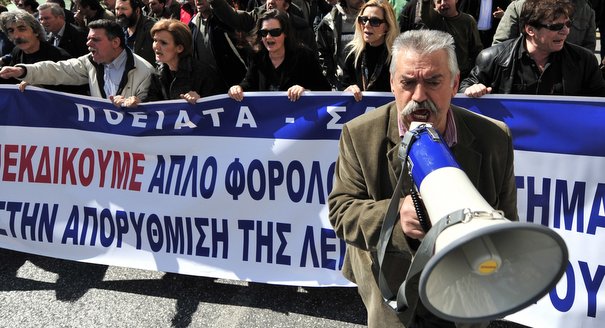
Unfortunately for Brussels, however, whether or not the package works is not a decision that will or can be decided there. The real decisions needed to deal with Europe's crisis will have to be taken in Portugal, Spain, and Italy. It won't be easy; belt-tightening and tough choices are needed. This is something last week's rioters in Athens seemed to understand all too well. Therefore, as the different countries attempt to reform their economies, expect street demonstrations in Lisbon, Madrid, and Rome.
Before raining on the parade, however, we should mention an upside to the Brussels package. The measures taken are important not just because of the unprecedented amount of money involved (the size of the financial package is larger than the economies of Finland and the Netherlands combined) but also because they mark the end of two dangerous ideas—and their promotion by European leaders.
IMGXYZ4927IMGZYXFirst, the bailout requires Europe to admit that the Eurozone setup is defective at its very foundation. The measures mark the end of the misguided hope that centralized monetary policy can co-exist with decentralized fiscal behavior. Since the single currency's inception, interest rates and the money supply for the whole of Europe have been decided by a single entity, the European Central Bank (ECB), while taxes and public expenditures remain under the control of each national government. The recent decisions explicitly recognize that a monetary union is as weak as its weakest link and, as such, requires strong fiscal coordination. Inevitably, this means that countries will have to cede some of the autonomy that they have thus far used to (mis)manage their fiscal affairs. On the other side, the ECB's decision to buy government bonds is also a landmark, eliminating the pretense that the central bank will not help governments in difficulty under any circumstance.
Second, the measures also mark the end of the pretense that the Eurozone can and will take care of its problems without anyone else's help. For this emergency, help was marshaled not only from other EU countries that are not members of the Eurozone but also from the U.S. Federal Reserve and the International Monetary Fund (IMF). The IMF will carry an unprecedented financial burden in support of Europe's rescue, and its help never comes without stringent conditions: The IMF will play a central role in dictating how Europe has to behave in order to access the funds it needs.
Shedding these illusions is good news. But that's where the good news ends. For a start, 750 billion euros represents only about 18 months of the financing requirements for Europe's most obviously vulnerable countries, which, contrary to pretense, also include Italy, whose debt burden and labor cost disadvantage is as high as that of Greece. The solution to their problems—a loss of competitiveness, inflated government payrolls, and rigid labor markets—obviously won't be come with a new borrowing facility. These measures only buy time, and not very much time at that.
Indeed, the time available to bring these countries back from the brink is very limited. This is not about governments bailing out insolvent banks, as was the case with the financial rescues at the end of 2009; this is about unsound governments trying to bail out other unsound governments. Greece, Portugal, Spain, and Italy, for example, are on the hook for more than 6 percent of their GDP in support of the agreed facilities, not counting any money that the European Central Bank might lose on the government bonds it has agreed to buy. That's money that these countries simply do not have. And with the average debt to GDP ratio of advanced G20 countries on pace to hit 120 percent by 2015, the financial ability of Germany, France, and others to backstop Europe's errant countries is also in doubt.
The real problem is that Europeans are not ready for the reforms they need, and politicians have not clearly explained the severity of the situation to their citizens. Europeans must realize that, unless Europe moves forward with the necessary and deeply unpopular reforms still required, the newly available money will do little to save them. Rather than postponing reforms again, leaders must use the time they just bought to build the political coalitions needed to implement the necessary changes.
What will that look like exactly? The medicine for these sick countries is well known. Spain, Portugal, and Italy must cut their budget deficits, freeze or reduce government wages, and reform labor markets in a quest to boost productivity and claw back some of their lost competitiveness vis-à-vis Germany. Meanwhile, Germany and other healthier economies must take more aggressive measures to boost domestic demand in order to keep Europe from spiraling into deflation.
And yes, under this scenario, European leaders must come clean soon on cases in which debts simply cannot be repaid (which is obviously the case in Greece) and insist that— instead of the European and Greek taxpayers carrying the entire burden—the private creditors also take a hit.
The way to gauge the economic measures decided by the European leaders on Sunday is not by watching the gyrations of the stock markets. The real mark of success will be the determination and speed with which Europe's individual economies pursue tough reforms at home. And, tragically, that is why street demonstrations in Lisbon, Madrid, or Rome would be a better indicator of the seriousness with which governments are pursuing the reforms.
Uri Dadush is a senior associate in and the director of Carnegie’s International Economics Program. Moises Naim is the editor-in-chief of Foreign Policy magazine.
Former Senior Associate, International Economics Program
Dadush was a senior associate at the Carnegie Endowment for International Peace. He focuses on trends in the global economy and is currently tracking developments in the eurozone crisis.

Distinguished Fellow
Moisés Naím is a distinguished fellow at the Carnegie Endowment for International Peace, a best-selling author, and an internationally syndicated columnist.
Carnegie does not take institutional positions on public policy issues; the views represented herein are those of the author(s) and do not necessarily reflect the views of Carnegie, its staff, or its trustees.

The EU can impose sanctions but struggles to enforce them without the United States. With Washington increasingly disinterested in backing European interests, the bloc must now fend for itself.


Nicu Popescu, Tiago Antunes

Russia is testing the waters of NATO’s mutual defense clause. What do strikes in Romanian territorial waters mean for the alliance’s posture toward Moscow?

Dimitar Bechev

With its public finances in shambles, the far right polling at 35 percent ahead of the 2027 presidential election, and a growing protest movement, is France’s crisis a threat to the EU’s geopolitical awakening?

Rym Momtaz, ed.

Ahead of a tough winter for Ukraine, Donald Trump’s swing back toward Russia bodes ill. But instead of panicking, Kyiv’s European allies are focusing on action.
Rym Momtaz

Funding Ukraine remains a priority for European leaders. As Russia’s war of aggression heads into another winter, two feasible options to mobilize support for Kyiv should be fast-tracked.


Vladyslav Rashkovan, Gregory P. Wilson