

Commentary
Thomas de Waal
{
  "authors": [
    "Thomas de Waal"
  ],
  "type": "other",
  "centerAffiliationAll": "dc",
  "centers": [
    "Carnegie Endowment for International Peace",
    "Carnegie Europe",
    "Carnegie Russia Eurasia Center"
  ],
  "collections": [
    "Turkey’s Transformation"
  ],
  "englishNewsletterAll": "ctw",
  "nonEnglishNewsletterAll": "",
  "primaryCenter": "Carnegie Europe",
  "programAffiliation": "russia",
  "programs": [
    "Russia and Eurasia",
    "Middle East"
  ],
  "projects": [],
  "regions": [
    "Middle East",
    "Russia",
    "Europe",
    "Türkiye",
    "Eastern Europe",
    "Caucasus",
    "Armenia"
  ],
  "topics": [
    "Political Reform",
    "Security"
  ]
}
Source: Getty
While there is virtually no hope that the 2009 Armenian–Turkish Protocols will be ratified soon, both parties should take steps to rebuild confidence and affirm their faith in the process.
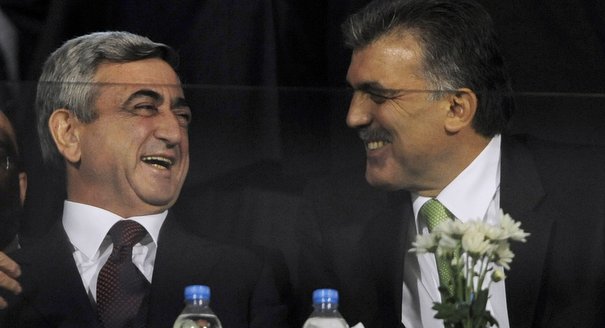
One year ago, Armenia and Turkey began a historic rapprochement and signed two protocols on normalizing their relations. Unfortunately, the process stalled in April. In an updated policy brief, Thomas de Waal argues that the protocols—the most positive initiative in the South Caucasus for many years—must be kept alive as the process still has the potential to transform the region.
“If the process is to get back on track, all involved parties, including the United States, should set their sights on longer-term goals several years hence and ‘make haste slowly’ toward them,” de Waal writes. ”The centenary of the Armenian tragedy in 2015 is a good reference point by which to set the goal of full Armenian-Turkish normalization.”

Senior Fellow, Carnegie Europe
Thomas de Waal is a senior fellow at Carnegie Europe, specializing in Eastern Europe and the Caucasus.
Recent Work
Thomas de Waal
Thomas de Waal
Carnegie does not take institutional positions on public policy issues; the views represented herein are those of the author(s) and do not necessarily reflect the views of Carnegie, its staff, or its trustees.

Before the next wave of EU enlargement takes place, the union needs to grapple with thorny questions of how power is distributed among its members.


Emil Sondaj Hansen, Ditte Brasso Sørensen

The new U.S.–Denmark–Greenland agreement will help Washington exert political, economic, and financial dominance under the guise of security. Yet, it acknowledged Copenhagen’s and Nuuk’s sovereignty on the island.

Marc Pierini

A summer of escalation in the Black Sea has hurt Ukraine economically and is exacerbating world food security. A truce is needed—as is a broader reframing of Europe’s Ukraine strategy.
Thomas de Waal

Are Germany’s economic, industrial, and political struggles becoming a liability for the EU’s ability to rise to the geopolitical moment?

Rym Momtaz, ed.

European Commission President Ursula von der Leyen is about to give her annual address on the state of the EU. Here’s what she won’t—but should—say.
Rym Momtaz