

In The Media
David Rothkopf
{
  "authors": [
    "David Rothkopf"
  ],
  "type": "legacyinthemedia",
  "centerAffiliationAll": "",
  "centers": [
    "Carnegie Endowment for International Peace",
    "Carnegie Europe",
    "Malcolm H. Kerr Carnegie Middle East Center"
  ],
  "collections": [],
  "englishNewsletterAll": "",
  "nonEnglishNewsletterAll": "",
  "primaryCenter": "Carnegie Endowment for International Peace",
  "programAffiliation": "",
  "programs": [],
  "projects": [],
  "regions": [
    "North America",
    "United States",
    "Middle East",
    "Iran",
    "Israel",
    "Gulf"
  ],
  "topics": [
    "Security",
    "Foreign Policy",
    "Nuclear Policy"
  ]
}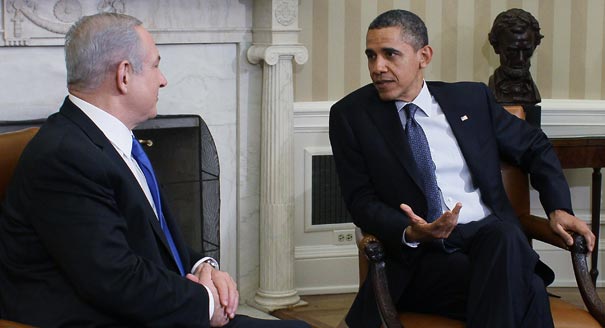
Source: Getty
Israel and the United States have focused on the security threat from Iran's nuclear program, but this threat may be overstated. Indeed, both Israel and the United States may have bigger security concerns closer to home.
Source: Foreign Policy

By focusing on Iran, indeed by having some among Israel's top leaders seemingly obsessed about it, Israel is ignoring (or seeking an excuse to ignore) the real existential threats on and within its own borders -- demographic, social, and economic. By allowing Iran to occupy too much bandwidth, American leaders have also taken their eye off the ball. There are far greater national security threats and opportunities that require attention right now, from fixing the broken U.S. economic model to exploring the potential for a sound energy policy in order to both strengthen that economy and dramatically reduce the leverage and thereby the relevance of regimes like the one in Tehran.
This is not to suggest that Iran's nuclear program is not a cause for concern. Every available means short of an all-out war should be used to stop Iran from getting the bomb. But even with regard to Tehran's dangerous and expanding weapons efforts, the approach to addressing the problem shows a misplaced focus.Israel speaks of the threat of a nuclear Iran as though it were something new and destabilizing. It is not. At the same time, the greatest threat it does pose is not being effectively addressed, while lesser ones are.
Iran is hardly the first of Israel's enemies to seek or even possess nuclear weapons capabilities. For the entire Cold War, Israel, as a vital U.S. ally in the Middle East, was vulnerable to nuclear attack from the Soviet bloc. Iraq and Syria, of course, sought nuclear weapons capabilities, and some of the countries that supported them in that endeavor remain a threat. One country that has represented such a proliferation threat in the broader region and is at least as great a state sponsor of terrorism as Iran is Pakistan -- a country with many more weapons than Iran could have for decades and one that is far less stable.
Senior Israelis have also correctly pointed out, as did Amos Yadlin, a former Israeli military intelligence chief in March 1's New York Times, that one cannot stop a country with sufficient economic and industrial resources from getting a bomb within a matter of a few years from making the decision to have one. Even a successful raid on Iran is likely to only delay that country's acquisition of nuclear weapons. At the same time, any failed raid is likely to only strengthen the Iranian regime, inflame the region, and, potentially, reveal in ways damaging to both the United States and Israel the limits of Israeli power.
The greatest threat associated with the Iranian nuclear program is that it might trigger a regional arms race that would be deeply destabilizing and would dramatically increase the risk of a weapon falling into the wrong hands, the use of such weapons, and an acceleration of weapons acquisition in middleweight powers worldwide. (Indeed, one mistake the Israelis have made in seeking to mobilize action against Iran has been not to emphasize this larger threat more.)
If a nuclear arms race is the greatest threat, then doesn't logic dictate that this should be the top priority for policymakers seeking to contain the problem? U.S. Secretary of State Hillary Clinton long ago called for a security umbrella in the region. Putting teeth into this proposal could amount to getting countries threatened by a nuclear power in their midst to agree to respond collectively, backed up by the United States, to any such threat. Not only would this create meaningful deterrence, but it might also help extract promises from participating states not to go nuclear. Indeed, were they to do so, they would be expelled and become not a beneficiary but a target of the program.
Such an approach, particularly should it involve the participation of more than one or several of the world's leading nuclear powers, would address both proliferation and containment simultaneously. Given the clear ineffectiveness of the toothless current global nonproliferation regime and the inability to revise and refine it effectively, such an agreement -- smaller and with members with a pressing need to join in -- would be welcome. Indeed, were it successful, perhaps it might also create the opportunity to initiate a phased-in process of eliminating such weapons as did exist -- in the region and worldwide.
A world without nukes might seem far-fetched, but it is both the expressed policy objective of the president of the United States and the only way to ultimately solve the proliferation problem. As Obama suggested with his famous Prague speech, the only safe number of nuclear weapons states is zero.
If containing the proliferation threat is the dimension of the Iran nuclear standoff that deserves the most attention, both Israel and the United States ought to recognize the risks associated with ignoring the bigger threats that loom for each of them.
Israel's demographic clock is ticking, and its future as a Jewish state is threatened by the growing size of the Palestinian population on and within its borders. It also must recognize that the shifting political sands of the region surrounding it have fundamentally altered its security situation. Not only is Egypt likely to be a less dependable stabilizer, but the outcome of turmoil in Syria, Iraq, and elsewhere may produce volatility that creates new risks. Further, the United States is losing interest in the region and has both the reasons and the resources to become less so in the future. Meanwhile, the countries whose presence in the Middle East is growing as they become greater and greater consumers of the region's oil -- China and India -- simply do not have the same historical, cultural, or other strategic ties to Israel. Consequently, for Israel, the urgent business at hand is neither Iran nor even haggling over the specifics of its borders with a potential Palestinian state -- it is the recognition that the state already exists and that Israel's future depends heavily on both Palestine's economic viability and the degree to which it evolves as a productive economic partner of Israel's.
As for Americans, we will not be secure if we fail to address our fiscal vulnerability, the weakness of our job-creation machinery, the withering of the American dream of social mobility, and the American ideal of fairness and opportunity for all. One opportunity is staring us in the face: Blessed with peaking energy demand and massive, newly viable oil and gas reserves, the United States can grow dramatically less dependent on the turbulent Middle East. (We just need a little perspective. We debate, for example, having a higher gas tax to pay for infrastructure and energy exploration, but the past decade's misguided Middle East policies will have cost us trillions when they are done. That's some big gas tax.)
So, while Iran is a danger, it is not the greatest danger. And while it deserves our serious attention, these other threats -- from proliferation to the peace process, debt and competitiveness to energy -- demand even more focus and creativity. By resetting our priorities, both Israel and the United States, together with our allies around the world, can more effectively preserve our security, contain any potential Iranian threat, and at the same time advance not only our broader national interests but those of the region and the world.
Former Visiting Scholar
David Rothkopf was a visiting scholar at the Carnegie Endowment as well as the former CEO and editor in chief of the FP Group.
Recent Work
David Rothkopf
David Rothkopf
Carnegie does not take institutional positions on public policy issues; the views represented herein are those of the author(s) and do not necessarily reflect the views of Carnegie, its staff, or its trustees.

Russia is testing the waters of NATO’s mutual defense clause. What do strikes in Romanian territorial waters mean for the alliance’s posture toward Moscow?

Dimitar Bechev

With its public finances in shambles, the far right polling at 35 percent ahead of the 2027 presidential election, and a growing protest movement, is France’s crisis a threat to the EU’s geopolitical awakening?

Rym Momtaz, ed.

Ahead of a tough winter for Ukraine, Donald Trump’s swing back toward Russia bodes ill. But instead of panicking, Kyiv’s European allies are focusing on action.
Rym Momtaz

Funding Ukraine remains a priority for European leaders. As Russia’s war of aggression heads into another winter, two feasible options to mobilize support for Kyiv should be fast-tracked.


Vladyslav Rashkovan, Gregory P. Wilson

While the EU and European governments are embracing the much-lauded middle-power moment, this entails three difficult conundrums.

Richard Youngs