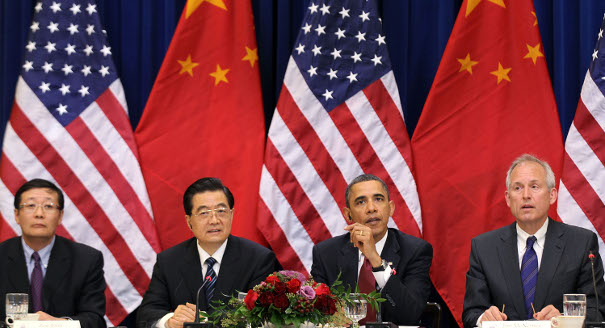
The Pew Research Center released today the initial report of the U.S.-China Security Perceptions Project, presenting the findings of a survey of U.S. foreign affairs experts and the American public conducted by the Pew Global Attitudes Project.
The U.S.-China Security Perceptions Project is a unique collaborative undertaking between leading research institutions in Washington and Beijing launched in 2011. The Carnegie Endowment for International Peace has coordinated this project and provided funding for the U.S. and Chinese public and elite surveys, with additional funding from the China-United States Exchange Foundation and the Ford Foundation. Carnegie's Senior Associate Michael D. Swaine and Research Analyst Rachel Esplin Odell have been the leads in organizing the project.
Carnegie’s partners in this endeavor include, on the U.S. side, the Pew Research Center and the Kissinger Institute on China and the United States at the Woodrow Wilson International Center for Scholars, and on the Chinese side, the China Strategic Culture Promotion Association (CSCPA), a national non-profit civil society group that does security-related analysis, and the Research Center for Contemporary China (RCCC) at Peking University.
This project emerged from an awareness of the growing influence, in both the United States and especially China, of both public and elite attitudes on what many analysts recognize as the increasingly turbulent bilateral security relationship. Its objective is to obtain non-partisan policy-relevant data and insights on the evolving content and influence of such attitudes, as policymakers seek to reduce the likelihood of serious future bilateral crises or conflicts. The project intends to discover and analyze the views of the public and elites in five distinct categories – government, business, academia, the military, and the media – regarding a wide range of national security issues, from the nature of American and Chinese power, both globally and in Asia, to the images held of one another’s national character.
On the U.S. side, the Pew Research Center has conducted, in consultation with the Carnegie Endowment and the Kissinger Institute, the elite and public surveys, while the RCCC and CSCPA have together performed similar tasks in China. This initial project report by the Pew Research Center conveys the findings of the U.S. surveys, including the views of the American public and U.S. foreign affairs experts. Future reports by the project will include findings from parallel surveys in China.
In addition, as part of the broader project, workshops are planned in both Washington and Beijing that will bring together leading experts on U.S.-China relations, as well as representatives of the expert groups polled by the project, to discuss in detail the survey findings and their implications for policy in the United States and China. Following the workshops, the Carnegie Endowment, the Kissinger Institute, and CSCPA will issue a final report on the project. In the longer term, the aim is to make the surveys and workshops a regular event, charting changes over time in how Americans and Chinese see one another in the national security realm.
This project promises to bring a unique perspective to an important topic in international affairs and provide insights on the reasoning behind each country’s security policies and behavior. These findings will thereby help to inform policymakers, the media, and the global public about important issues in U.S.-China relations moving forward.
The full text of the report published by the Pew Research Center is available here.