

Commentary
Judy Dempsey
{
  "authors": [
    "Judy Dempsey"
  ],
  "type": "legacyinthemedia",
  "centerAffiliationAll": "",
  "centers": [
    "Carnegie Endowment for International Peace",
    "Carnegie Europe"
  ],
  "collections": [
    "Transatlantic Cooperation"
  ],
  "englishNewsletterAll": "",
  "nonEnglishNewsletterAll": "",
  "primaryCenter": "Carnegie Europe",
  "programAffiliation": "",
  "programs": [],
  "projects": [],
  "regions": [
    "Europe",
    "North America",
    "United States",
    "Eastern Europe",
    "Western Europe"
  ],
  "topics": [
    "Security",
    "Foreign Policy"
  ]
}
Source: Getty
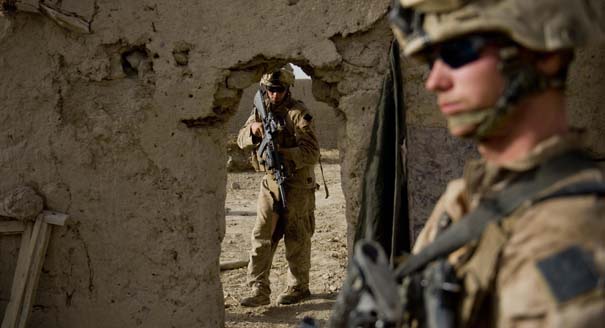
Given Washington’s “pivot” toward Asia, you would think Europe would be doing more to provide for its own military defense. You would be wrong.
Source: New York Times

They will almost certainly show a decline for most countries. The global financial crisis, followed by the euro crisis, has put immense pressure on finance ministries to cut budgets, including, in most places, defense budgets.
It is interesting to note that Greece, of all European countries, has maintained a fairly high level of spending. Given the shape of the Greek economy, that creates problems of its own which I discuss in my latest Letter from Europe.Mr. Rasmussen has repeatedly asked Alliance members to invest in defense to deal with new threats, such as cyber and energy security. He also fears that the technological gap between Europe and the United States will widen so much that ‘interoperability,’ the ability to operate together on missions, will be endangered.
The United States spends 31 percent of its defense budget on investment. The Europeans spend 22 percent, according to Claude-France Arnould, the chief executive of the E.U.’s European Defence Agency, which was established over a decade ago to promote defense cooperation.
There are few signs that Europeans are willing to invest more. Indeed, defense spending among E.U. member states was at a record low, Ms. Arnould said during a security conference in Berlin last November.
Both NATO and the E.U. believe there is one way to try bridge this gap: through smart defense or “pooling and sharing.”
In practice, it would mean NATO and E.U. members, the majority of whom belong to each other’s organization, cooperating much more on defense, instead of — for example — duplicating expensive equipment.
Ms. Arnould has warned E.U. countries not to use pooling and sharing as an excuse to invest even less. “Pooling and sharing offers a way to acquire together what is out of reach individually and get more efficiency in the deployment of these capabilities,” she said. “We see that Europe risks losing significant industrial capability between now and 2020.”
Yet, for all the cajoling by NATO, the E.U. and Pentagon officials, little has changed.
European governments still believe that defense policy and defense spending are intrinsic elements of national sovereignty.
And while governments will agree to participate in small collaborative projects, such as the European Defense Agency’s helicopter training program, they shy away from anything big enough to really improve Europe’s military technology sector or its security.
What a foolhardy attitude to have, say analysts, considering that the Obama administration’s security agenda is focusing increasingly on Asia. Surely, analysts add, this should be the time for Europe to take on more responsibility for its own security.

Nonresident Senior Fellow, Carnegie Europe
Judy Dempsey is a nonresident senior fellow at Carnegie Europe
Recent Work
Judy Dempsey
Judy Dempsey
Carnegie does not take institutional positions on public policy issues; the views represented herein are those of the author(s) and do not necessarily reflect the views of Carnegie, its staff, or its trustees.

The EU can impose sanctions but struggles to enforce them without the United States. With Washington increasingly disinterested in backing European interests, the bloc must now fend for itself.


Nicu Popescu, Tiago Antunes

Russia is testing the waters of NATO’s mutual defense clause. What do strikes in Romanian territorial waters mean for the alliance’s posture toward Moscow?

Dimitar Bechev

With its public finances in shambles, the far right polling at 35 percent ahead of the 2027 presidential election, and a growing protest movement, is France’s crisis a threat to the EU’s geopolitical awakening?

Rym Momtaz, ed.

Ahead of a tough winter for Ukraine, Donald Trump’s swing back toward Russia bodes ill. But instead of panicking, Kyiv’s European allies are focusing on action.
Rym Momtaz

Funding Ukraine remains a priority for European leaders. As Russia’s war of aggression heads into another winter, two feasible options to mobilize support for Kyiv should be fast-tracked.


Vladyslav Rashkovan, Gregory P. Wilson