

Article
C. Raja Mohan, Darshana M. Baruah
{
  "authors": [
    "C. Raja Mohan"
  ],
  "type": "legacyinthemedia",
  "centerAffiliationAll": "dc",
  "centers": [
    "Carnegie Endowment for International Peace",
    "Carnegie China",
    "Carnegie India"
  ],
  "collections": [
    "China’s Foreign Relations",
    "China and the Developing World"
  ],
  "englishNewsletterAll": "ctw",
  "nonEnglishNewsletterAll": "",
  "primaryCenter": "Carnegie India",
  "programAffiliation": "SAP",
  "programs": [
    "South Asia"
  ],
  "projects": [],
  "regions": [
    "South Asia",
    "East Asia",
    "Southeast Asia"
  ],
  "topics": [
    "Security",
    "Foreign Policy"
  ]
}
Source: Getty
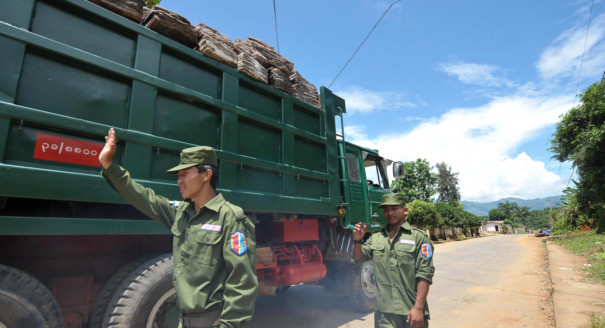
China’s relationship with Myanmar is developing alongside the latter’s domestic political evolution.
Source: Indian Express
As calm returns to eastern Ladakh after three weeks of military standoff between Delhi and Beijing, a complex dynamic is unfolding on China's frontiers with Myanmar. Unlike the disputed India-China border that has no agreed delineation of the line of actual control, Beijing and Yangon have a settled boundary.
The problems are of a different nature on the 2200 km long Sino-Myanmarese border — of restive ethnic minorities that spread across the boundaries, cross-border crime, and a history of Chinese intervention across the border in Myanmar. In the past, this included Chinese fraternal support to the Communist Party of Burma that sought a violent overthrow of the national government. Beijing also sought chase across the border the remnants of the Guomindang that took shelter in Myanmar after the civil war in China.
Over the last quarter of a century, China reached out to the Myanmar military, also called the Tatmadaw, extended military assistance to it, and deepened economic cooperation with Myanmar, which was seen as a valuable source of raw materials and a bridge to the Indian Ocean. As Myanmar ended its political isolation a couple of years ago, China's privileged position in the country appeared to be under threat. China's renewed support to ethnic militias in northern Myanmar appears to have risen in tandem.In focus are reports that Beijing has begun supply of weapons to the United Wa State Army in northern Myanmar. The USWA was formed out of the detritus of the Communist Party of Burma (CPB) in the late 1980s. At the end of last month, Jane's Intelligence Review reported that China has sent Mi-17 helicopters armed with TY-90 air-to-air missiles. The helicopters apparently reached Myanmar from Laos rather than from across the Chinese border.
Denying the reports, the Chinese embassy in Yangon said, "As a good neighbor and true friend of Myanmar, China would never seek to establish any kind of illegal relations with any parties or organisations in Myanmar". Despite the denials, Chinese support to the Wa is being interpreted as a warning to Yangon not to trample upon its vital interests in Myanmar.
Reports last year suggested that Beijing had supplied surface-to-air missiles and armored vehicles also known as "tank-killers" to the Wa. Equipped with these new capabilities, the Wa army will be in a better position to stand up against a reported offensive being planned by the Tatmadaw.
On another front, China has actively sought to mediate between Yangon and the Kachin Independence Organization, which have been at odds since the breakdown of the ceasefire a couple of years ago. China hosted two rounds of talks this year on its territory in Yunnan, provided security to participants from both sides, and actively shaped the agenda and the negotiations. Beijing's intervention in the peace process has unsurprisingly irked Yangon.
But a third round of talks was postponed last month amidst reports that China leaned on the Kachins not to attend the meeting, which was to take place in Myanmar. China was apparently concerned about potential involvement of the United Nations and the Western powers in the peace process.
While pointing to the negative leverages it has in Myanmar, Beijing is also trying to improve its image in the country, where it is increasingly perceived as a ruthless exploiter. Beijing is asking its corporations to reach out to communities around the project areas and undertake visible social welfare activities. Beijing is inviting leaders of the ethnic minorities as well as mainstream parties to visit neighboring Yunnan and Beijing.
A delegation of leaders form National League of Democracy is visiting China this week. The delegation does not include its leader Aung San Suu Kyi, who has expressed her interest to visit China at some point. But China's effort to sustain its primacy in Myanmar is being tested by other powers. After a prolonged absence from Myanmar, Japan is intensifying the strategic engagement with Myanmar under the activist reign of Prime Minister Shinzo Abe.
Last month, Abe received Suu Kyi in Tokyo and plans to arrive on a state visit in Myanmar later this month. Meanwhile, President Thein Sein is preparing to visit Washington. It will be first such visit in nearly five decades.
Former Nonresident Senior Fellow, Carnegie India
A leading analyst of India’s foreign policy, Mohan is also an expert on South Asian security, great-power relations in Asia, and arms control.
Recent Work

C. Raja Mohan, Darshana M. Baruah


Alexander Gabuev, Paul Haenle, C. Raja Mohan, …
Carnegie does not take institutional positions on public policy issues; the views represented herein are those of the author(s) and do not necessarily reflect the views of Carnegie, its staff, or its trustees.

While the EU and European governments are embracing the much-lauded middle-power moment, this entails three difficult conundrums.

Richard Youngs

Europe is facing rising populism internally as well as external pressures from Russia, China, Turkey, and the United States.

Dimitar Bechev

Much has been said of the changes Brussels is trying to make to the EU enlargement process. Here’s why gradual integration might—or might not—be the answer.
Dimitar Bechev

The European Commissioner for Trade is headed to China. But after President Xi’s bridge-building visit to Washington, can a more isolated EU overcome Beijing’s stranglehold on critical raw materials? Who will blink first?

Rym Momtaz, ed.

European NATO countries are wrestling with the possibility of U.S. disengagement from the alliance. With the continent’s security increasingly uncertain, governments must restore the credibility of their collective defense.



Hans-Dieter Lucas, Adam Thomson, Pierre Vimont