

Commentary
Judy Dempsey
{
  "authors": [
    "Judy Dempsey"
  ],
  "type": "legacyinthemedia",
  "centerAffiliationAll": "",
  "centers": [
    "Carnegie Endowment for International Peace",
    "Carnegie Europe"
  ],
  "collections": [],
  "englishNewsletterAll": "",
  "nonEnglishNewsletterAll": "",
  "primaryCenter": "Carnegie Europe",
  "programAffiliation": "",
  "programs": [],
  "projects": [],
  "regions": [
    "Europe",
    "Western Europe",
    "Germany"
  ],
  "topics": [
    "EU",
    "Economy",
    "Migration"
  ]
}
Source: Getty
Propelled by high unemployment, thousands of educated graduates are leaving Southern Europe for Germany. But it won't be enough to solve the country's long-term labor shortage.
Source: New York Times
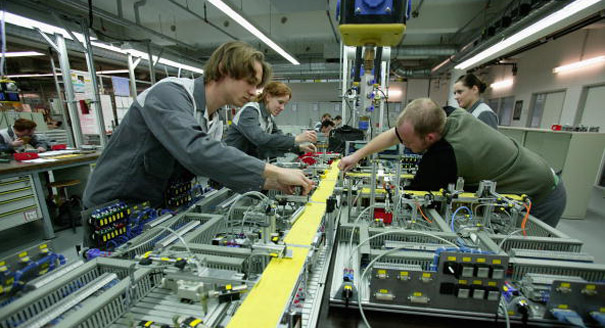
The Association of German Engineers, or V.D.I., is desperate. It needs 70,000 engineers, and quickly.
Its members, consisting of large and small companies, are scouting the universities and schools for mechanical, electronic and machine-building engineering graduates or trainees to sustain Europe’s biggest and most successful export-driven economy.
As it is, it takes an average of 114 days to fill an engineering post, according to the V.D.I.
Some help is at hand, thanks to the economic crisis in Spain, Portugal and Greece, where youth unemployment has soared to an average of 50 percent.As a result, thousands of young, educated graduates from these countries are migrating to Germany, helping to make up the shortfall of engineers and other professionals.
“It is estimated that about 50,000 Spaniards have come to Germany over the past two years,” said Ángel de Goya Castroverde, head of the Spanish Embassy’s labor and social affairs section in Berlin.
The advantages for the German economy are immense. Apart from industry, staff shortages are also acute in hospitals and homes for the elderly, the services and the retailing sector. They all are now employing young Spaniards and other Southern Europeans.
The new immigrants, eager to find work, are integrating quickly. They have either learned German back home or are taking intensive language courses in Germany.
“You can’t imagine how the number of young Spaniards wanting to learn German has soared over the past two years,” said Manfred Ewel, deputy director and language teacher at the Goethe Institute in Madrid. Last year, more than 10,000 students enrolled in Madrid and Barcelona, a 60 percent increase over 2010.
“It’s all because of Angela Merkel,” Mr. Ewel said, referring to the chancellor’s visit to Spain more than two years ago. “She said Spanish engineers and other professions would be welcomed in Germany. It was a sensation. Suddenly, Germany was on the map as a place to find work. Young Spaniards took her up on the offer.”
While this migration is an enormous boon for the German economy, there is a downside. Some analysts worry how much this brain drain of engineers and doctors, nurses and computer programmers will hurt Spain once its economy recovers.
“There are concerns. But I see it differently,” said Matilde Mas of the Valencian Institute of Economic Research. “The Spanish crisis is having positive spinoffs,” she explained.
Dr. Mas believes that Spain will gain from those who return after a few years — they will have enormous experience under their belts.
The crisis is changing social structures, too.
“I kept telling my students to go out and see the world. Get experience. But the family structures are very conservative, very protective, especially for the girls. If you could not find a job after studying, you stayed at home,” Dr. Mas said. “Now, with this crisis, this is no longer an option,” she added.
Yet analysts in Germany warn that Ms. Merkel’s government is still failing to devise a long-term strategy for tackling the labor shortage. Given Germany’s catastrophic demographic trends, the influx of Southern Europeans will not be sufficient to solve it, either.
According to the Cologne Institute for Economic Research, there is already a shortage of 210,000 MINT graduates (the German acronym for mathematicians, engineers, scientists and I.T. specialists).
The German Federal Statistics Office has estimated that the working-age population of those between 20 and 65, who number about 50 million today, will fall to 33 million by 2060, unless there is sufficient immigration. The influx of Southern Europeans is but a drop in the ocean.
It’s not that Germany did not have any opportunity to tackle the labor shortage and demographic crisis.
During the 1990s, when millions of Russians and ethnic Germans from Russia moved to Germany, the government refused to recognize their Russian university degrees, wasting the talents and training of tens of thousands of scientists, engineers and computer programmers.
Successive German governments also failed to provide the country’s three million residents of Turkish descent with the education needed to make use of their talents.
Today, Germany cannot assume that the influx of thousands of young Southern Europeans will resolve the problem. “Germany needs more qualified immigrants not just from Southern Europe but from non-E.U. countries,” said Jörg Dräger, chairman of the Bertelsmann Foundation, which had published a new report on Germany’s labor shortage. “It needs a long-term integration strategy.”
This article was originally published in the New York Times.

Nonresident Senior Fellow, Carnegie Europe
Judy Dempsey is a nonresident senior fellow at Carnegie Europe
Recent Work
Judy Dempsey
Judy Dempsey

Are Germany’s economic, industrial, and political struggles becoming a liability for the EU’s ability to rise to the geopolitical moment?

Rym Momtaz, ed.

European Commission President Ursula von der Leyen is about to give her annual address on the state of the EU. Here’s what she won’t—but should—say.
Rym Momtaz

Radical-right parties are expected to do well in upcoming elections in four of the EU's biggest member states. If successful, they could prevent the union from addressing key challenges ahead.

Stefan Lehne

The aftermath of the Ceuta crisis shows Europe has drawn the wrong lessons. Rather than doubling down on failed migration policies, the EU needs to address the underlying roots of such episodes.

Richard Youngs

An overwhelming victory by a far-right-wing party in a small state in eastern Germany will have major repercussions for Chancellor Friedrich Merz’s coalition.
Judy Dempsey