

Commentary
Judy Dempsey
{
  "authors": [
    "Judy Dempsey"
  ],
  "type": "legacyinthemedia",
  "centerAffiliationAll": "",
  "centers": [
    "Carnegie Endowment for International Peace",
    "Carnegie Europe"
  ],
  "collections": [
    "EU Integration and Enlargement"
  ],
  "englishNewsletterAll": "",
  "nonEnglishNewsletterAll": "",
  "primaryCenter": "Carnegie Europe",
  "programAffiliation": "",
  "programs": [],
  "projects": [],
  "regions": [
    "Europe",
    "Western Europe"
  ],
  "topics": [
    "Foreign Policy",
    "EU",
    "Democracy",
    "Global Governance",
    "Civil Society"
  ]
}
Source: Getty
The European Union must decide how best to encourage human rights before it is too late.
Source: New York Times
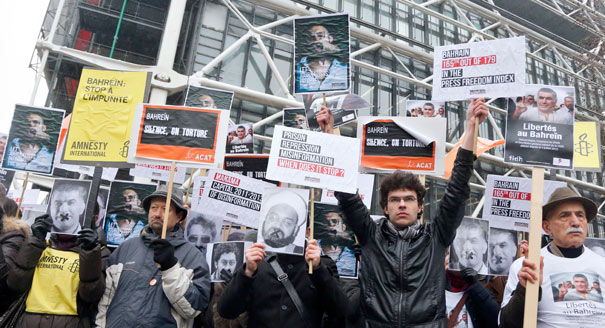
When Catherine Ashton, the European Union’s foreign policy chief, and Stavros Lambrinidis, her human rights envoy, recently visited the Gulf state of Bahrain, there were high hopes from democracy activists that both would speak out about that country’s human rights record.
During the two-day ministerial meeting with the Gulf Cooperation Council, hosted by Bahrain, Mr. Lambrinidis spent much time discussing human rights with officials and nongovernmental organizations.
He also visited Jaw Prison, where many activists are being held for participating in pro-democracy demonstrations that were crushed in 2011 by the Bahraini government. Despite the meetings, democracy activists criticized the E.U. officials. In their view, they did not speak out loudly enough against Bahrain’s suppression of human rights.The dispute over Ms. Ashton and Mr. Lambrinidis’s visit confirms the dilemma facing the European Union and its member governments: How can human rights — supposedly at the center of Europe’s foreign policy — best be promoted?
On the one side are diplomats like Ms. Ashton, who believe in quiet diplomacy. On the other are human rights organizations, which favor a much more vocal stance.
In her remarks after the Gulf Cooperation Council meeting, Ms. Ashton put trade before human rights. Even then, the comments about Bahrain’s record on human rights were cautious. “We do have honest and open discussions on issues, for example on human rights,” Ms. Ashton said. “We may have different perspectives at times, but we’re able to have that honest dialogue.”
Maryam al-Khawaja, who is acting president of the independent Bahrain Center for Human Rights, said she was extremely disappointed with Ms. Ashton’s public statement.
“The regime barely received a slap on the wrist,” said Ms. Khawaja, whose father, Abdulhadi al-Khawaja, was sentenced to life in prison for his role in the democracy demonstrations of 2011. This was all the more disheartening, she added, because hundreds of activists remained behind bars, torture was common, and social media were under strict surveillance.
A new report by the European Union Institute for Security Studies, based in Paris, said the Bahraini prime minister, Khalifa bin Salman al-Khalifa, who has been in power since 1971, showed no willingness to change. “Bahrain is caught between reforms it is not willing to undertake and an uprising it is unable to suppress,” wrote Florence Gaub and Boukja Kistemaker, the report’s authors.
This has placed the European Union in a situation in which it is torn between pursuing quiet diplomacy, in order to be able to keep the lines of communication open with the Bahraini government, or speaking out publicly with the risk of Bahrain breaking off any dialogue on human rights. The Bahraini government already canceled a visit by Juan E. Méndez, the United Nations’ special rapporteur on torture and other cruel, inhuman or degrading treatment.
Yet if human rights are part of Europe’s identity, surely Europe’s diplomats should have no qualms about speaking out in their defense. That is what Markus Löning, Germany’s human rights envoy, believes.
Mr. Löning has been a consistent advocate of public diplomacy. He told a meeting of the European Parliament Panel on Human Rights (full disclosure: This writer was moderating it) that Ms. Ashton must speak out loudly and consistently about human rights.
Mr. Löning’s concern is that the European Union is failing to defend its values despite believing them to be universal. “If we don’t take human rights seriously all the time, we will not be serious partners on other issues, either,” he said.
Several officials from the European External Action Service, which is led by Ms. Ashton, also attended the hearing. They said that quiet diplomacy was crucial for building up trust and confidence with leaders in nondemocratic countries. It was also the only way of making progress in countries going through immense political transformation, like Egypt.
A diplomat with the External Action Service said Ms. Ashton and Mr. Lambrinidis had spent many hours talking to Egypt’s leadership about the need to promote and protect human rights before President Mohamed Morsi was ousted by the military last week.
Despite the recent waves of unrest, detentions and deaths, as well threats to close nongovernmental organizations, Ms. Ashton’s policy was to keep talking behind closed doors, the diplomat explained. It would be counterproductive to break off communications or to make loud statements, the diplomat said, speaking on the condition of anonymity, a common practice for diplomats.
There is another reason for this silence. European governments are under immense pressure from lobbyists and industry to go softly on human rights. Criticism might jeopardize lucrative contracts.
In Germany, for example, industry grumbles whenever Chancellor Angela Merkel criticizes the human rights policies of Russia or China.
Human rights experts believe that such grumbling is strategically flawed because without human rights, there will be no long-term stability. Before the Arab Spring, Western governments were accused of making a strategic mistake in supporting the authoritarian regimes in the region, favoring the status quo over human rights.
The European Bank for Reconstruction and Development and the World Bank now argue that Western governments and companies act contrary to their own interests if they bow to authoritarian regimes. Pandering to habits of corruption and bypassing civil society movements both effectively undermine stability in the long run, the organizations argue.
This leaves the European Union with a big challenge: how to encourage human rights before it is too late. In the case of Bahrain, Ms. Ashton seems conscious of time pressure. But is her quiet diplomacy the right answer? Experts are divided.
This article was originally published in the New York Times.

Nonresident Senior Fellow, Carnegie Europe
Judy Dempsey is a nonresident senior fellow at Carnegie Europe
Recent Work
Judy Dempsey
Judy Dempsey
Carnegie does not take institutional positions on public policy issues; the views represented herein are those of the author(s) and do not necessarily reflect the views of Carnegie, its staff, or its trustees.

Ahead of a tough winter for Ukraine, Donald Trump’s swing back toward Russia bodes ill. But instead of panicking, Kyiv’s European allies are focusing on action.

Rym Momtaz

Funding Ukraine remains a priority for European leaders. As Russia’s war of aggression heads into another winter, two feasible options to mobilize support for Kyiv should be fast-tracked.


Vladyslav Rashkovan, Gregory P. Wilson

While the EU and European governments are embracing the much-lauded middle-power moment, this entails three difficult conundrums.

Richard Youngs

Europe is facing rising populism internally as well as external pressures from Russia, China, Turkey, and the United States.

Dimitar Bechev

A notable degree of participative democracy has firmly arrived in Europe. But to have more far-reaching impact, democratic deliberation needs to move into a radically new phase.
Richard Youngs